1. Introduction
The two enantiomers of a chiral drug can differ in potency, in metabolism and in toxicity, a point argued forcefully by Ariens (1984), who described the less active isomer in a racemate as ballast that pharmacologists had been too willing to ignore. Regulators took the same view. The policy statement issued by the United States Food and Drug Administration asks sponsors to characterise each enantiomer and to justify the development of a racemate (FDA, 1992), and the ICH guideline on specifications treats the opposite enantiomer as an impurity to be controlled where a single enantiomer is developed (ICH, 1999). Every chiral drug candidate therefore needs an enantioselective assay, and most need a preparative separation long before an asymmetric synthesis is in hand.
Chromatography on chiral stationary phases meets both needs (Francotte, 2001; Maier et al., 2001). For many years it was practised mainly in normal-phase liquid chromatography with alkane and alcohol eluents. Supercritical fluid chromatography, usually abbreviated SFC, has taken over much of that work. The fluid is carbon dioxide, whose critical point lies near 31 degrees Celsius and 74 bar, mixed with a polar organic modifier. Columns packed for liquid chromatography can be used unchanged, and a chiral separation by packed-column SFC was reported on a brush-type phase as early as the mid-1980s (Mourier et al., 1985).
The selector on the column, more than the instrument, decides whether two enantiomers separate. This review examines the chiral stationary phases used in SFC of pharmaceutical compounds: what they are, how they are thought to discriminate, and how they behave under carbon dioxide-based mobile phases rather than liquids.
2. Scope and Approach
The article is a narrative review of the published literature, organised by selector class. It draws on the original descriptions of the selectors and on the major reviews of chiral SFC (Mangelings and Vander Heyden, 2008; De Klerck et al., 2012; Kalikova et al., 2014; West, 2019). It does not attempt a complete catalogue of applications, and it avoids quoting resolution values or success rates, which depend on the compound set and the conditions chosen. Trade names appear only where one has become the common name of a selector.
3. Why Carbon Dioxide Changes the Chromatography
SFC dates from the experiments of Klesper et al. (1962), and its modern packed-column form owes much to the instrumentation described by Berger (1995). Compressed carbon dioxide has a viscosity several times lower than that of common liquid eluents, and solutes diffuse through it faster. Higher flow rates can therefore be used without a severe loss of efficiency or an excessive pressure drop, and columns re-equilibrate quickly after a change of conditions (Lesellier and West, 2015). In practice the mobile phase usually contains enough alcohol that it is no longer strictly supercritical, but the distinction has little practical consequence and the name has stayed (Taylor, 2009).
Three features of the mobile phase bear directly on chiral recognition. Carbon dioxide is about as non-polar as a light alkane, so the chromatography resembles normal-phase work and polar interactions between analyte and selector are strong. The modifier, most often methanol, ethanol or 2-propanol, competes for hydrogen-bonding sites and adsorbs on the stationary phase, altering its effective structure. And carbon dioxide reacts reversibly with alcohols and traces of water to give alkylcarbonic and carbonic acid, so the mobile phase is mildly acidic even when no acid is added. Basic drugs are often retained strongly or elute as tailing peaks for that reason, and a small amount of a basic additive such as isopropylamine or diethylamine is routinely included; acidic additives serve acidic analytes, and volatile ammonium salts or a little water help with polar compounds (West, 2019).
Density is the remaining variable. Because the fluid is compressible, pressure and temperature alter its solvating power, and retention generally falls as density rises. The effect on enantioselectivity is usually smaller than that of the modifier, although temperature can on occasion reverse the elution order.
4. How Chiral Stationary Phases Discriminate
The classical account of chiral recognition is the three-point description, first stated by Dalgliesh (1952) for amino acids and developed for bonded phases by Pirkle and Pochapsky (1989): for one enantiomer to be bound more firmly than the other, at least three simultaneous interactions are needed, of which one or more must depend on stereochemistry. The interactions available are hydrogen bonds, dipole stacking, attraction between aromatic rings, ionic attraction and steric fit into a cavity or groove. A detailed modern treatment is given by Lammerhofer (2010).
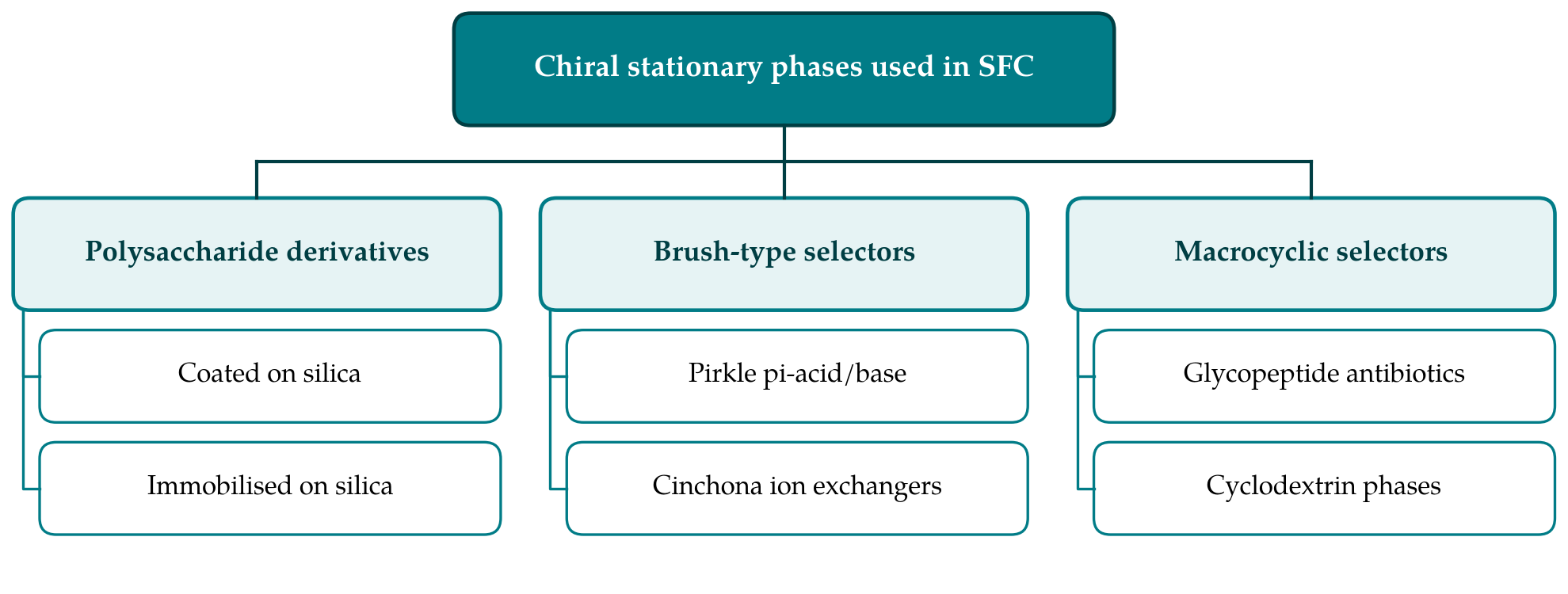
The selectors used today differ in which of these interactions they offer and in how well defined their binding sites are. Figure 1 groups them into three families, and Table 1 summarises their main interactions and their behaviour in SFC.
| Family | Main interactions | Well suited to | Note for SFC |
|---|---|---|---|
| Macrocyclic glycopeptide | Inclusion, H-bond, ionic | Amino acids, acids, some amines | Needs alcohol modifier and additive (Armstrong et al., 1994) |
| Cyclodextrin | Inclusion, H-bond | Compact analytes that fit the cavity | Inclusion weaker in CO2 than in water (Szejtli, 1998) |
| Cinchona ion exchanger | Ionic plus H-bond, aromatic | Chiral acids (and zwitterions) | Retention tuned by additive counter-ion (Lammerhofer and Lindner, 1996) |
| Family | Main interactions | Well suited to | Note for SFC |
|---|---|---|---|
| Polysaccharide, coated | H-bonding, aromatic, groove fit | Broad range of neutral and weakly polar drugs | Avoid solvents that dissolve the coating (Okamoto and Yashima, 1998) |
| Polysaccharide, immobilised | As coated phases | Same, plus solvents that strip coated phases | Tolerates chlorinated and ether modifiers (Francotte, 2001) |
| Brush-type (Pirkle) | pi-pi, dipole, H-bond | Analytes with an aromatic group near the centre | Rational, predictable; first phase run in SFC (Pirkle and Pochapsky, 1989) |
5. Polysaccharide Phases
Derivatives of cellulose and amylose are used for the large majority of chiral separations in SFC, as they are in liquid chromatography. The phenylcarbamates and the benzoate esters introduced and studied by Okamoto and Yashima (1998) are the workhorses. The polymer is helical, and its backbone and the pendant carbamate or ester groups together define grooves whose shape and hydrogen-bonding character are chiral. An analyte is held by hydrogen bonding to the carbamate carbonyl and NH, by dipole and aromatic interactions, and by insertion into a groove; small changes in the aromatic substituents, such as the methyl and chloro groups of the widely used dimethylphenyl and chloromethylphenyl carbamates, shift selectivity appreciably.
A practical division cuts across the chemistry. In a coated phase the derivatised polysaccharide is physically deposited on silica, and solvents that dissolve it, such as tetrahydrofuran, ethyl acetate, dichloromethane and acetone, must be kept out of the mobile phase and the sample diluent. In an immobilised phase the polymer is fixed by crosslinking or covalent attachment, so the full range of organic solvents can be used (Francotte, 2001). In SFC, where carbon dioxide and alcohols are the usual fluids, the solvent restriction on coated phases is seldom reached, but immobilised columns matter for preparative work, where the sample is often dissolved in a strong solvent to raise loading, and for the occasional separation that needs an unusual modifier.
Because four or five polysaccharide selectors between them resolve so many compounds, screening a small set of these columns under a few generic gradients has become the standard opening move in method development, and is treated in the next section.
6. Brush-Type Phases
Brush-type, or Pirkle, phases carry a small, well-defined chiral molecule bonded to silica through a short tether (Pirkle and Pochapsky, 1989). The selector typically combines an aromatic ring that can act as an electron donor or acceptor with a hydrogen-bonding amide and a bulky group, so that an analyte bearing a complementary aromatic ring and hydrogen-bond donor or acceptor near its stereocentre is held in a definable geometry. Because the binding site is a single small molecule rather than a polymer groove, the interactions can be reasoned about and in favourable cases the elution order predicted, and the same logic lets a phase be designed for a target by making the analyte and selector reciprocal. These phases suit aromatic analytes and underlie many separations of profens and related compounds; they were also the first selectors used in packed-column SFC, and they tolerate the carbon dioxide mobile phase well.
7. Macrocyclic and Cyclodextrin Phases
Macrocyclic glycopeptide antibiotics such as vancomycin and teicoplanin, introduced as chiral selectors by Armstrong et al. (1994), present a cluster of fused rings forming a shallow basket lined with hydrogen-bond donors and acceptors, ionisable groups and sugar residues. They are strongest for amino acids, small peptides and carboxylic acids, where an ionic interaction supplements inclusion and hydrogen bonding. Teicoplanin in particular is a common choice for underivatised amino acids. In SFC these phases need an alcohol modifier and usually an additive to supply or exchange the charged partner.
Cyclodextrins are cyclic oligomers of glucose whose truncated-cone cavity binds a guest that fits it, with the rim hydroxyls providing hydrogen bonds at the mouth (Szejtli, 1998). Native and derivatised cyclodextrins resolve compact analytes whose shape matches the cavity. Their inclusion chemistry was developed largely for aqueous media, and in the non-aqueous carbon dioxide environment the hydrophobic driving force for inclusion is weaker, so cyclodextrin phases are used less in SFC than polysaccharide or glycopeptide phases.
8. Cinchona Ion Exchangers
A more specialised class derives from the Cinchona alkaloids quinine and quinidine. Bonded through a carbamate link, these selectors act as weak anion exchangers whose quinuclidine nitrogen pairs with the anion of a chiral acid, while the quinoline ring and the carbamate add aromatic and hydrogen-bonding contacts that make the pairing stereoselective (Lammerhofer and Lindner, 1996). Because quinine and quinidine are near-enantiomeric, a pair of columns often gives opposite elution orders, which is useful preparatively when the first-eluting enantiomer is wanted pure. These phases are the tool of choice for chiral acids and for zwitterions, a group that the polysaccharide phases handle less reliably. Retention is governed by the counter-ion supplied in the additive, and in SFC the additive and the modifier must be chosen together.
9. Screening, Efficiency and Preparative Use
Enantioselectivity is still difficult to predict from structure, so method development is largely empirical. The accepted practice is to screen a small set of complementary columns, usually several polysaccharide phases plus one or two others, under a few generic modifier gradients with and without a basic or acidic additive, and then to optimise around any hit (Mangelings and Vander Heyden, 2008; De Klerck et al., 2012). The fast re-equilibration of SFC makes such screening quicker than its liquid-phase equivalent, and automated column and solvent switching has made it routine.
Efficiency has improved with particle size. Columns packed with sub-two-micron and superficially porous particles, following the trend that reshaped liquid chromatography after the work of MacNair et al. (1997), give narrower peaks and shorter analyses, though the instrument must control pressure and temperature tightly for the gain to be realised. For purity testing the result is a short, rugged enantiomeric assay.
Preparative separation is where SFC has displaced liquid chromatography most decisively (Francotte, 2001). Because the bulk of the mobile phase is carbon dioxide, which evaporates when the pressure is released, the collected fractions contain only the enantiomer dissolved in a little alcohol, so solvent consumption and the labour of concentrating dilute fractions are much reduced. Immobilised polysaccharide phases help here, since a strong sample solvent raises the mass that can be loaded per injection.
10. Open Questions
Three problems remain. The first is prediction. Despite progress in modelling retention on polysaccharide phases and in correlating selector and analyte properties, there is still no reliable way to say in advance which column will separate a given pair, and screening remains the practical answer. The second is the most polar and permanently ionic drugs, which are weakly retained or poorly shaped by the carbon dioxide mobile phase; added water, ionic additives and the glycopeptide and ion-exchange phases extend the range, but these analytes are still handled less comfortably than lipophilic ones. The third is standardisation. Retention and even elution order depend on pressure, temperature, modifier and additive, and on the exact batch of stationary phase, so transferring a method between instruments and laboratories demands care, and reported conditions must be complete enough to be reproduced (West, 2019).
11. Conclusion
For the separation of pharmaceutical enantiomers, supercritical fluid chromatography combines the selectivity of established chiral stationary phases with the speed and the easy solvent recovery of a carbon dioxide mobile phase. Polysaccharide carbamates and esters resolve most compounds and anchor the standard screening approach; brush-type, macrocyclic, cyclodextrin and Cinchona phases fill the gaps, particularly for aromatic analytes, amino acids and chiral acids. The mobile phase itself shapes the chromatography through its low polarity, its interaction with the modifier and its mild acidity, and the chromatographer who keeps those effects in mind, and who chooses and reports conditions carefully, can expect SFC to settle most chiral problems that arise in drug development.
Conflict of interest
To be declared by the author(s) before publication.
Funding
To be declared by the author(s) before publication.