1. Introduction
Silicon Valley Bank was closed by its supervisors on 10 March 2023. On the previous day its customers had asked to withdraw more than 40 billion US dollars, and requests for a far larger sum were pending for the following morning (Board of Governors of the Federal Reserve System, 2023). Signature Bank was closed two days later and First Republic Bank was resolved at the start of May. Nothing in the earlier record of bank failures matched the pace, and the official reviews that followed pointed to a combination of causes that included the reach of social media and the ease of moving money from a telephone (Basel Committee on Banking Supervision, 2023).
The claim that online talk can drive deposits out of a bank is easy to state and hard to test. Banks that attract hostile comment are usually banks with visible problems, so that sentiment and weakness arrive together. Depositors may read posts, or may hear the same news from colleagues, investors and the financial press. And the quantity of interest, the flow of deposits out of a given bank hour by hour, is observed by the bank and its supervisor and by almost nobody else.
This article reviews the literature that bears on the question. It asks what theory predicts about the effect of faster and more public communication on the likelihood of a run, what is known about which depositors leave and why, how sentiment is extracted from text, and what the first studies of the 2023 failures have found. Its concern is with regional and mid-sized banks, whose funding is less diversified than that of the largest institutions and whose customers are often drawn from one place or one industry.
2. Scope and Approach
The article is a narrative review of the published literature. It draws on the theoretical and empirical research on bank runs, on the finance literature that uses text as data, on working papers written since 2023, and on the reports of supervisors and standard setters. No formal search protocol was applied and no pooled estimate is offered; the studies differ too much in setting and method for that. The aim is to set the main findings beside one another and to be explicit about how far each can be carried over to the question of social media. Episodes outside the United States and from earlier periods are included where depositor-level evidence exists, since such evidence is rare.
3. Runs, Beliefs and Information
The modern theory of runs begins with Diamond and Dybvig (1983). A bank that funds illiquid assets with deposits payable on demand has two equilibria: one in which only those who need cash withdraw, and one in which everybody does because everybody expects the rest to do so. In that model the trigger can be anything that coordinates expectations, and it need have no connection with the condition of the bank. A different tradition holds that runs are responses to information. Depositors cannot see the loan book, so bad news about the economy or about a class of assets leads them to withdraw from banks that might be exposed. Gorton (1988) found that panics in the United States before the First World War followed signals of recession and were not random events, and Calomiris and Mason (1997) showed that the banks that failed in the Chicago panic of 1932 were weaker beforehand than those that survived.
The two views were joined by the global games approach, developed by Morris and Shin (1998) for currency attacks and applied to banks by Goldstein and Pauzner (2005). When each depositor receives a slightly noisy private signal about fundamentals, the multiplicity disappears. There is a threshold below which a run occurs, and it lies above the level at which the bank is insolvent, so that some solvent banks fail because of the fear of others withdrawing. Fundamentals and coordination both matter, and the probability of a run rises with the share of funding that can leave on demand.
This framework gives a precise sense in which social media could matter. A post seen by thousands of depositors is a public signal. It tells each reader something about the bank and, more to the point, tells each reader what the others now know. Public signals carry more weight in coordination problems than their information content warrants, because they shift beliefs about beliefs. A network in which a concern can become common knowledge within hours does not create fragility, but it shortens the interval between the weakening of fundamentals and the run.
4. Evidence on Which Depositors Leave
Direct evidence on depositor behaviour is scarce and comes from a handful of episodes. Table 1 sets out the main strands of evidence considered in this review. The most detailed study is that of Iyer and Puri (2012), who used minute-by-minute records from an Indian cooperative bank that suffered a run after a neighbouring bank failed. Deposit insurance reduced the tendency to withdraw but did not remove it. Customers who had held accounts for longer, or who also borrowed from the bank, were less likely to run, and a customer was more likely to run if others in the same neighbourhood or the same introducer network had done so. A later study of the same bank compared a run without a solvency problem with one that had a real basis and found that depositors responded differently to the two (Iyer et al., 2016).
| Strand | Main message | Representative sources | Limit for this question |
|---|---|---|---|
| Run theory | Runs depend on fundamentals and on beliefs about other depositors | Diamond and Dybvig, 1983; Goldstein and Pauzner, 2005 | Silent on the channel of communication |
| Depositor-level studies | Withdrawals spread through social ties; relationships and insurance damp them | Iyer and Puri, 2012; Kelly and Ó Gráda, 2000 | Few episodes, all before social media |
| Deposit sensitivity | Uninsured deposits respond to distress and to disclosure | Egan et al., 2017; Chen et al., 2022 | Quarterly data hide fast flows |
| Text and sentiment | Tone of media text is related to prices and volatility | Tetlock, 2007; Loughran and McDonald, 2011 | Developed for equities, not deposits |
| Studies of 2023 | Online exposure went with larger losses at fragile banks | Cookson et al., 2023; Jiang et al., 2024 | Outcomes are share prices, not deposit flows |
| Digital banking | Deposits at banks with digital platforms are more mobile | Koont et al., 2024 | Concerns slow outflows more than runs |
The importance of social ties is not new. Kelly and Ó Gráda (2000) traced the behaviour of Irish immigrant depositors at a New York savings bank in the panics of 1854 and 1857 and found that the county of origin, which defined a depositor's circle of acquaintance in the city, predicted who closed an account. In the financial crisis of 2007 to 2009, Swiss households were less inclined to withdraw from distressed banks when they had a broad relationship with the bank and when moving would have been costly (Brown et al., 2020). The retail queues at Northern Rock in 2007, as Shin (2009) pointed out, came after wholesale lenders had already declined to roll over their funding: the visible run was the last stage of an invisible one.
Bank-level data add a further regularity. Uninsured deposits respond to signs of distress and insured deposits largely do not, which makes a bank with a high uninsured share exposed to self-fulfilling loss of funding (Egan et al., 2017). Uninsured flows are also more sensitive to performance at banks that disclose more (Chen et al., 2022). Both findings imply that better and faster information is not simply stabilising. It strengthens discipline and raises the chance that weak results are met by withdrawal.
5. Measuring Sentiment in Financial Text
Sentiment, in the sense used by Baker and Wurgler (2007), is a belief about future cash flows and risks that the facts at hand do not justify. Text offers one way to measure it. Tetlock (2007) showed that pessimistic wording in a daily newspaper column was followed by lower market returns and then by a reversal, a pattern consistent with sentiment and not with news. Antweiler and Frank (2004) classified messages on internet stock boards and found that their volume and disagreement helped to predict volatility, while their effect on returns was small. Tone and attention, on this evidence, are related to prices, but the relation is modest and short-lived.
Method matters a great deal in this literature. General-purpose word lists misclassify financial language: words such as liability, tax and cost are negative in everyday dictionaries and neutral in an annual report, which is why Loughran and McDonald (2011) built lists specific to finance. Posts about a bank add difficulties of their own. They are short, they use irony and slang, they mix customers with investors and bystanders, and some are written by automated accounts. Attention and tone are also distinct. A surge in the number of posts naming a bank may matter more for coordination than the balance of positive and negative words, and research on the spread of online news has found that false stories travel farther and faster than true ones (Vosoughi et al., 2018). A sentiment index is therefore a constructed quantity whose meaning depends on the dictionary or classifier, the sample of accounts and the time window chosen.
6. Social Media and the Failures of 2023
The banks that failed in 2023 shared a set of balance sheet features. Rising interest rates had reduced the market value of long-dated securities and loans across the system, and Jiang et al. (2024) showed that a bank became vulnerable to a run by its uninsured depositors where those unrecognised losses were large in relation to capital and the uninsured share of funding was high. The link between the two is the deposit franchise. Deposits whose rates respond slowly to market rates act as a hedge against losses on fixed-rate assets when rates rise (Drechsler et al., 2017; Drechsler et al., 2021), but the hedge holds only for as long as depositors stay. If they leave, the losses are realised and the hedge disappears with them.
Against that background, Cookson et al. (2023) examined posts on Twitter about listed United States banks. Banks that had been discussed more heavily before the episode suffered larger falls in their share prices during it, and the effect was concentrated among banks with large unrealised losses and a high proportion of uninsured deposits. Within the day, bursts of negative posts about a bank were followed by declines in its share price, and posts from accounts connected with the technology start-up community carried particular weight. The authors read this as evidence that social media acted as a catalyst. Figure 1 summarises the mechanism that this and related work describes, in which public discussion, withdrawals and realised losses reinforce one another.
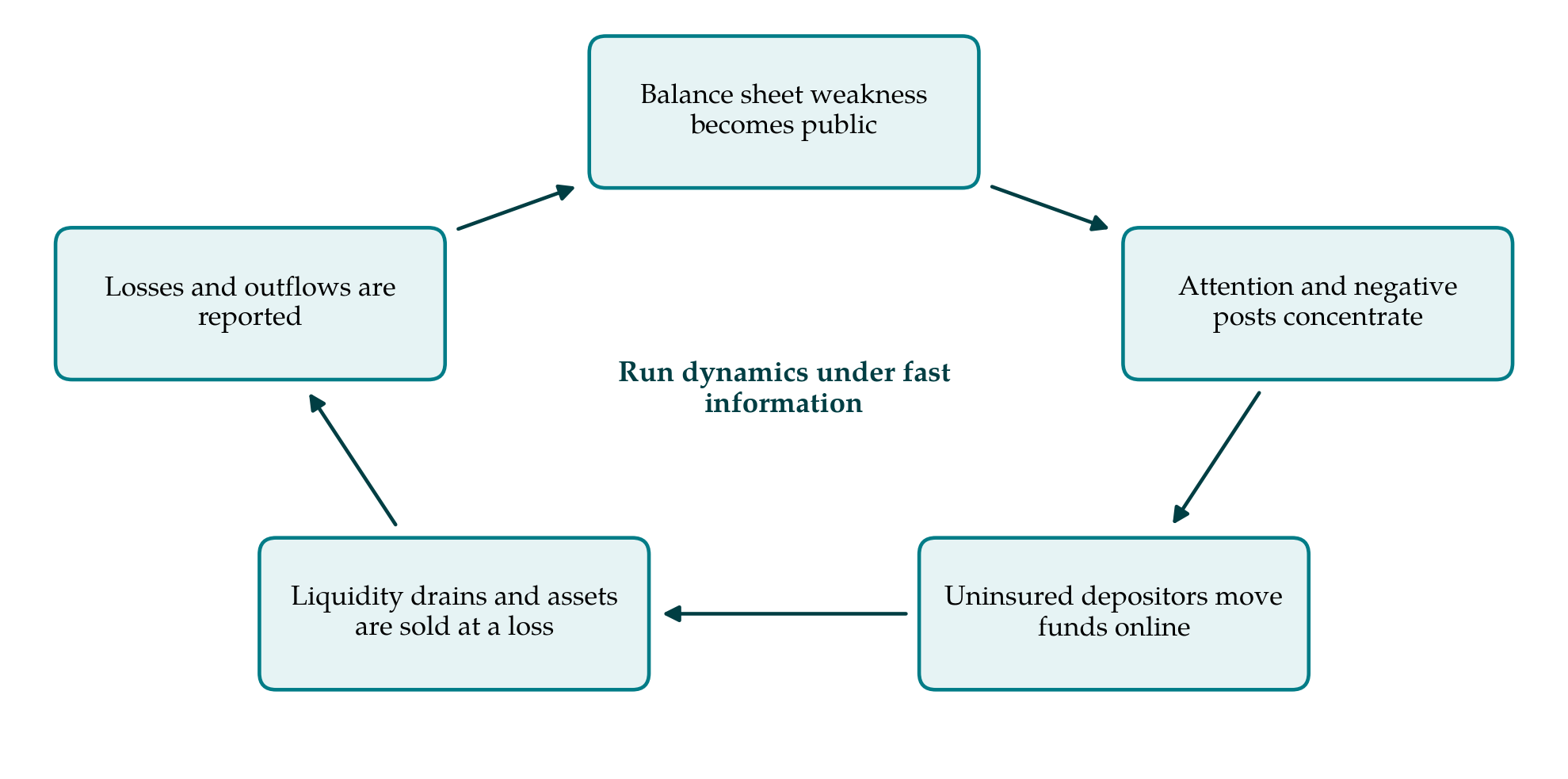
Three qualifications apply. The outcome in that study is the share price, because deposit flows at high frequency are not public, and equity investors and depositors need not react alike. Exposure to social media is not assigned at random: a bank whose customers are venture-backed firms will be talked about by people who are active online and who also know one another offline, a point the supervisory review of Silicon Valley Bank makes when it describes a concentrated and highly networked depositor base (Board of Governors of the Federal Reserve System, 2023). And the interaction with fundamentals runs in one direction. Heavy online attention was associated with larger losses at fragile banks and had little association with losses at sound ones.
Speed has a second source that is independent of sentiment. Koont et al. (2024) found that deposits at banks offering full digital services left more readily as market rates rose, which they describe as a walk and distinguish from a run. Online and mobile channels remove the physical limits that once slowed withdrawals: the queue, the opening hours of a branch, the paperwork for a transfer. Social media affects how quickly depositors form the wish to leave, while digital banking affects how quickly they can act on it. Separating the two contributions has not yet been achieved.
7. Implications for Liquidity Regulation and Supervision
The Liquidity Coverage Ratio requires a bank to hold enough high-quality liquid assets to meet net outflows over a stress lasting 30 calendar days, with outflow rates assigned to each class of deposit (Basel Committee on Banking Supervision, 2013). Those rates were calibrated on the experience of the financial crisis of 2007 to 2009. The withdrawals seen in 2023 exceeded them within days for the affected banks, and several of those banks were in any case outside the full requirement under national rules. The Basel Committee has since drawn attention to the speed of outflows, the role of digitalisation and social media, and the adequacy of the existing assumptions (Basel Committee on Banking Supervision, 2023).
The literature reviewed here suggests where supervisory attention is best directed. Concentration of the depositor base by industry, by size of balance and by social connection is a better guide to run risk than the uninsured share alone. Monitoring of online discussion can give early warning, but a rise in hostile posts is informative chiefly when read together with unrealised losses and funding structure. Operational readiness matters more when the time available is measured in hours: collateral placed with the central bank in advance, tested access to its lending facilities, and a communications plan. Proposals to slow withdrawals by design remain contested, since any friction that depositors can foresee gives them a reason to leave earlier.
8. Gaps and Directions for Research
The largest gap is the lack of work that connects online activity to deposit flows at the level of the account. Supervisors and banks hold such data, and studies under confidentiality arrangements, comparable to those done for the Indian and Swiss episodes, would show whether depositors exposed to a given post behaved differently from similar depositors who were not. A second gap is identification. Designs that exploit differences in the timing of exposure, in platform outages or in the composition of a bank's followers could help to separate the effect of online conversation from that of the underlying news.
Measurement needs attention as well. Classifiers trained on equity discussion have not been validated on text about deposit safety, and the relative importance of volume, tone and the identity of the author is unsettled. Almost all of the recent evidence concerns one country and one month. Whether the same dynamics hold in systems with different deposit insurance limits, with messaging applications that are closed to observation, or with a retail and not a corporate depositor base is unknown. Work on these points would also inform the recalibration of outflow assumptions, which at present rests on a very small number of observations.
9. Conclusion
Theory gives good reason to expect that fast, public communication raises the speed of a run and lowers the level of weakness at which one begins. The depositor-level studies show that withdrawals have always spread through networks of acquaintance, and that insurance and close ties to the bank hold them back. The first studies of 2023 fit this picture: social media amplified runs on banks that carried large unrealised losses and depended on uninsured, concentrated funding, and there is no evidence that it brought down banks without those weaknesses. Sentiment measures are therefore best treated as one input to the assessment of liquidity risk, read alongside balance sheet indicators. The firmer conclusions that regulation needs will depend on research that observes deposits directly.
Conflict of interest
To be declared by the author(s) before publication.
Funding
To be declared by the author(s) before publication.