1. Introduction
The charge that Christianity bears responsibility for the environmental crisis was made in its best known form by White (1967), who argued that the Latin West had inherited from its religion a view of nature as existing for human use. White himself pointed to resources within the tradition, contrasting Western attitudes with those of the Greek East and proposing Francis of Assisi as a patron for ecologists. Much Christian writing on ecology since then has been a search for further resources of that kind, and the theologians of the first eight centuries have been a principal place to look.
The search has had results. Santmire (1985) traced two motifs through the history of Christian thought, one that directs attention away from the material world and one that affirms it, and found the second strongly present in Irenaeus and the later Augustine. Orthodox theologians have drawn on the Greek Fathers for an account of the human being as priest of creation (Zizioulas, 1989; Theokritoff, 2009). The encyclical Laudato Si' cites Basil among other early authorities (Francis, 2015).
What these retrievals lack is a shared account of method. A sentence from a fourth-century homily is asked to support a judgement about biodiversity or climate, and the steps between the two are rarely shown. This article proposes a framework that makes the steps explicit. It is intended for theologians and ethicists who are not specialists in early Christianity as well as for patristic scholars who wish to address ecological questions. The framework is set out and illustrated here, and it has not been tested on a defined set of texts.
2. Background
The framework draws on three sources, which are reviewed briefly before the steps are described.
2.1. Lessons from ecological biblical hermeneutics
Biblical scholars met the same difficulty earlier and have reflected on it more fully. The Earth Bible project read biblical texts in the light of a set of ecojustice principles, among them the intrinsic worth of the Earth and its interconnectedness, and asked whether each text upheld or suppressed the voice of the Earth (Habel, 2000). Horrell et al. (2010a) classified existing approaches as readings of recovery, which hold that the Bible, rightly understood, supports ecological concern, and readings of resistance, which either reject texts in the name of ecological values or reject ecological values in the name of the texts. They proposed a third course in which the interpreter acknowledges that every reading is guided by a doctrinal lens, a constructed centre such as stewardship or the community of creation, and makes that lens open to criticism. The essays collected in Horrell et al. (2010b) extend the discussion to historical and theological readers of the Bible. The framework proposed below takes over the notion of the doctrinal lens directly.
2.2. The historical discipline of patristic study
Patristic texts are not a second scripture, and they come to the reader through a specialised scholarship. Young (1997) showed that early Christian exegesis was formed by the methods of the ancient schools of grammar and rhetoric, and that its aims cannot be understood apart from that training. Clark (2004) argued that the surviving texts are elite literary productions which call for the methods of intellectual history and textual criticism and do not open a window onto ordinary life. The general warning of Skinner (1969) applies with full force: historians of ideas are prone to credit past authors with doctrines on subjects they never considered, and to read scattered remarks as anticipations of later positions. No early Christian writer had a concept of an ecosystem or of anthropogenic climate change, and a method for ecological reading must begin from that fact.
2.3. Philosophical hermeneutics
If the historian's caution were the last word, patristic texts could be described and never used. Gadamer (1989) gives reasons for thinking otherwise. Understanding, on his account, is not the reconstruction of an author's mental state. It is a meeting of the horizon of the text with that of the interpreter, in which the interpreter's questions are a condition of understanding and not an obstacle to it. A text also has an effective history, the series of readings through which it has reached the present, and that history shapes what the interpreter is able to see. The framework therefore asks for two things that are sometimes thought to exclude each other: strict attention to what the author was doing, and an open statement of the present concern that motivates the reading.
3. The Framework
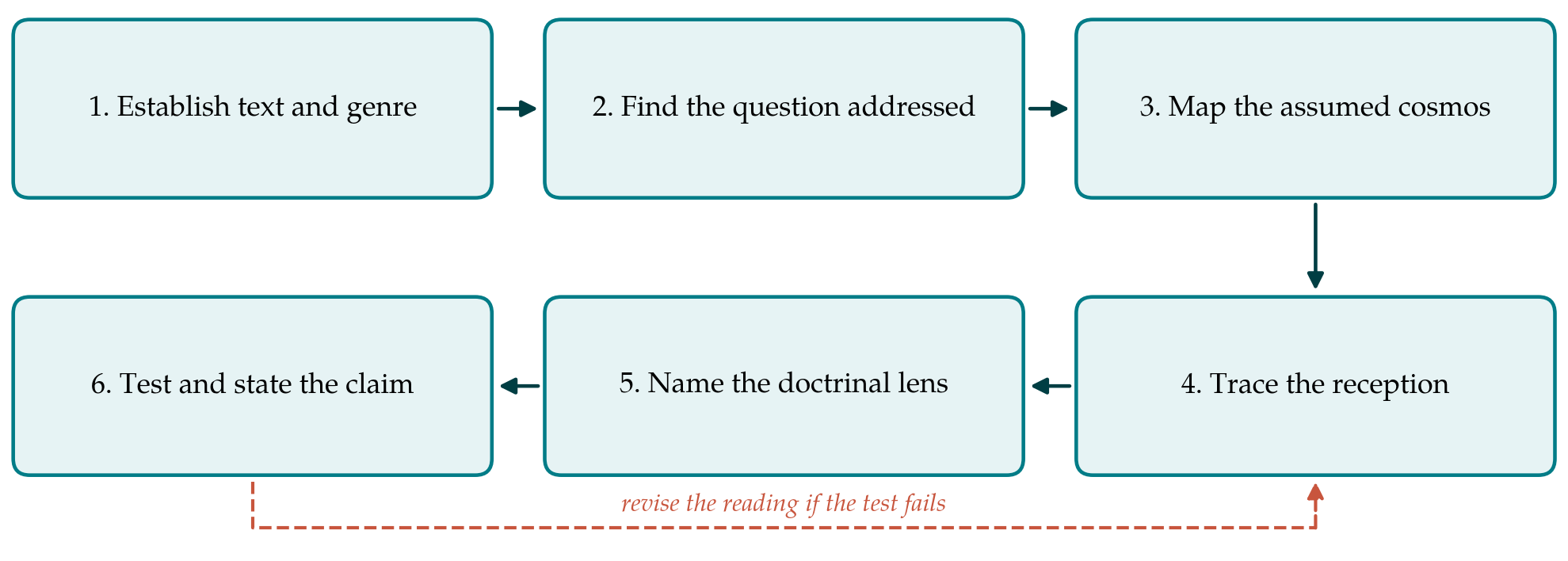
The framework consists of six steps. They are listed in Table 1, with the guiding question for each and the error it is meant to prevent, and their sequence is shown in Figure 1. The steps are ordered, and the last can send the interpreter back to an earlier one.
| Step | Guiding question | Error guarded against |
|---|---|---|
| 1. Text and genre | What is the text, in what edition, and what kind of writing is it? | Quoting from anthologies; ignoring genre |
| 2. Question addressed | What controversy or pastoral need was the author answering? | Treating polemic as general doctrine |
| 3. Assumed cosmos | What natural philosophy and view of the human being does the text presuppose? | Reading modern science into the text |
| 4. Reception | How has the text been used since, and by whom? | Mistaking a later use for the original sense |
| 5. Doctrinal lens | Which theological centre governs the present reading? | Presenting a construction as plain meaning |
| 6. Test and claim | Does the proposed claim survive ecological and ethical scrutiny? | Claiming more than the text can bear |
3.1. Step 1: Establish the text and its genre
The interpreter begins by identifying the work, its critical edition and a reliable translation, and by reading the passage in the context of the whole. Genre governs what can be inferred. Basil's Hexaemeron is a series of nine homilies on the opening of Genesis, delivered to a congregation (Basil of Caesarea, 1963). Its descriptions of animals and plants serve praise of the Creator and moral instruction of the hearers, and they should not be read as a treatise on the standing of other species. An ascetic letter, a hymn, a commentary and a dogmatic treatise each make claims in a different manner.
3.2. Step 2: Identify the question the author was addressing
Early Christian statements about the material world were usually made against someone. Irenaeus affirmed the goodness of matter against teachers who assigned the visible world to a lesser creator. Later writers defended creation from nothing against the eternity of matter, and the resurrection of the body against those who found it unworthy. The interpreter should state what the opposing position was and what would have counted as an answer to it. An affirmation of the goodness of creation made against dualism is not yet an answer to the question whether humans may exhaust a fishery, though it may supply a premise for one. Blowers (2012) provides a comprehensive account of the settings in which early teaching on creation took shape.
3.3. Step 3: Map the cosmological and anthropological assumptions
Patristic authors shared with their contemporaries a picture of the world made up of four elements, a hierarchy of living things and a human being composed of body and rational soul. Much of what they say about nature depends on it. When Maximus describes the human being as a microcosm who mediates between the divisions of reality, in the text known as Ambiguum 41, he relies on an anthropology in which the human shares in both the sensible and the intelligible (Maximus the Confessor, 2014; Louth, 1996). The interpreter needs to decide which elements of such a picture the argument requires and which are incidental. Ideas of dominion deserve particular care. Harrison (1999) has shown that the reading of Genesis 1 as a mandate for the technological mastery of nature belongs chiefly to the early modern period, and that earlier interpreters commonly understood dominion in moral or allegorical terms.
3.4. Step 4: Trace the reception of the text
Few readers meet a patristic passage without mediation. Maximus's teaching on the logoi, the inner principles of created things held together in the divine Logos, has become prominent in ecological theology through twentieth-century Orthodox interpreters, whose concerns and emphases differ from his. Tracing this history shows the interpreter which features of the current reading come from the text and which from its recent advocates. It also shows which texts have been neglected. A corpus of ecological proof texts has formed through repetition, and passages that sit less comfortably with present aims, such as ascetic calls to withdraw attention from sensible things, are part of the evidence too.
3.5. Step 5: Name the doctrinal lens
No one moves from an ancient text to an ethical conclusion without an organising theological idea. In current work the commonest are stewardship, the priesthood of humanity, the sacramental character of the world and deification extended to the whole creation. Jenkins (2008) has shown that the main strategies of Christian environmental ethics correspond to different understandings of grace, and that the choice among them is a doctrinal decision. The framework asks the interpreter to state the lens in use, to show where the patristic author supports it and where the author is being extended beyond anything said, and to consider whether a different lens would yield a different reading of the same passage.
3.6. Step 6: Test the reading and state the claim
The last step faces the present. The interpreter formulates the ethical claim the reading is meant to support and asks two questions of it. The first is whether it is consistent with what ecology and the other environmental sciences say about how living systems work. A patristic picture of a harmonious and stable natural order, for example, has to be set beside the scientific account of disturbance, predation and extinction. The second is whether the claim does any work in ethical argument that could not be done without the text. If the claim fails either test, the interpreter returns to an earlier step, as the feedback arrow in Figure 1 indicates. The result should be worded with matching modesty: a text may supply a motive, a symbol, a premise or a criticism of current assumptions, and each is a different kind of contribution.
4. Fitting the Framework to Practice
The framework is meant to be proportionate. A full study of a single treatise might give a chapter to each step, whereas an ethicist citing one passage in an article might satisfy the first four with a paragraph and a few references to the specialist literature. What the framework excludes is the unsupported quotation. It also suits collaborative work, since steps one to four depend on the skills of the historian and philologist and steps five and six on those of the systematic theologian and ethicist. For teaching, the six guiding questions can be given to students as a worksheet to accompany a set text.
Reporting matters as much as procedure. A study that follows the framework should say which edition and translation were used, which opponents or occasions were identified in the second step, and which doctrinal lens was adopted in the fifth, so that another reader can repeat the path and disagree at a definite point. It should also record the passages that were considered and set aside, with the reason. A reading of Basil that cites his delight in the variety of creatures, for instance, ought to mention that the same homilies treat animals chiefly as lessons for human conduct. Recording such material guards against the gradual narrowing of the evidence that the fourth step is designed to detect.
5. Limitations and What Remains to Be Shown
The framework is a proposal, and it has not been validated here. Whether it changes the conclusions interpreters reach, or only the care with which they are stated, can be learned only by applying it to a defined group of texts and comparing the outcome with existing readings. It may prove too demanding for routine use, and a shorter form may be needed. It is also shaped by its sources. The reading strategies it borrows were designed for scripture, which has an authority in Christian ethics that patristic writings do not have in the same way, and the status of the Fathers differs between Orthodox, Catholic and Protestant traditions. The examples used here are Greek. Syriac and Latin authors, and the liturgical and hagiographical material in which much early Christian feeling for the natural world is preserved, would test the framework further.
6. Conclusion
Patristic texts can inform ecological ethics, but not by quotation alone. The framework proposed here requires the interpreter to establish what a text is and what it was for, to recognise the ancient picture of the world it assumes, to notice the history that has brought it into ecological discussion, to declare the theological lens through which it is read, and to test the resulting claim against present knowledge. Its purpose is to make retrieval accountable both to the historical record and to the ethical questions being asked, and its usefulness now needs to be tried in sustained studies of particular authors.
Conflict of interest
To be declared by the author(s) before publication.
Funding
To be declared by the author(s) before publication.