1. Introduction
The recognition of antibody-mediated encephalitis has changed the boundary between neurology and psychiatry. Anti-N-methyl-D-aspartate (NMDA) receptor encephalitis was characterised in 2007 in young women with ovarian teratoma who presented with psychiatric symptoms, memory loss, seizures and reduced consciousness (Dalmau et al., 2007), and a family of disorders associated with antibodies to neuronal surface proteins has since been described (Dalmau and Graus, 2018). Many patients are first seen by psychiatrists, and most who are treated survive, often with a recovery that extends over many months (Titulaer et al., 2013).
During that recovery new psychiatric symptoms can appear. Among them are intrusive thoughts and repetitive behaviours that look like obsessive-compulsive disorder (OCD). In an adult with no earlier history this is an unusual presentation, because OCD typically starts early in life (Stein et al., 2019). The clinician faces a practical question with consequences: do the symptoms mean that the encephalitis is active again, or are they something else. An error in one direction exposes the patient to immunotherapy that is not needed; an error in the other leaves a treatable relapse unrecognised.
The published literature on this specific problem consists largely of case descriptions and theoretical discussion. This article does not add a case. It proposes an ordered way of assessing such a presentation, drawing on established diagnostic criteria and consensus guidance, so that the reasoning can be made explicit and recorded. The framework is offered for discussion and testing, and it does not replace specialist judgement.
2. Background
Three bodies of knowledge inform the framework: what is established about autoimmune encephalitis and its course, what is known about obsessive-compulsive symptoms that arise from brain disease, and the proposals that link immune mechanisms to OCD.
2.1. Autoimmune encephalitis and its psychiatric course
Consensus criteria define possible autoimmune encephalitis by subacute onset, over less than three months, of working memory deficits, altered mental status or psychiatric symptoms, together with supporting findings such as new focal signs, seizures, cerebrospinal fluid pleocytosis or suggestive magnetic resonance imaging, after reasonable exclusion of other causes (Graus et al., 2016). Definite diagnoses rest on characteristic syndromes and antibody results. Best-practice recommendations describe the investigations and the stepwise use of immunotherapy, decisions that belong to neurology (Abboud et al., 2021).
Psychiatric features are prominent at onset in anti-NMDA receptor encephalitis. Presentations that remain purely psychiatric are uncommon, although they are reported somewhat more often at relapse than at first presentation (Kayser et al., 2013). Relapses occur in a minority of patients and may be less severe than the first episode (Titulaer et al., 2013). An international consensus on psychosis of suspected autoimmune origin lists the features that should raise suspicion in a psychiatric presentation, including rapid onset, seizures, movement disorder, autonomic disturbance and disproportionate cognitive dysfunction (Pollak et al., 2020). No equivalent consensus exists for obsessive-compulsive presentations in adults.
2.2. Obsessive-compulsive symptoms arising from brain disease
That brain disease can produce obsessions and compulsions has been known for a century. Survivors of the encephalitis lethargica epidemic were described with compulsive behaviours alongside parkinsonism (Cheyette and Cummings, 1995), and bilateral lesions of the basal ganglia have been followed by stereotyped, compulsive-like activity (Laplane et al., 1989). These observations helped to shape the view that OCD involves circuits linking orbitofrontal and anterior cingulate cortex with the striatum and thalamus (Graybiel and Rauch, 2000). The fifth edition of the Diagnostic and Statistical Manual of Mental Disorders provides a category for obsessive-compulsive and related disorder due to another medical condition, which requires evidence that the disturbance is the direct pathophysiological consequence of that condition (American Psychiatric Association, 2013).
2.3. Immune hypotheses in obsessive-compulsive disorder
The best-known immune hypothesis concerns children. Swedo and colleagues described abrupt-onset OCD and tics after streptococcal infection and proposed an autoimmune mechanism (Swedo et al., 1998). The concept remains debated. More recently an autoimmune subtype of OCD in adults has been proposed, with suggested warning signs such as atypical age at onset, subacute course, accompanying neurological signs and poor response to standard treatment (Endres et al., 2022). These are proposals. How often adult OCD has an immune cause is not known, and the proposed criteria have not been validated.
3. The Proposed Framework
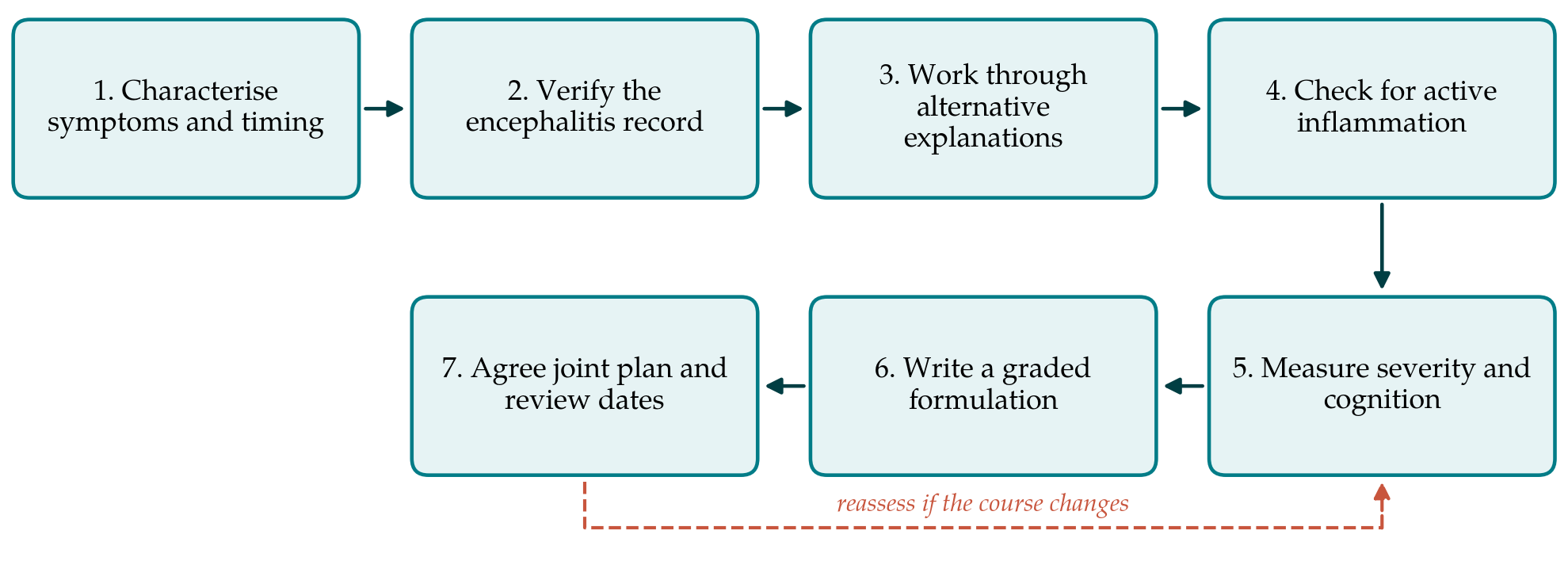
The framework has seven steps, shown in order in Figure 1. It assumes an adult with a documented episode of autoimmune encephalitis who has developed obsessive-compulsive symptoms since, and it assumes that psychiatry and neurology can confer.
3.1. Step 1: Characterise the symptoms and their timing
The first task is descriptive. The clinician establishes whether there are true obsessions, meaning recurrent intrusive thoughts, images or urges that the person recognises as their own and usually tries to resist, and true compulsions, meaning acts performed in response to an obsession or according to rigid rules. The date of onset is fixed as closely as possible against the timeline of the encephalitis: during the acute illness, during early convalescence, or after a period of stable recovery. A collateral account is sought, because patients recovering from encephalitis may have patchy memory of the period. Previous obsessional traits, tics and family history are asked about directly, since a mild pre-existing tendency changes the interpretation.
3.2. Step 2: Verify the encephalitis record
The second step returns to the original diagnosis. The records are checked against the consensus criteria (Graus et al., 2016): the syndrome, the antibody and whether it was found in serum, cerebrospinal fluid or both, imaging and electroencephalography, any tumour search, the immunotherapy given and the response. A diagnosis recorded as autoimmune encephalitis on limited evidence carries less weight in later reasoning than one that met definite criteria. The step also establishes the baseline at discharge, including cognitive and behavioural status, against which change can be judged.
3.3. Step 3: Work through the alternative explanations
The third step is a structured differential. Table 1 lists the principal explanations, the features that favour each and the check that helps to confirm or exclude it. The distinction between compulsion and perseveration deserves particular care. After encephalitis, executive dysfunction can produce repetitive questions, checking and ordering that arise from poor memory or difficulty shifting set and carry no obsessional thought or sense of relief. Treatments also need review: corticosteroids are well known to cause mood and behavioural change, and some antiseizure medicines have recognised behavioural adverse effects.
| Explanation | Features that favour it | Helpful check |
|---|---|---|
| Relapse of encephalitis | Subacute onset with new cognitive, seizure, movement or autonomic signs | Neurological review; step 4 investigations |
| Lasting sequela of the episode | Onset in convalescence; stable course; no new neurological signs | Comparison with discharge baseline |
| Perseveration from executive deficit | Repetition without intrusive thought, resistance or relief | Cognitive assessment; careful phenomenology |
| Medication effect | Onset follows a change in steroid or antiseizure treatment | Medication timeline |
| Seizure-related phenomena | Brief, stereotyped episodes with altered awareness | Electroencephalography |
| Mood or anxiety disorder | Ruminations congruent with low mood or health anxiety | Full mental state examination |
| Primary OCD, coincident or unmasked | Earlier traits or family history; typical symptom themes | Developmental and family history |
3.4. Step 4: Check for active inflammation
If steps 1 to 3 leave relapse as a real possibility, the question passes to neurology. The investigations that may be considered are those used at first diagnosis: neurological examination, magnetic resonance imaging, electroencephalography, cerebrospinal fluid analysis and repeat antibody testing, with a renewed tumour search where the antibody type warrants it (Abboud et al., 2021). The framework does not prescribe which tests to order. Its contribution is to make sure the question is asked and that the psychiatric findings reach the neurologist in a usable form. It should be noted that antibody levels in serum correlate imperfectly with clinical state, so a persisting antibody alone does not prove relapse and a normal scan does not exclude it (Dalmau and Graus, 2018).
3.5. Step 5: Measure severity and cognition
Standardised measurement gives a baseline for follow-up. The Yale-Brown Obsessive Compulsive Scale is the established clinician-rated measure of the severity of obsessions and compulsions (Goodman et al., 1989). It was developed in primary OCD and has not been validated after encephalitis, so scores should be interpreted as a record of change within one person and not against published thresholds. A cognitive assessment covering memory, attention and executive function is obtained at the same time, together with a simple account of daily functioning, since these influence both interpretation and the choice of psychological approach.
3.6. Step 6: Write a graded formulation
The sixth step states a conclusion with its degree of confidence. Four working categories are proposed: symptoms probably due to active encephalitis; symptoms probably a consequence of the earlier episode without evidence of current inflammation; symptoms probably unrelated or only incidentally related; and undetermined. The reasoning uses the considerations that apply to any attribution of a psychiatric syndrome to a medical condition: temporal relationship, atypical features for the primary disorder, a plausible mechanism and the course in relation to the medical illness (American Psychiatric Association, 2013).
3.7. Step 7: Agree a joint plan and review dates
The final step turns the formulation into a plan shared by psychiatry, neurology, the patient and the family. Where active inflammation is judged probable, decisions about immunotherapy rest with neurology. Where it is not, the established treatments for OCD, cognitive behavioural therapy with exposure and response prevention and selective serotonin reuptake inhibitors, are the reference point (National Institute for Health and Clinical Excellence, 2005). Their effectiveness in post-encephalitic presentations has not been established by trials, and cognitive deficits may require psychological work to be adapted. The framework gives no dosing guidance. It asks that the plan name who is responsible for each element, the signs that should trigger urgent neurological review, and dates for reassessment, at which the sequence is repeated if the picture has changed.
4. Fitting the Framework to Practice
The framework is intended for settings where a psychiatrist can reach a neurologist with experience of autoimmune encephalitis, whether in a joint clinic or by referral. In services without that access, steps 1 to 3 and 5 can still be completed and will improve the quality of the referral. The record produced at each step also serves teaching and audit. Should clinicians wish to publish their experience, the CARE guidelines for case reports set out the information a report should contain, including the timeline, diagnostic reasoning and patient perspective (Gagnier et al., 2014).
5. Limitations and What Remains to Be Shown
The framework is derived from criteria and consensus documents written for other purposes. It has not been tested, and several of its premises are uncertain. It is not known how often obsessive-compulsive symptoms follow autoimmune encephalitis in adults, whether they differ in form from primary OCD, or how often they herald relapse. The four formulation categories are a convenience and their reliability between clinicians is unknown.
Evaluation would need to proceed in stages. Agreement between independent clinicians applying the framework to the same clinical information could be examined first. Prospective follow-up of patients after encephalitis, with systematic screening for obsessive-compulsive symptoms, would then show how common the presentation is and whether the categories predict course. Only after that could the effect of using the framework on decisions and outcomes be assessed.
6. Conclusion
New obsessive-compulsive symptoms in an adult who has had autoimmune encephalitis raise a question that neither specialty can answer alone. The seven-step framework proposed here orders the assessment so that phenomenology, the original diagnosis, alternative explanations, evidence of active disease, measurement and formulation are each addressed and recorded before a plan is made. It is a structure for clinical reasoning assembled from existing guidance, it remains untested, and its usefulness will depend on evaluation by clinicians who see these patients.
Conflict of interest
To be declared by the author(s) before publication.
Funding
To be declared by the author(s) before publication.