1. Introduction
In 2023 a federal court in New York sanctioned two lawyers who had filed a brief citing judicial decisions that did not exist. The cases had been supplied by a chatbot, and the lawyers had not looked them up (United States District Court, 2023). The episode was widely reported as a story about unreliable technology. It is better read as a story about supervision. A junior associate who invented authorities would have been caught by any partner who checked the citations, and a partner who did not check would have been responsible for the result. Nothing in that analysis changes when the junior is a program.
Law schools have mostly approached automated drafting as a problem of academic integrity. Policies specify when students may use the tools and how use must be disclosed. Those policies are necessary, but they treat the technology as a threat to assessment and say nothing about the competence graduates will need. The argument of this article is that responsible supervision of automated drafting should be taught deliberately, as a professional skill, to every law student.
2. The Duty Already Exists
The case for teaching supervision does not depend on any new rule. The American Bar Association's Model Rules of Professional Conduct require competence, and the commentary to that rule has since 2012 said that a lawyer should keep abreast of the benefits and risks of relevant technology. The rules also make lawyers with supervisory authority responsible for the conduct of the nonlawyer assistance they use. In 2024 the Association's ethics committee applied these and other provisions to generative tools, concluding that lawyers must understand the capacities and limits of a tool sufficiently to use it competently, must protect client confidences when entering information, and may not rely on output without an appropriate degree of independent verification (American Bar Association, 2024). The European Union's Artificial Intelligence Act separately obliges organisations that deploy such systems to ensure a sufficient level of literacy among the staff who operate them (European Parliament and Council, 2024).
These sources describe a standard of conduct. They do not explain how a person comes to meet it. That has always been the province of legal education and of apprenticeship. The influential report of the Carnegie Foundation described professional formation as three apprenticeships, of knowledge, of practice and of professional identity, and criticised law schools for attending closely to the first and too little to the others (Sullivan et al., 2007). An earlier American Bar Association task force had already listed the skills and values a new lawyer needs (American Bar Association, 1992). Supervising automated drafting sits where the three apprenticeships meet: it requires legal knowledge to see the error, practical technique to find it, and a settled sense that the signature on the document is one's own.
3. Why Supervision Has to Be Taught
It might be thought that a competent lawyer will supervise a machine competently without special instruction. The research on human interaction with automated systems, most of it from aviation and process control, suggests otherwise. Bainbridge (1983) identified the central irony: automation is introduced because it outperforms the human operator, and the operator is then asked to monitor it and to take over when it fails, a task for which the same automation has removed the practice. Parasuraman and Riley (1997) distinguished misuse, meaning over-reliance, from disuse, meaning the neglect of a tool that would help, and showed that both follow from poorly calibrated trust. People given an automated aid tend to accept its output without seeking other information, and this bias appears in experts as well as novices and is not removed by simply telling people to be careful (Skitka et al., 1999; Parasuraman and Manzey, 2010).
Language models make the problem harder in a specific way. They are built to produce text that is statistically likely given what precedes it, which is why their output reads well, and fluency is not evidence of accuracy (Bender et al., 2021). A systematic study of legal queries put to general-purpose models found that fabricated or mistaken answers were common, and more common for less prominent courts and questions (Dahl et al., 2024). At the same time the models can perform creditably on law school and bar examinations (Choi et al., 2022; Katz et al., 2024). A tool that is usually right and confidently wrong at unpredictable moments is exactly the kind that the human factors literature shows people supervise worst. Good intentions do not cure this. What helps is training that gives the supervisor a procedure to follow and experience of the tool's failures.
4. What Should Be Taught
The content can be stated as a working routine, shown in Figure 1, which a student should be able to carry out and to explain. It begins before the tool is opened, with a decision about whether the task is suitable and what the draft is for, and ends with a record. Table 1 sets out the component competences, a place for each in the existing curriculum, and a way of assessing it.
| Competence | What the student can do | Where it fits | How it can be assessed |
|---|---|---|---|
| Task framing | Decide whether a tool is suitable and write a precise instruction | Legal writing | Marked instruction memo |
| Confidentiality | Identify what may not be entered and remove or withhold it | Professional responsibility | Problem question on a client file |
| Critical reading | Find legal and factual errors in a fluent draft | Doctrinal courses | Annotated critique of a seeded draft |
| Verification | Check each authority and quotation at source | Legal research | Citation audit with a log |
| Revision and ownership | Rewrite so that the final text reflects the student's own judgement | Clinics; drafting courses | Comparison of draft and final version |
| Disclosure and record | Tell court, client or supervisor what is required; keep a note | Professional responsibility | Short reflective report |
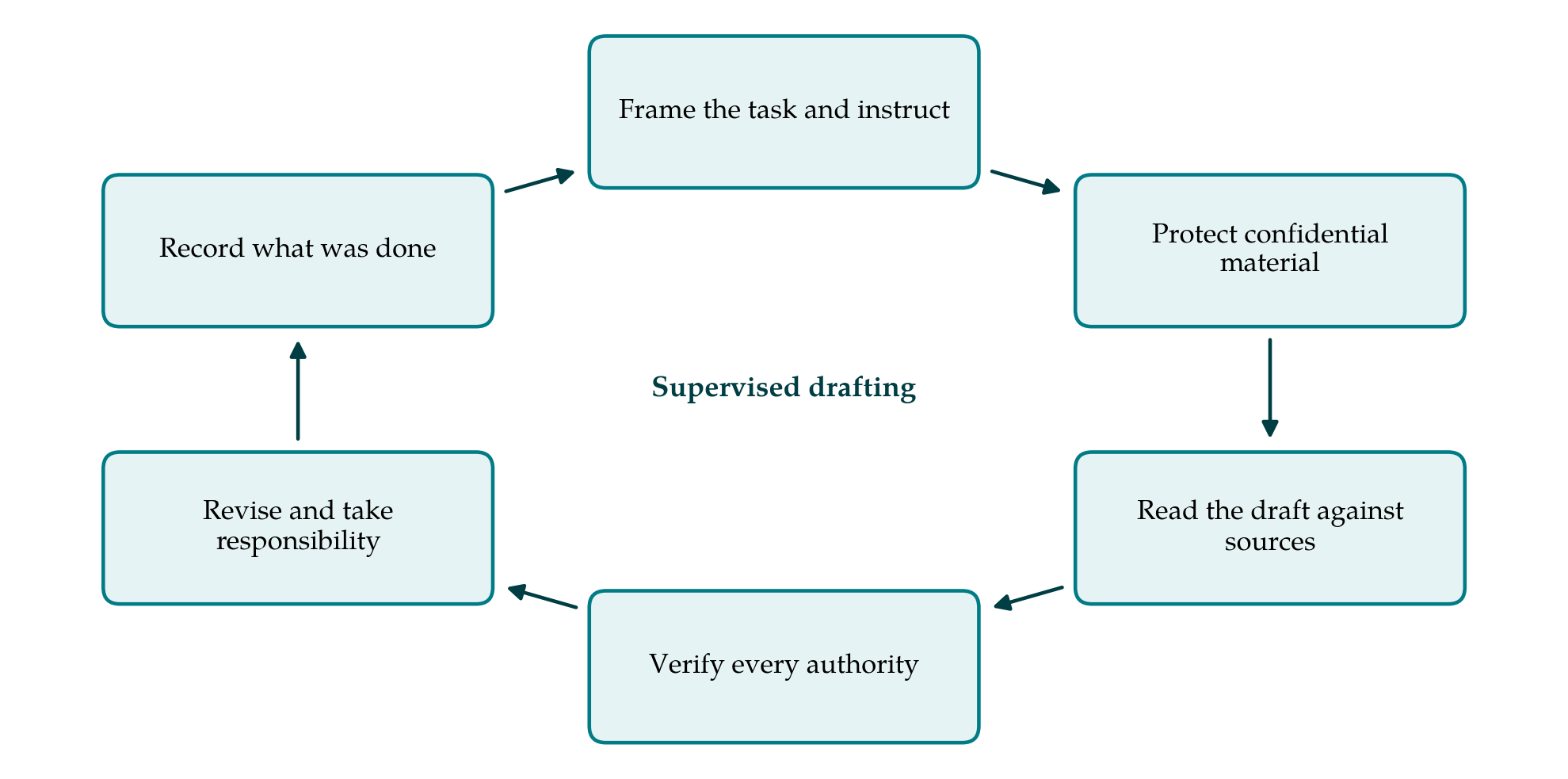
Three of these deserve emphasis. Instruction is a legal skill and not a technical trick: telling a tool what document is wanted, for whom, under which law and on what facts is the same act as briefing a junior, and students who cannot do one cannot do the other. Verification must be taught as a habit with fixed steps. Every authority is retrieved from a primary source and read; every quotation is checked against the original; every statement of fact is traced to the file. Finally, students need to learn when to decline. Some material should not be entered into an external system at all, and some tasks, such as advice that turns on a client's particular circumstances, call for the lawyer's own first thoughts before any draft is generated.
The teaching method matters as much as the list. Schön (1983) described professional competence as reflection in action, learned by doing the work under the eye of someone who can name what went wrong. The most direct exercise is to give students a generated memorandum into which errors of different kinds have been deliberately placed, some obvious and some subtle, and to ask them to find, correct and explain each one. Clinics offer the same lesson with real stakes. Students should also continue to draft unaided at intervals throughout the degree, for the reason Bainbridge gave: a supervisor who has stopped practising the task soon loses the ability to judge it.
5. Four Objections
The first objection is that the tools change so quickly that anything taught will be obsolete by graduation. That is true of interfaces and product names. It is not true of the routine set out above, which would apply equally to a draft from a trainee, a precedent bank or a contract lawyer in another office. The skill is supervision, and its object is incidental.
The second is that students must first learn to think and write like lawyers, and that tools introduced too early will prevent it. The premise is right and the conclusion does not follow. Nobody can supervise work they could not do themselves, so unaided analysis and drafting remain the foundation, and the first year may reasonably be kept largely free of generative tools. The claim made here is that supervision should be added to the fundamentals and taught in sequence with them. Pasquale (2019) has argued that legal judgement cannot be delegated to software without loss, and a curriculum that trains students to check machine output against their own reasoning takes that argument seriously.
The third objection is that firms will train their recruits. Some will, in the use of the particular products they have licensed. Many graduates, however, go to small practices, public bodies and legal aid organisations with no training budget, and those are also the settings in which an unchecked filing does most harm to clients who cannot easily change lawyers. Observers who expect technology to take over routine legal tasks disagree about the pace (Susskind and Susskind, 2015; Remus and Levy, 2017), but on any view the work that remains for humans is the exercise and review of judgement, and a profession cannot leave its core competence to the discretion of employers.
The fourth is fairness. Capable tools cost money, and students who can pay for better ones may gain an advantage. The answer is institutional: a school that teaches supervision should provide the tool used in the teaching, as it provides the library and the research databases, and should assess the checking and not the polish of the generated text.
6. Implications
If the argument is accepted, several things follow for those who design and regulate legal education. Integrity policies should be rewritten around responsibility for the submitted work, with disclosure of tool use treated as a professional norm and not as a confession. Legal writing and research courses should include at least one assessed exercise in auditing a generated draft. Professional responsibility courses should cover the guidance issued by bar authorities on generative tools alongside the traditional rules on competence, confidentiality and candour. Accrediting bodies that define the outcomes expected of graduates could name the supervision of delegated and automated work among them. Teachers themselves will need time and support to learn the tools well enough to demonstrate their failures. None of this requires new courses. It requires that existing ones acknowledge how drafts are now produced.
7. Conclusion
A lawyer has always been responsible for work prepared by others, and the arrival of software that drafts does not alter the principle. It alters the frequency with which the principle is tested and the ease with which it can be forgotten. Law schools are the one place where every future lawyer can be made to practise checking a persuasive draft until the habit is fixed. Teaching students to supervise automated drafting is continuous with what legal education has long claimed to do, and the schools that do it will send out graduates who are safer for their clients and more useful to the courts.
Conflict of interest
To be declared by the author(s) before publication.
Funding
To be declared by the author(s) before publication.