1. Introduction
By the 1950s the naming of enzymes had become disorderly. The same enzyme was known by several names, the same name was applied to different enzymes, and many names, such as diaphorase or old yellow enzyme, said nothing about the reaction catalysed. The International Union of Biochemistry set up an Enzyme Commission in 1956 to deal with the problem, and its first report, published in 1961, introduced the scheme of classes and four-part code numbers still in use (Tipton and Boyce, 2000). The list is now maintained by the Nomenclature Committee of the International Union of Biochemistry and Molecular Biology, and has grown from several hundred entries to several thousand (McDonald and Tipton, 2014).
The system has been a success by any reasonable measure. It is also widely misread. Most users meet EC numbers as labels attached to proteins in databases and assume that the label describes the protein. This note sets out where that assumption and a handful of others lead authors astray. It reports no new data and proposes no change to the rules; its aim is to make the existing rules easier to apply.
2. What an EC Number Denotes
An EC number has four parts, read from left to right as increasingly specific descriptions of a reaction (Figure 1). The first gives the class: oxidoreductases, transferases, hydrolases, lyases, isomerases, ligases or translocases. The second and third narrow the chemistry, in ways that differ from class to class, and the fourth is a serial number within the sub-subclass. L-Lactate dehydrogenase, EC 1.1.1.27, is thus an oxidoreductase acting on a CH-OH group of the donor with NAD+ or NADP+ as acceptor. Each entry carries an accepted name for everyday use, a systematic name that spells out substrates and reaction type, and a list of other names found in the literature (IUBMB, 1992).
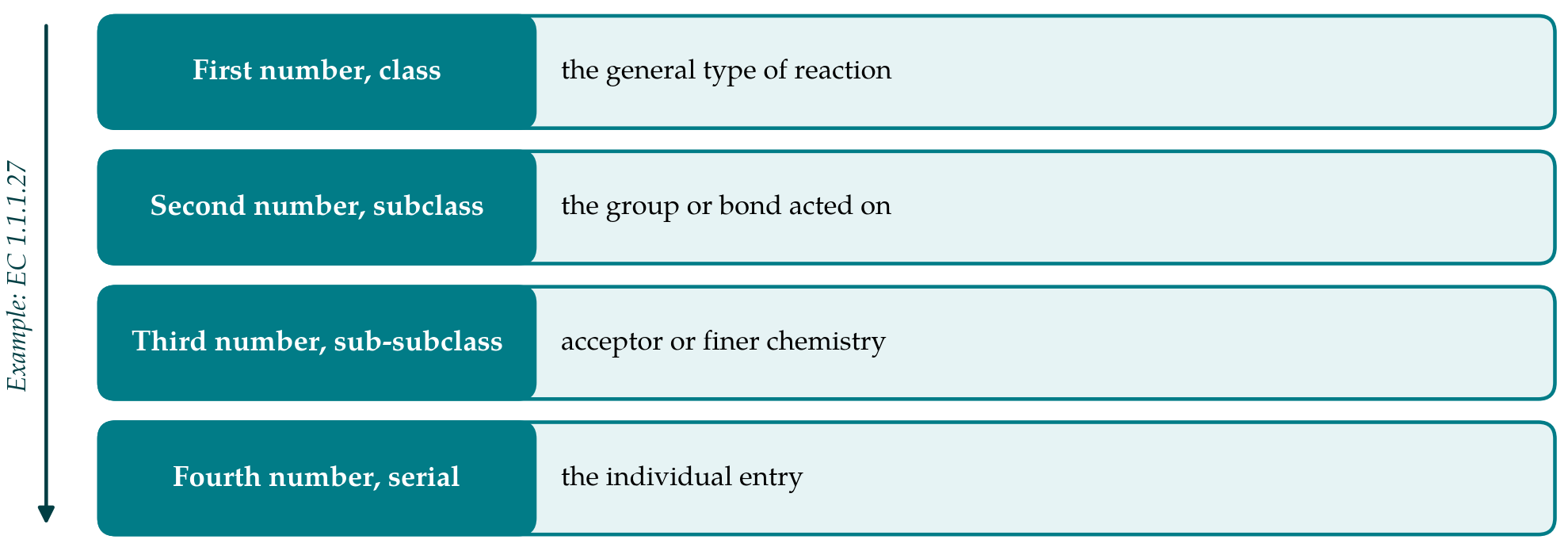
The essential point is that the classification is of reactions. The Commission chose this basis deliberately, at a time when few enzymes had been purified and almost none sequenced, and the choice has two consequences that surprise newcomers. Proteins with no evolutionary relationship and entirely different folds receive the same number if they catalyse the same reaction; such analogous or non-homologous isofunctional enzymes are common (Galperin et al., 1998; Omelchenko et al., 2010). Conversely, a single polypeptide with two active sites, or one active site of broad specificity, may properly carry more than one number. An EC number is therefore not an identifier for a gene or a protein, and should not be used as one.
The scheme also resolves some kinds of enzyme more finely than others. Where specificity is a matter of small-molecule chemistry the entries are precise. Where it lies in the recognition of a macromolecule it is hard to express as a reaction, and many protein kinases with quite different protein substrates fall under a single general entry for non-specific serine/threonine protein kinases. Two proteins that share such a number may have little in common biologically, and the number says nothing about cofactor requirements, regulation, subunit structure or cellular location.
3. Recurring Sources of Confusion
Table 1 lists the misunderstandings met most often in the literature, each with an example. Several deserve a few words of explanation.
| Source of confusion | Example | What to do |
|---|---|---|
| Number taken to identify a protein | Unrelated proteins share one EC number | Give gene or accession as well |
| One name, different enzymes | Mammalian glucokinase is hexokinase IV, EC 2.7.1.1 | State EC number and organism |
| Synthase and synthetase | Glycogen synthase is a transferase; glutamine synthetase a ligase | Check the class in the list |
| Name follows the written direction | Pyruvate kinase forms pyruvate in glycolysis | Describe the physiological direction in words |
| Outdated number | Transport ATPases moved from EC 3.6.3 to class 7 | Consult the current entry |
| Incomplete or provisional number | EC 2.7.-.- or a serial beginning with n | Do not present it as a full classification |
| Ambiguous abbreviation | GS for two unrelated enzymes; AST and GOT for one | Define at first use |
Old names persist because they are short and familiar. Glucokinase is the standard illustration. In the enzyme list the name belongs to EC 2.7.1.2, a glucose-specific enzyme of microorganisms, whereas the liver and pancreatic enzyme that physiologists call glucokinase is an isoenzyme of hexokinase, EC 2.7.1.1, which happens to have a low affinity for glucose. A paper that says glucokinase without a number or an organism leaves the reader to guess.
The pair synthase and synthetase is a similar trap. Synthetase was once reserved for enzymes that couple a synthesis to the hydrolysis of a nucleoside triphosphate, which are ligases of class 6, and synthase for those that do not. Because the distinction was so often muddled, the nomenclature committee later allowed synthase for any enzyme named for its synthetic product, so the word alone no longer indicates the class (Cornish-Bowden, 2014). Direction causes related trouble. Within each class reactions are written in one direction by convention so that entries are comparable, and names follow the written direction. A name such as pyruvate kinase or creatine kinase does not tell the reader which way the reaction runs in the cell.
Abbreviations multiply the difficulty because they are coined locally. GS is used both for glycogen synthase, a glycosyltransferase of class 2, and for glutamine synthetase, a ligase of class 6. In the opposite direction, one enzyme may travel under two abbreviations in different communities: the aspartate transaminase of the biochemist, EC 2.6.1.1, is the AST of the clinical laboratory and the GOT of older clinical reports. Readers searching the literature by abbreviation will miss part of it unless authors give the full name and number once.
Numbers also change. When a classification is revised the old number is retired, never reassigned, and the entry records where the enzyme went. The largest recent revision was the creation in 2018 of class 7, the translocases, for enzymes that move ions or molecules across membranes. Many ATP-driven pumps formerly listed as hydrolases under EC 3.6.3 were transferred to it, and older papers and unrevised database records still carry the superseded numbers. The current status of any entry can be checked in the official list (McDonald et al., 2009). Finally, numbers with dashes in place of the last digits, and provisional serial numbers assigned by databases ahead of a decision by the committee, are placeholders and should be described as such.
4. Consequences for Annotation
These points matter more now than when the system was devised, because most enzyme assignments are made by computer. A newly sequenced gene is given the name and number of its closest characterised relative, and that assignment becomes the basis for annotating the next genome. Within a superfamily, however, homologous enzymes frequently catalyse different reactions, and an analysis of public databases found high rates of misannotation in several superfamilies for exactly this reason (Schnoes et al., 2009). Enzymes that catalyse secondary reactions (Khersonsky and Tawfik, 2010) or that have a second, non-catalytic role (Jeffery, 1999) fit the one-protein, one-number habit of mind even less well.
The reverse gap also exists. A substantial share of the reactions in the enzyme list have never been linked to any sequence, the so-called orphan enzymes (Lespinet and Labedan, 2005), so an activity measured in an extract may have an EC number and no known gene. Curated resources such as BRENDA record the evidence behind each assignment and are the right place to check what has in fact been demonstrated for a given organism (Chang et al., 2021).
5. Suggestions for Authors
A few habits remove most of the ambiguity. Give the EC number with the accepted name the first time an enzyme is mentioned, and after that use one name consistently. Identify the protein separately, by organism and by gene name or sequence accession, because the number cannot do this. Look up the entry in the current list before submission, so that a transferred or deleted number is not repeated from an older source. Define every abbreviation. Where a reaction is discussed in the direction opposite to its name, say so in plain words. And where the function of a protein has been inferred from sequence similarity and not measured, state that, and avoid attaching a complete four-part number to it as if the activity had been shown.
6. Conclusion
The enzyme list classifies what enzymes do, and it does that well. Confusion arises when it is asked to do other things: to identify proteins, to imply evolutionary relationship, or to stand as evidence of an activity nobody has assayed. Keeping reaction, protein and evidence distinct in writing costs an author a few extra words and saves readers, curators and annotation pipelines a good deal of error.
Conflict of interest
To be declared by the author(s) before publication.
Funding
To be declared by the author(s) before publication.