1. Introduction
For most of their history, satellite and cellular systems were designed by different communities under different standards and met only at a gateway. That separation is ending. The 3rd Generation Partnership Project studied the adaptation of New Radio to satellites and aerial platforms in two technical reports (3GPP, 2020; 3GPP, 2021) and included normative support for non-terrestrial networks (NTN) in Release 17, with enhancements following in later releases (Lin et al., 2021). The International Telecommunication Union's framework for systems of 2030 and beyond lists ubiquitous connectivity as a usage scenario and expects terrestrial and non-terrestrial components to interwork (ITU-R, 2023).
Several developments lie behind the change. Launch costs have fallen and large low Earth orbit (LEO) constellations have been deployed for broadband, which has altered the economics that sank earlier ventures (Del Portillo et al., 2019; Kodheli et al., 2021). Terrestrial coverage, meanwhile, still leaves oceans, airspace, sparsely populated land and disaster zones unserved, and no amount of densification will change that. Visions of the sixth generation (6G) accordingly treat the network as three-dimensional, with space, air and ground segments operating as one system (Saad et al., 2020; Giordani and Zorzi, 2021).
Integration is easier to announce than to engineer. A base station that moves at several kilometres per second, or sits tens of thousands of kilometres away, breaks assumptions built into timing, synchronisation, mobility management and spectrum planning. This review concentrates on three areas where those assumptions bite hardest and where the literature is most developed: architecture, handover and spectrum sharing.
2. Scope and Approach
The article is a narrative review of the published literature. It relies on the principal survey papers on satellite communications and NTN (Rinaldi et al., 2020; Azari et al., 2022), on standardisation documents, on textbooks of satellite engineering, and on research papers selected because they introduced a mechanism or argument that later work builds on. It does not attempt a systematic search and does not rank proposals by reported performance, since the simulation assumptions behind published figures differ too much for such a ranking to mean anything. Where the standards have made a choice, the review says so and explains the reasoning. Where the question is open, it sets out the competing positions.
3. Architectures
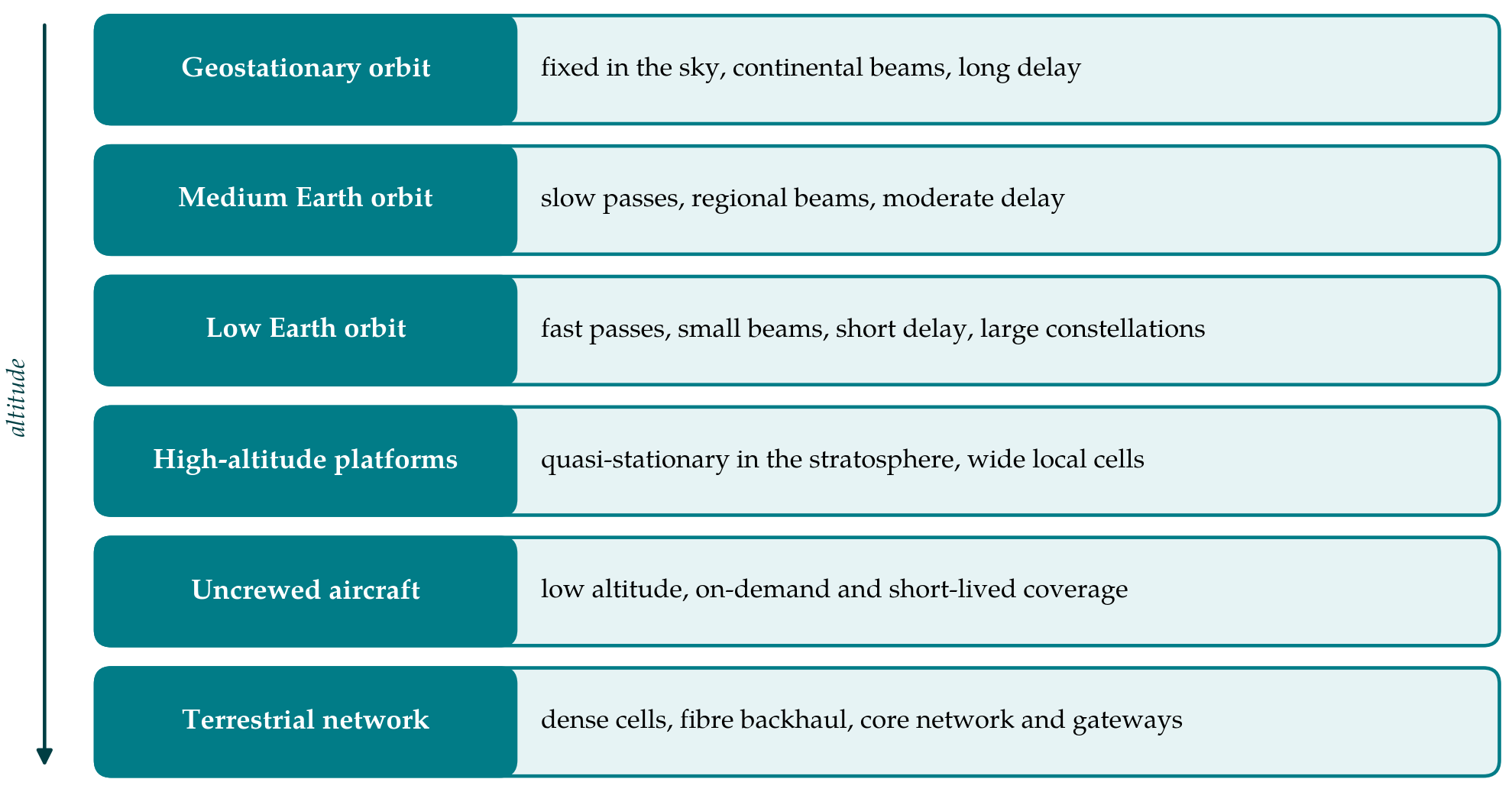
An NTN is defined by its platforms and by how radio access functions are divided between sky and ground. Figure 1 shows the platform layers that the literature on space-air-ground integration usually distinguishes (Liu et al., 2018).
3.1. Platforms and orbits
A geostationary satellite orbits at an altitude of 35,786 km above the equator and appears fixed from the ground. Three such satellites cover nearly the whole globe apart from the polar regions, and a terminal never needs to change satellite. The cost is distance: the one-way propagation delay to the ground is of the order of 120 ms, and the link budget for a handheld device is severe (Maral et al., 2020). LEO satellites, below 2,000 km, cut the delay to a few milliseconds and ease the link budget, but each one is visible from a given point for only a few minutes, so continuous service needs a constellation of hundreds or thousands arranged in regular orbital planes of the kind first analysed by Walker (1984). Medium Earth orbits sit between the two in every respect.
Below the satellites, high-altitude platform stations in the stratosphere, defined in the Radio Regulations as operating between 20 and 50 km, offer quasi-stationary coverage of a region with delays comparable to terrestrial links, and have been proposed as aerial macro cells and as relays between satellites and the ground (Kurt et al., 2021). Uncrewed aerial vehicles at low altitude can carry small base stations for temporary capacity or emergency coverage, with endurance and backhaul as their limiting factors (Mozaffari et al., 2019). Most architectural proposals for 6G combine several of these layers so that each compensates for the weaknesses of the others.
3.2. Transparent and regenerative payloads
The most consequential architectural choice is what the platform carries. With a transparent, or bent-pipe, payload the satellite filters, frequency-converts and amplifies the signal, and the base station remains on the ground behind a gateway. The radio link then spans two legs, the service link between terminal and satellite and the feeder link between satellite and gateway, and both contribute delay. With a regenerative payload the satellite demodulates and decodes, and can host all or part of the base station: the full node, or only the distributed unit with the central unit on the ground (3GPP, 2021; Guidotti et al., 2019). The first normative release specified the transparent case, which reuses existing satellites and keeps complexity on the ground (Lin et al., 2021).
Regeneration brings three benefits that matter for 6G. It halves the delay seen by radio protocols, since timers no longer span the feeder link. It allows inter-satellite links to carry traffic and signalling, so a satellite out of sight of any gateway can still serve users. And it permits on-board scheduling close to the user. Studies of routing over laser inter-satellite links have shown that a dense LEO mesh can offer lower latency than terrestrial fibre over long distances, because light travels faster in vacuum than in glass (Handley, 2018), while the topology of those links has to be designed around the constant relative motion of orbital planes (Bhattacherjee and Singla, 2019). The price is mass, power and the difficulty of upgrading software and hardware in orbit.
3.3. Adapting the radio interface
Two physical effects dominate the air-interface work. The round-trip delay exceeds anything anticipated on the ground and, in LEO, changes continuously as the satellite moves. Its Doppler shift, produced by an orbital speed of roughly 7.5 km/s, is far larger than that of any terrestrial vehicle. The approach taken in the standards is to make the terminal do the compensation: equipped with a satellite navigation receiver and with orbital data broadcast by the network, it calculates its own timing advance and frequency offset before transmitting. Scheduling offsets and protocol timers are lengthened, and hybrid automatic repeat request feedback can be disabled where the delay makes it useless (Lin et al., 2021; Guidotti et al., 2019). Dependence on satellite navigation is itself a weakness, and removing it is a stated research goal for later systems (Azari et al., 2022).
4. Handover
In a terrestrial network a handover happens because the user moves. In a LEO network it happens because the base station does. A stationary terminal is passed from beam to beam and satellite to satellite every few minutes or less, depending on beam size, and when a satellite sets, every terminal it serves must move at nearly the same moment.
4.1. The classical literature
The problem was studied thoroughly for the first generation of LEO telephony systems. Akyildiz et al. (1999) and the survey by Chowdhury et al. (2006) distinguish link-layer handover, subdivided into spot-beam, satellite and inter-satellite-link handover, from network-layer handover, where the route or address of a session changes. They also set out the satellite-fixed and Earth-fixed cell concepts. In the former, beams point in a constant direction relative to the satellite and sweep the ground. In the latter, the satellite steers its beams to hold a ground area for as long as geometry allows, which reduces handover frequency at the cost of steerable antennas. Both concepts reappear in the current standards as Earth-moving and quasi-Earth-fixed cells (3GPP, 2021).
4.2. Why terrestrial triggers fail
Terrestrial handover is triggered by measurement: the terminal reports when a neighbour cell becomes stronger than the serving cell by a margin. This works because received power falls quickly with distance from a tower. From orbit, the path lengths to the centre and the edge of a beam differ only slightly, so received power is nearly flat across the cell and the difference between serving and neighbour signals near the boundary is small compared with measurement noise. Simulation studies of New Radio mobility over LEO report late handovers, radio link failures and ping-pong between cells as the result (Juan et al., 2022). A second difficulty is delay: by the time a measurement report has been sent, processed and answered across a long link, the geometry has changed.
4.3. Mechanisms adopted and proposed
The response has been to use what a satellite network knows and a terrestrial one does not: the future. Orbits are predictable, so the time at which a cell will stop covering a place can be computed in advance. Conditional handover, in which the network prepares one or more target cells ahead of time and the terminal executes the change itself once a configured condition is met, removes the dependence on a timely command. For NTN the conditions were extended beyond signal measurements to include the distance of the terminal from a cell reference point and a time window (Lin et al., 2021; Juan et al., 2022). Table 1 compares the trigger families discussed in the literature.
| Trigger | Basis of the decision | Advantage | Weakness |
|---|---|---|---|
| Signal measurement | Neighbour signal exceeds serving signal by a margin | Reuses terrestrial procedures | Signal nearly flat across the beam; delayed reports |
| Terminal location | Distance from terminal to cell reference point | Insensitive to measurement noise | Needs terminal position and accurate ephemeris |
| Time window | Known interval during which the cell serves the area | No measurements or position reports | Coarse for moving beams and moving users |
| Conditional handover | Target prepared early; terminal executes on a condition | Tolerates long signalling delay | Resources reserved in several candidate cells |
| Network prediction | Whole-constellation schedule of satellite and feeder switches | Spreads signalling; can balance load | Depends on traffic forecasts and central control |
| Multi-connectivity | Simultaneous links to two satellites or layers | No interruption at the switch | Doubles radio resource use and terminal complexity |
Two further issues receive attention. One is signalling load: when a satellite or feeder link switches, all its users hand over together, and proposals to stagger the event, to hand over groups with common signalling, or to keep the cell identity unchanged across the satellite switch aim to flatten the resulting peak (Azari et al., 2022). The other is vertical handover between layers, for example from a terrestrial cell to a satellite at the edge of ground coverage, where the two candidates differ in delay and capacity by orders of magnitude and signal strength alone is a poor guide (Giordani and Zorzi, 2021). For 6G the literature increasingly frames handover in dense constellations as a scheduling problem over a known time-varying graph and not as a reaction to measurements (Leyva-Mayorga et al., 2020).
5. Spectrum Sharing
Spectrum is where terrestrial and satellite interests meet most directly, since the bands attractive to both are finite and already occupied.
5.1. Allocations and regulatory limits
Satellite services have operated for decades in L and S bands for mobile links and in Ku and Ka bands for broadband, under allocations and coordination procedures set by the ITU Radio Regulations (ITU, 2020). The first NTN bands specified for New Radio lie in the mobile-satellite allocations of the L and S bands, with Ka-band operation addressed afterwards (Lin et al., 2021). Non-geostationary systems that share frequencies with geostationary ones must respect equivalent power flux-density limits laid down in Article 22 of the Regulations, which bound the aggregate interference a constellation may cause to geostationary earth stations and satellites (ITU, 2020). Operators meet these limits by switching off or re-pointing beams when a satellite passes close to the geostationary arc as seen from the ground, a constraint that feeds back into constellation and handover design (Del Portillo et al., 2019).
5.2. Coexistence between satellite and terrestrial systems
Sharing between satellite and terrestrial networks has been studied mainly through cognitive radio. Maleki et al. (2015) describe Ka-band scenarios in which satellite terminals use spectrum allocated primarily to terrestrial fixed links, protected by exclusion zones, beamforming at the terminal and knowledge of where the incumbent links are. Höyhtyä et al. (2017) survey database-assisted approaches, in which a geolocation database holding incumbent locations and protection criteria grants or refuses access, and argue that such databases suit satellite bands well because incumbents are few, fixed and registered. The common thread is asymmetry: a satellite beam covers an area containing thousands of terrestrial cells, so interference from space is weak but ubiquitous, while interference towards space is the sum of very many small contributions.
An integrated 6G network changes the framing. If one operator, or a partnership under a single standard, controls both components, sharing becomes a matter of joint resource management and not of protecting a stranger. Proposals include reusing terrestrial frequencies from satellites in areas with no ground coverage, coordinated beam and carrier assignment between layers, and dynamic division of a band according to traffic (Kodheli et al., 2021; Azari et al., 2022). Direct satellite service to ordinary handsets in bands identified for terrestrial mobile use is the sharpest form of the question. It raises cross-border interference issues, because a satellite beam does not stop at a frontier, and these are being examined in the international regulatory process.
6. Open Problems and Directions
Four gaps stand out. First, evaluation is fragmented: architectural, mobility and spectrum studies use different constellation, channel and traffic assumptions, and few results are directly comparable. Agreed reference scenarios beyond those in the standardisation reports would help. Second, most handover research considers a single LEO shell and a transparent payload, whereas the systems now envisaged combine multiple shells, regenerative nodes, inter-satellite links and aerial layers. Third, sharing studies usually analyse one victim and one interferer, and the aggregate effect of several large constellations and dense terrestrial networks in adjacent or common bands is less well understood. Fourth, the dependence on satellite navigation for synchronisation, and on accurate orbital data for location-based and time-based mobility, creates a common point of failure that the literature has only begun to address.
There are also questions that engineering alone will not settle. Regenerative payloads place network functions, and potentially user data, on platforms that cross jurisdictions continuously. Spectrum access for direct-to-device service depends on national licensing as much as on interference analysis. And the cost of terminals able to operate across layers will decide whether integration reaches the users for whom terrestrial coverage is absent, which is the stated purpose of the exercise.
7. Conclusion
Non-terrestrial networks have moved from a separate industry to a component of the cellular standard, and 6G is expected to complete the move by designing for sky and ground together from the start. The literature reviewed here shows broad agreement on the direction of travel: regenerative payloads and inter-satellite links in place of bent pipes, mobility procedures driven by orbital prediction in place of signal measurements, and coordinated use of spectrum in place of segregation. It also shows that each of these shifts carries unresolved costs, in on-board complexity, in dependence on positioning, and in regulatory coordination. Progress will depend as much on shared evaluation scenarios and on decisions taken in the regulatory arena as on new algorithms.
Conflict of interest
To be declared by the author(s) before publication.
Funding
To be declared by the author(s) before publication.