1. Introduction
A weaving village does not disappear at once. The looms fall silent one household at a time, as yarn prices rise, orders thin out and the young find other work. Economic historians have traced this process for Indian handloom weaving across the twentieth century and have shown that it was neither uniform nor a simple story of defeat by the mill (Roy, 1993; Haynes, 2012). What the economic record does not hold is the experience of those who lived through it, or the knowledge of warping, sizing, dyeing and pattern-making that they carried.
That knowledge has gained formal recognition. Traditional craftsmanship is one of the domains named in the UNESCO convention on intangible cultural heritage, which commits states to documentation carried out with the participation of the communities concerned (UNESCO, 2003). Oral history is the method most often reached for. Its handbooks, however, were written chiefly with spoken testimony about events in mind (Thompson, 2000; Ritchie, 2015), and a weaver asked to explain how a border design is set up will often answer that it cannot be told, only shown.
This article proposes a method for a village-scale project that takes that answer seriously. It is written for researchers, local heritage bodies and weavers' organisations planning such work. No project is reported: the village of the title stands for a type of place, and the procedure is offered for others to apply, test and amend.
2. Background
The design rests on three bodies of writing, on oral testimony, on collective memory and on the learning of craft, and on what each implies for practice.
2.1. Oral testimony as evidence
Early oral historians defended their sources by arguing that spoken accounts could be checked and were as reliable as documents (Vansina, 1985). A later generation changed the question. Portelli (1991) showed that the ways in which narrators misdate, merge and reshape events are themselves evidence of what those events meant to them. On this view an interview yields two things: information about the past, and a present-day account of a life, shaped by the encounter with the interviewer. Current theory treats the second as the distinctive contribution of the method (Abrams, 2016). For a declining craft the implication is that stories of decline should be recorded as interpretations, with attention to who tells them and to whom.
2.2. Memory held in common and in the body
Halbwachs (1992) argued that individuals remember within frameworks supplied by the groups they belong to, so that a family, a caste or guild, or a neighbourhood sustains a shared version of its past. Connerton (1989) added that societies also remember through habitual bodily practice, in posture, gesture and routine, and that such memory is passed on without being put into words. A loom is a place where both kinds meet. The rhythm of the shuttle is bodily memory; the story of how the village came to weave a certain cloth is collective memory. A method confined to the second would miss the first.
2.3. Craft knowledge and how it is passed on
The difficulty of describing skill is a classic problem. Polanyi (1966) summed it up in the remark that people know more than they can tell. Studies of apprenticeship have since described how such knowledge is acquired: newcomers begin with simple tasks at the edge of the work and move towards full participation, learning by watching and doing more than by instruction (Lave and Wenger, 1991; Marchand, 2008). Sennett (2008) stresses that skill is a trained responsiveness to materials and not the execution of a plan. Learning of this kind depends on years spent near the work, which is what is lost when children leave the loom shed for school and wage labour.
2.4. Generations
Mannheim (1952) proposed that people who meet the same historical changes at the same stage of life form a generation with a shared outlook. In a weaving village the idea has a concrete form. Those who learned as children when weaving was the only livelihood, those who trained but left, and those who have never woven stand in different relations to the craft and will narrate its decline differently. The method treats these positions as a structuring device for the whole project. Doing so also guards against a common bias of salvage projects, which is to interview only the oldest practitioners and so to record the craft solely as its elders wish it remembered.
3. The Proposed Method
The method has seven steps. Table 1 lists them with their purpose and the record each should leave, and Figure 1 shows their sequence. The steps are set out below in the order in which a project team would meet them.
| Step | Purpose | Record produced |
|---|---|---|
| 1. Frame the questions | Agree with the village what the project is for and what it will ask | Written project statement in the local language |
| 2. Consent and ownership | Settle permission, rights in recordings and terms of access | Signed or recorded agreements; access conditions |
| 3. Generational map | Identify households, roles in production and generational positions | Household list and selection grid |
| 4. Life-story interviews | Record remembered experience in the narrator's own order | Audio, interview summary, field notes |
| 5. Sessions at the loom | Capture skill through demonstration and talk about objects | Video, photographs, annotated glossary |
| 6. Transcribe and index | Make recordings usable without flattening the language | Transcript, translation, time-coded index |
| 7. Interpret, return, deposit | Analyse with narrators, give material back, secure its future | Thematic report, village copy, archive deposit |
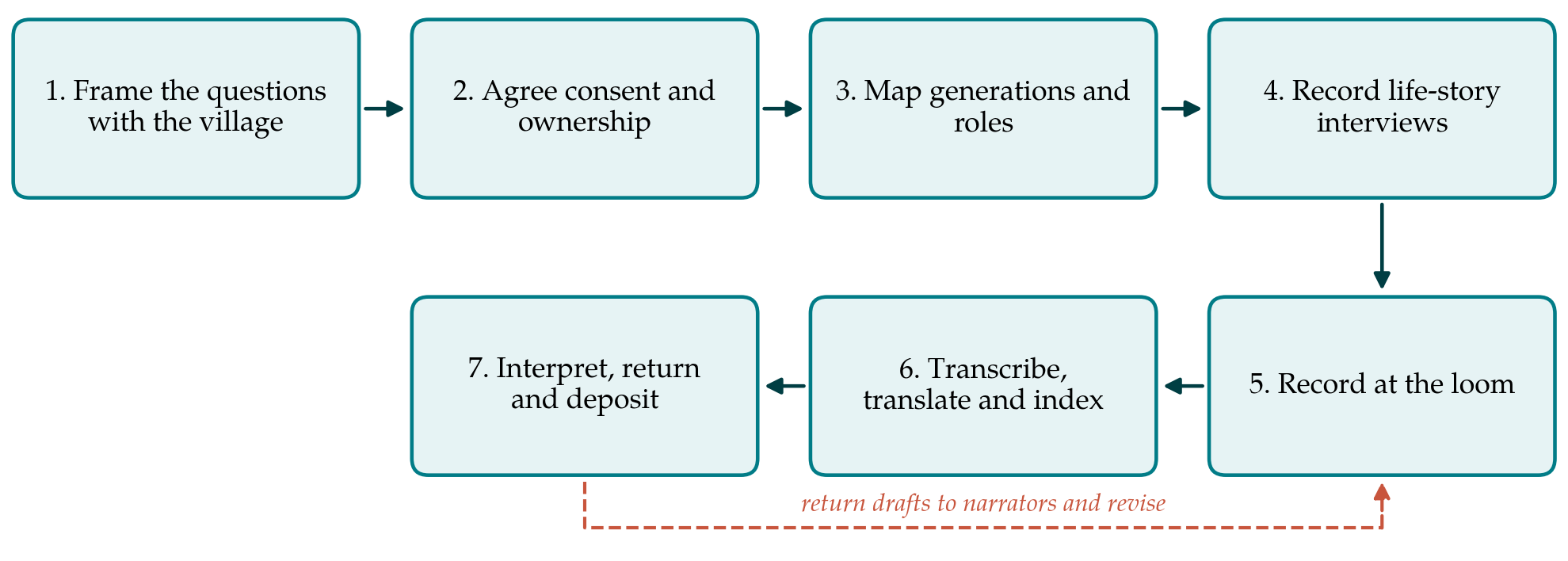
3.1. Step 1: Frame the questions with the village
The project begins with open meetings at which the team explains what it hopes to do and asks what residents would want recorded. Frisch (1990) called the principle shared authority: the interpretation of a life belongs to narrator and historian together. In practice this means a short written statement of aims, agreed with a weavers' cooperative or village council where one exists, and revised if the meetings show that the team's interests and the residents' diverge.
3.2. Step 2: Agree consent and ownership
Consent is sought from each narrator before recording and confirmed afterwards, when the person knows what has been said. The agreement should state who holds rights in the recording, where copies will be kept, who may hear them and whether any passages are closed. Professional guidance treats these as continuing obligations and not a form signed once (Oral History Association, 2018). Designs and techniques may have commercial value to the families who own them, and narrators should be able to withhold them from public access.
3.3. Step 3: Map generations and roles
A household list is drawn up with local help, noting for each adult the relation to weaving: active weaver, former weaver, never a weaver. It also notes roles that interviews with weavers alone would miss, among them the women and children who wind bobbins and prepare warps, dyers, loom carpenters, yarn dealers and the traders who commission cloth. Narrators are then chosen to cover the grid of generation and role. The aim is range, and no claim of statistical representativeness should be attached to the selection.
3.4. Step 4: Record life-story interviews
Each narrator is first invited to tell the story of his or her life with little interruption, and only afterwards asked about topics on a common guide: learning, the working day, relations with merchants, festivals and the ritual uses of cloth, the moment of leaving or staying. The life-story form lets narrators set their own emphasis and shows where weaving sits in a life (Thompson, 2000). Interviews are held in the narrator's first language, at home, and where possible by an interviewer from the region. Interviewers note silences and topics avoided, which accounts of working lives often contain and which carry meaning of their own (Abrams, 2016).
3.5. Step 5: Record at the loom
A second session takes place where the work is done. The narrator demonstrates a sequence of operations on video and talks through it, handles tools, old cloths, pattern books or photographs, and names parts and processes. Objects prompt recollection that questions do not, and demonstration records what cannot be said. Where a loom stands idle, a former weaver may be asked to sit at it again. Sessions that bring an older weaver together with a younger relative are especially useful, because the explanation is then pitched at a learner and the exchange between the two is itself a record of how transmission worked or failed. Terms for tools, motions and faults are gathered into a glossary as the sessions proceed.
3.6. Step 6: Transcribe, translate and index
Recordings are transcribed in the original language before translation, keeping dialect words and technical terms and marking pauses and laughter. A time-coded index by topic makes the audio and video searchable, which matters because the recording, with its tone and gesture, remains the primary source and the transcript a guide to it (Portelli, 1991).
3.7. Step 7: Interpret, return and deposit
Analysis proceeds by reading across the generational grid. Thematic analysis, in which transcripts are coded and the codes grouped into themes through repeated reading, offers a transparent procedure (Braun and Clarke, 2006); it should be supplemented by attention to narrative form, to how stories are told as well as what they contain. Draft interpretations are taken back to narrators and to a village meeting, and disagreements are recorded. Copies of all material remain in the village in a usable form, and a full set is deposited in a public archive under the agreed conditions.
4. Fitting the Method to Local Conditions
Three features of weaving communities call for adjustment. Production is often organised by caste or community, and by debt to master weavers and merchants, so that narrators may be unwilling to speak freely about those on whom they depend; private sessions and the option of closed passages protect them. Work is divided by gender, and women's preparatory labour tends to be described by both sexes as help; interviewing women separately, by women, guards against its omission. Finally, researchers should be candid that documentation does not revive a livelihood, and should not let the project raise expectations it cannot meet.
The scale of the work should be set by what a small team can transcribe and return, since a recording that is never indexed is of little use to anyone. A modest number of narrators interviewed twice, once at home and once at the loom, will usually serve the purpose better than a large number interviewed once. Equipment can be simple. A good external microphone matters more than the camera, and the clatter of a working loom means that talk and demonstration are best recorded in alternation and not together. Recordings should be copied to at least two separate stores on the day they are made.
5. Limitations and What Remains to Be Shown
The method is untested as a whole. Each element has a record of use in oral history or in the ethnography of craft, but their combination in a single village project is proposed here and has not been tried. A first application should examine whether loom-side sessions add knowledge that interviews do not, whether the generational grid sorts narratives as expected or imposes divisions that residents do not recognise, and whether returning drafts changes interpretations or merely delays them.
There are limits no refinement removes. Video preserves the look of a skilled movement and not the ability to perform it. Memory of the craft's better years is coloured by its present decline, and a project run by outsiders at the end of a tradition will tend to hear elegy. And one village is one village: findings would describe a place and suggest questions for others, without standing for handloom weaving at large.
6. Conclusion
Recording a weaving village before its last looms stop requires a method that listens to stories, watches hands and distinguishes the generations who speak. The seven steps proposed here bring together established practice in oral history with what is known about embodied memory and craft learning, and build consent, return and deposit into the design. Whether the combination works as intended is a matter for those who apply it to judge and report.
Conflict of interest
To be declared by the author(s) before publication.
Funding
To be declared by the author(s) before publication.