1. Introduction
A driver who logs on to a ride-hailing application decides when to work, owns the car and may switch to a competitor between trips. The same driver cannot set the fare, does not know the destination before accepting, is rated after every journey and can be removed from the application by an automated process. Asked whether this person is an employee or an independent contractor, courts applying the traditional tests have answered both ways. A federal judge in California, facing the question in litigation against Lyft, remarked that the jury would be handed a square peg and asked to choose between two round holes.
That remark captures the position taken here. The binary division between employment and self-employment, and the tests used to police it, do not describe platform work well enough to produce stable or predictable results. The standard reform proposal is to stretch the definition of employee until it covers platform workers. This article argues for a different course: the creation of a third statutory category with its own floor of rights. The idea has serious critics (Cherry and Aloisi, 2017). The claim made here is that the criticisms identify design faults that can be corrected, and that the alternative has had a decade to prove itself and has not.
2. Why the Existing Tests Are Failing
Employment status in common law systems turns on a cluster of indicators: the degree of control, integration into the business, who supplies the tools, who bears financial risk, and whether there is an ongoing obligation to offer and accept work. Civil law systems ask whether the work is performed in subordination. Both approaches were developed against a background in which control was exercised by a supervisor during fixed hours (Deakin and Wilkinson, 2005). Platform work pulls the indicators apart. Control over price, performance standards and discipline is intense, yet control over working time, the indicator on which many tests lean most heavily, is largely absent (Prassl and Risak, 2016). A test that weighs factors without ranking them cannot say which set should prevail, so the result depends on the tribunal.
The evidence of failure is in the law reports. The Supreme Court of the United Kingdom held in Uber BV v Aslam (2021) that drivers were workers, after five years of litigation and three appeals. The French Cour de cassation in 2020 and the Spanish Tribunal Supremo in the same year found employment relationships in cases concerning a ride-hailing driver and a delivery rider. Other courts, on similar contracts, reached the opposite conclusion, and the United Kingdom Supreme Court itself held in 2023 that Deliveroo riders, who were permitted to send substitutes, were not in an employment relationship for the purposes of trade union rights. Each ruling binds only the parties and the business model as it stood when the claim was filed. Platforms have responded by adjusting substitution clauses, log-in rules and fare settings to weaken the indicators on which they lost (Prassl, 2018).
Legislative tightening has not ended the instability. California adopted the three-part ABC test in Dynamex Operations West v Superior Court (2018) and codified it in Assembly Bill 5. Within a year the platforms had secured, by ballot initiative, a statute that declares application-based drivers to be independent contractors while granting them an earnings guarantee and a healthcare subsidy. Proposition 22 is in substance a third category, written by one side of the bargain. The contest over worker identity that lies behind such measures is traced by Dubal (2017). The European Union's Platform Work Directive introduces a rebuttable presumption of employment but leaves the triggering facts to be defined by national law and practice (European Union, 2024), which returns the question to the same national tests. The information asymmetries that algorithmic management creates between platform and worker, documented by Rosenblat and Stark (2016), make any fact-intensive test harder still for the worker to satisfy.
3. The Case for a Third Category
The argument for an intermediate status starts from the purposes of labour law. Davidov (2016) identifies two vulnerabilities that justify protective regulation: subordination to another's organisational power, and economic dependence on a particular relationship for one's livelihood. Classical employees exhibit both. Many platform workers exhibit one strongly and the other weakly, or both in a form that differs from the factory model. Figure 1 sets the two vulnerabilities against each other. Where both are high, employment is the right answer and no new category is needed. Where both are low, the person is running a business. The remaining two quadrants are where the binary test fails, and where a third status would do its work.
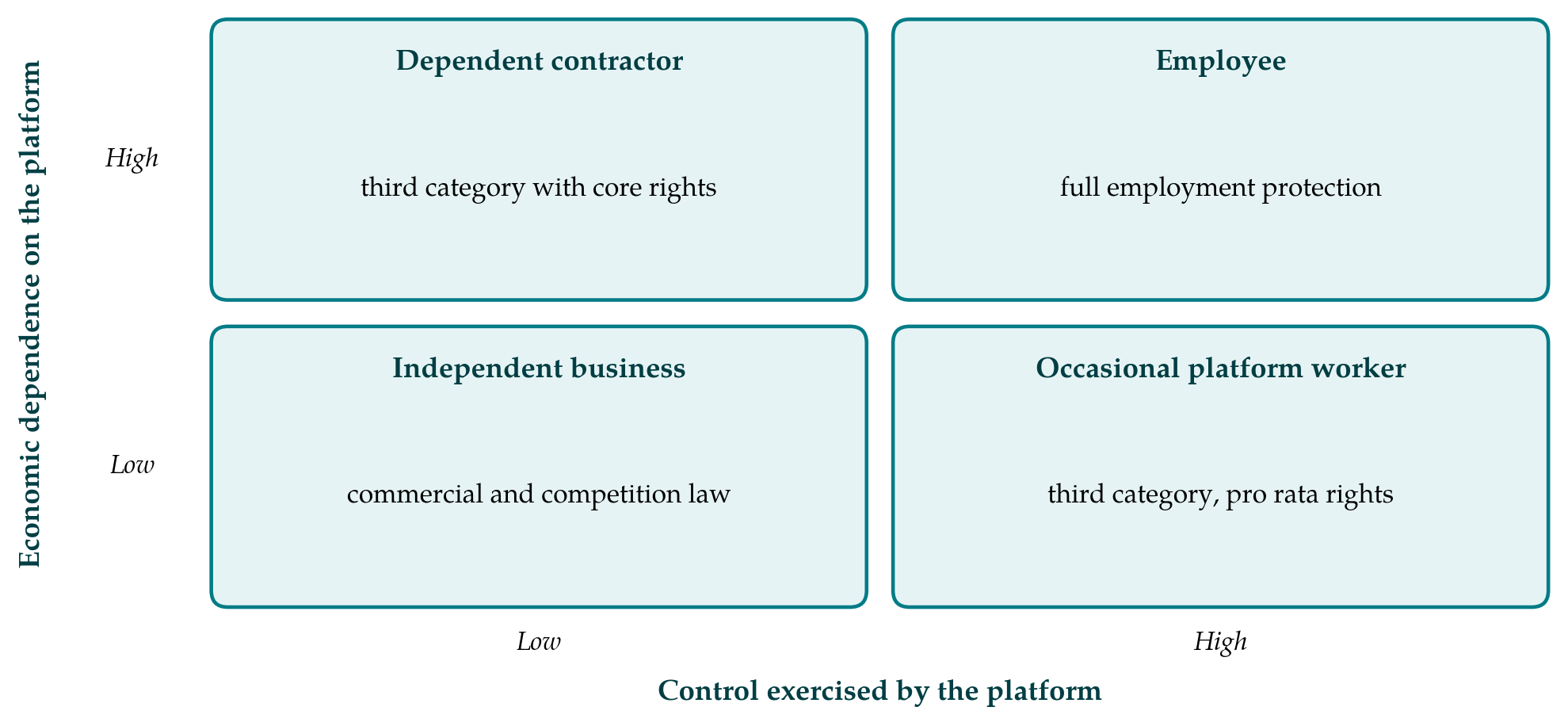
The proposal most often cited is that of Harris and Krueger (2015), who suggested an independent worker status for those whose working time cannot be measured because they choose when to log on and may serve several intermediaries at once. Their independent worker would have collective bargaining rights, protection against discrimination and employer contributions to social insurance, but no entitlement to hourly minimum wages or overtime. One need not accept their list to accept their premise, which is that some protections depend on measuring hours and others do not. Todolí-Signes (2017) reached a similar conclusion from a Spanish perspective, arguing for a special employment regulation adapted to the features of platform work.
Intermediate categories are already part of several legal systems, as Table 1 shows. The Canadian dependent contractor dates from a proposal by Arthurs (1965) to give collective bargaining rights to people who were formally self-employed but economically tied to one enterprise. The limb (b) worker in British law receives the minimum wage, paid holidays and protection from discrimination, and it was this status, not full employment, that the Uber drivers won.
| Jurisdiction | Category | Defining criterion | Main protections |
|---|---|---|---|
| United Kingdom | Limb (b) worker | Personal service for another who is not a client or customer | Minimum wage, working time and paid leave, discrimination law |
| Canada | Dependent contractor | Economic dependence on one enterprise | Collective bargaining; reasonable notice of termination |
| Spain | Economically dependent self-employed worker (TRADE) | At least 75 per cent of income from one client | Annual leave, compensation for unjustified termination, collective agreements |
| Germany | Employee-like person | Economic dependence and comparable need for social protection | Statutory leave, collective agreements, access to labour courts |
| Italy | Collaborations organised by the client | Personal, continuous work organised by the principal | Extension of employment protections by statute |
| United States (proposal) | Independent worker Harris and Krueger, 2015 | Hours cannot be attributed to one intermediary | Collective bargaining, civil rights, social insurance contributions |
A third category also suits the direction in which regulation is already moving. The chapter of the Platform Work Directive on algorithmic management, which limits automated monitoring and requires human review of significant decisions, applies to persons performing platform work whatever their contractual status (European Union, 2024). The International Labour Organization has likewise argued that certain protections should reach platform workers irrespective of classification (ILO, 2021). Rights that attach regardless of status are a third category in all but name. It would be better to define that category openly.
4. Objections and Replies
The most forceful objection is arbitrage. Cherry and Aloisi (2017) reviewed the intermediate categories of Canada, Italy, Spain and other systems and found that the Italian quasi-subordinate status in particular became a route for moving ordinary employees into a cheaper form of contract, which the legislature then spent years trying to close. The warning is sound, and it points to a design rule. A third category must be bounded from below as well as from above: it should be the default for anyone who personally performs work through a platform, with the burden on the platform to show genuine independent business, and it must not be available for work that satisfies the ordinary test of employment. The Italian reform of 2015 moved in this direction by extending employment protection to collaborations organised by the client.
A second objection is that three categories mean two boundaries to litigate instead of one (De Stefano, 2016). That is true only if both boundaries are defined by open-textured tests. A presumption that platform workers fall at least within the intermediate category removes the lower boundary from most disputes, and what remains is the question whether a given worker should be treated as a full employee, which is the dispute that exists today.
A third line of criticism holds that purposive interpretation of existing concepts is enough. On this view, courts should ask whether the worker needs the protection in question and classify accordingly (Davidov, 2017), or the law should abandon status and attach rights to all personal work relations (Freedland and Kountouris, 2011). Uber BV v Aslam is offered as proof that the purposive method works. But that judgment reached its result by placing the drivers in an intermediate category that British law happened to have. In systems without one, a purposive court must choose between granting everything, including protections that presuppose fixed hours, and granting nothing. Rogers (2016) is right that the basic question is who holds power over whom. A third category is a way of giving a legal answer to that question when the power is real but takes an unfamiliar form.
5. Design Conditions and Implications
Three conditions follow from the argument. The first is the presumption already described, which echoes the indicators of the International Labour Organization's Employment Relationship Recommendation (ILO, 2006) while reversing the burden. The second is a floor of rights selected by purpose: freedom of association and collective bargaining, protection from discrimination, insurance against work accidents, transparency and human review of automated decisions including deactivation, and a minimum rate for time spent on an accepted task. The third is public enforcement. Individual status litigation has been the weak point of the binary model, and a new category that could be claimed only through the same route would inherit the weakness. Labour inspectorates and collective actors need standing to enforce the floor.
For legislators the implication is that the choice is not between protecting platform workers as employees and leaving them unprotected. Intermediate arrangements are already emerging through ballot measures, sectoral statutes and status-neutral rights. The question is whether they will be designed in public with workers' interests in view or negotiated piecemeal.
6. Conclusion
The tests that divide employees from the self-employed were made for a world in which control and dependence arrived together. Platform work separates them, and a decade of litigation has shown that the tests cannot put them back. A third category, defined by presumption, equipped with a floor of rights that does not depend on counting hours, and enforced collectively, would give platform workers protection that is quicker to obtain and harder to design around. The risks its critics identify are real and are reasons for careful drafting. They are not reasons to keep relying on tests that no longer fit the work.
Conflict of interest
To be declared by the author(s) before publication.
Funding
To be declared by the author(s) before publication.