1. Introduction
The milling of olives yields oil as a minor fraction by mass and leaves the rest as waste. In three-phase mills the residues are a solid pomace and a large volume of olive mill wastewater; in two-phase mills they are combined in a wet pomace. Both are acidic, high in organic matter and inhibitory to plants and microorganisms, and their management has long been an environmental concern in Mediterranean producing regions (Roig et al., 2006). The same residues hold by far the larger share of the fruit's phenolic compounds, because these are more soluble in water than in oil. Hydroxytyrosol, tyrosol, oleuropein and its aglycones, verbascoside and several phenolic acids are the main constituents, and their antioxidant and antimicrobial activity has been documented extensively (Obied et al., 2005).
Recovering these compounds would turn part of a liability into a product. The established solvents for the purpose are aqueous alcohols and ethyl acetate, which are volatile and flammable and, in the case of methanol, toxic. Deep eutectic solvents have been put forward as an alternative. This communication does not present extraction data. It comments on what is known about these solvents that bears on the olive mill application and on the questions that remain open.
2. What Deep Eutectic Solvents Are
The term was introduced by Abbott et al. (2003) for a mixture of choline chloride and urea, two solids that form a liquid at room temperature when combined in a molar ratio of one to two. The depression of the melting point is attributed to hydrogen bonding between the halide anion and the donor. Many combinations of quaternary ammonium salts with amides, polyols and carboxylic acids behave similarly, and their properties have been reviewed in detail (Smith et al., 2014). Choi et al. (2011) observed that mixtures of common plant metabolites, such as sugars, organic acids, amino acids and choline, form liquids of the same kind and suggested that they occur in living cells. These natural deep eutectic solvents were then characterised as extraction media (Dai et al., 2013).
A caution on terminology is in order. Martins et al. (2019) point out that any two-component mixture has a eutectic point and argue that the word deep should be kept for systems whose melting temperature lies well below that predicted for an ideal mixture. Many liquids described as deep eutectic solvents in the extraction literature have not been tested against that criterion, and some contain enough water to be better regarded as concentrated aqueous solutions.
3. Why They Suit Olive Phenolics
The properties of these solvents cut both ways for an extraction process. Table 1 sets out the main ones with the consequence of each and the usual means of dealing with it. The first row accounts for the appeal of these liquids for olive residues, and the remaining rows lead to the questions taken up in the next section.
| Property | Consequence for extraction | Usual response |
|---|---|---|
| Extensive hydrogen bonding | High solubility of polar phenolics | Choose the donor to match the target compounds |
| High viscosity | Slow mass transfer; difficult filtration and pumping | Add water; raise temperature; apply ultrasound or microwaves |
| Negligible vapour pressure | No solvent loss to air; solvent cannot be evaporated from the extract | Recover solutes by adsorption, antisolvent or back-extraction |
| Acidity of acid-based mixtures | May hydrolyse oleuropein and other glycosides | Control temperature and time; verify the phenolic profile |
| Hygroscopic nature | Composition drifts as water is absorbed | Fix and monitor the water content |
| Components often food grade | Possibility of using the extract without solvent removal | Assess the safety of the mixture, not only its parts |
Olive phenolics carry several hydroxyl groups and, in the secoiridoids, ester and glycosidic functions. They are good hydrogen-bond donors and acceptors, and a solvent built from a dense network of hydrogen bonds accommodates them readily. The literature on phenolic extraction with these solvents, surveyed by Ruesgas-Ramón et al. (2017), reports extraction efficiencies comparable with or greater than those of aqueous alcohols for a range of plant materials. For olive products specifically, García et al. (2016) applied choline chloride-based solvents to the phenolics of virgin olive oil, and Chanioti and Tzia (2018) combined natural deep eutectic solvents with microwave, ultrasound, homogenisation and high-pressure assistance for olive pomace.
4. Open Questions
Viscosity and water. Most deep eutectic solvents are far more viscous than water or ethanol at room temperature, which slows diffusion into the plant matrix and complicates every later handling step. The standard remedy is to add water. Dai et al. (2015) showed that moderate dilution lowers viscosity sharply while the hydrogen-bonded structure persists, but that beyond roughly half water by volume the structure is lost and the liquid behaves as an aqueous solution of its components. Olive mill wastewater and wet pomace bring their own water, so the composition of the solvent in the extractor is not that of the solvent as prepared. Reports that do not state the water content at the point of extraction are difficult to interpret or reproduce.
Getting the phenolics out. A volatile solvent is removed by evaporation. A deep eutectic solvent is not, and the phenolics remain dissolved in a viscous, non-volatile liquid. Figure 1 shows the loop that a complete process would have to close. The options are adsorption on a macroporous resin followed by elution with ethanol, precipitation by an antisolvent, and back-extraction into a second liquid. Each reintroduces a conventional solvent or generates an aqueous stream, and each has a recovery of its own that multiplies with the extraction yield. Alternatively the extract may be used as it is, as an ingredient in which the solvent stays in the product, and that is possible only where every component is acceptable in the intended food, feed or cosmetic use.
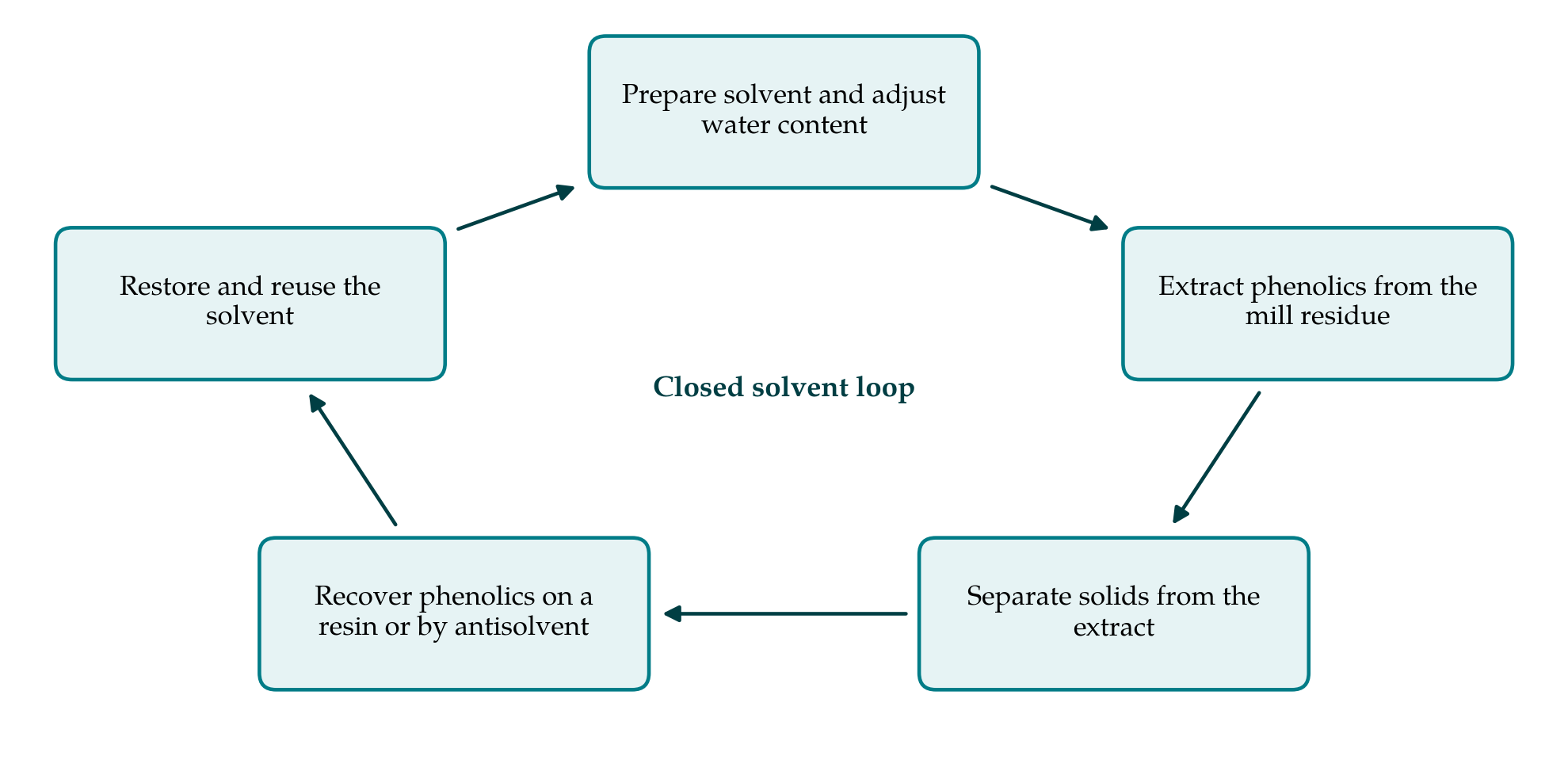
Stability and reuse. Claims of sustainability assume that the solvent is recycled. Recycling requires that the mixture keep its composition through repeated contact with a wet, acidic, sugar- and salt-containing residue. Carboxylic acid donors can esterify with choline or with polyols on heating, and sugars can degrade. Co-extracted sugars, salts and organic acids from the olive residue accumulate in the solvent unless they are purged. Studies that follow solvent composition and extraction performance over many cycles would be needed to settle the matter.
How green. The components of the common mixtures are individually of low toxicity, but Hayyan et al. (2013) asked whether that could be assumed for the mixtures themselves and reported that a mixture may behave differently from its separate components in toxicity tests. A fair comparison with aqueous ethanol, which is renewable, cheap and easily recovered by distillation, would also count the energy and materials used in solute recovery and solvent regeneration. A comparison of that kind has seldom been made for olive residues.
5. Implications for Analytical Work
Two points concern the analyst directly. Total phenolic content measured with the Folin-Ciocalteu reagent is the usual figure of merit in this literature, yet the reagent responds to reducing substances in general, and solvent components such as organic acids and sugars may contribute to the reading. Reported yields should therefore be supported by chromatographic determination of individual phenolics, with calibration prepared in the solvent matrix. Injection of a viscous, salt-rich extract into a liquid chromatograph also calls for dilution and for attention to peak distortion and to suppression of ionisation where mass spectrometric detection is used.
6. Conclusion
Deep eutectic solvents dissolve olive phenolics effectively, and their low volatility and simple preparation are real advantages. Whether they improve on aqueous ethanol for the valorisation of olive mill waste depends less on extraction yield than on the steps that follow it: separation of the phenolics, regeneration of the solvent and the fate of the water the residue brings with it. Work that reports the whole cycle, with stated water contents and compound-specific analysis, would allow the proposal to be judged on its merits.
Conflict of interest
To be declared by the author(s) before publication.
Funding
To be declared by the author(s) before publication.