1. Introduction
Total knee arthroplasty relieves pain and restores function for most patients with end-stage arthritis, yet a consistent minority are not satisfied with the result. In a large Canadian cohort, about one patient in five reported dissatisfaction after a technically uncomplicated primary knee replacement (Bourne et al., 2010). That figure has become the standard justification for almost every innovation in the field, from new implant designs to computer navigation, patient-specific instruments and, most recently, robotic assistance.
Robots are not new to the knee. Autonomous systems were used for knee replacement in Europe around the turn of the century (Siebert et al., 2002), but their adoption stalled. The current generation differs in concept: most are semi-active systems in which the surgeon moves a saw or burr that the robot constrains within haptic or software-defined boundaries, guided by a plan built on a computed tomography scan or on intraoperative mapping of the bone surface (Jacofsky and Allen, 2016). Their uptake has been rapid, and in some health systems it has outpaced the publication of comparative outcome data.
A department weighing the purchase of such a system faces three linked questions. What alignment should the robot be asked to deliver? How long does it take a surgeon and a theatre team to become proficient, and what happens to patients in the meantime? And does the technology pay for itself? This review takes the three in turn.
2. Scope and Approach
The article is a narrative review of the published literature on robotic-assisted total knee arthroplasty, read alongside the older and larger literature on alignment. It draws on randomised trials, cohort studies, cadaveric accuracy studies, systematic reviews and economic analyses. No formal systematic search or meta-analysis was performed. The focus is on primary total knee replacement; unicompartmental and revision surgery are mentioned only where they inform the argument. Individual commercial systems are not compared with one another, since most studies concern a single platform and differences between platforms are confounded by differences between the centres that use them.
3. Alignment Philosophy
For some four decades the dominant doctrine held that the components should be placed perpendicular to the mechanical axes of the femur and tibia, giving a neutral hip-knee-ankle axis and a joint line at right angles to it, with ligament releases used to balance the gaps (Insall et al., 1985). A contemporary alternative, the anatomical technique, also aimed at a neutral limb but kept the slight obliquity of the natural joint line (Hungerford and Krackow, 1985). The mechanical approach prevailed because it was reproducible with simple instruments and because early series associated varus malalignment with loosening.
3.1. The challenge to neutral alignment
Two lines of evidence unsettled this consensus. The first questioned whether neutral is normal. Bellemans et al. (2012) showed that a substantial proportion of healthy adults, particularly men, have a native limb alignment in several degrees of varus, which they termed constitutional varus. Later work classified the wide range of native coronal anatomy into phenotypes (Hirschmann et al., 2019) and into the Coronal Plane Alignment of the Knee classification, which combines the overall limb alignment with the obliquity of the joint line (MacDessi et al., 2021). Forcing every such knee to neutral necessarily changes its anatomy and may require soft tissue release.
The second line questioned whether neutral matters for survival. In a long-term series of modern cemented implants, Parratte et al. (2010) found that knees outside the conventional target of neutral plus or minus three degrees survived as well as those within it. Other large series reached a less permissive conclusion, linking tibial varus and overall malalignment to failure (Ritter et al., 2011). The two findings are not contradictory. They suggest that the limb axis alone is a crude predictor and that the orientation of the individual components, especially the tibia, deserves separate attention.
3.2. Kinematic, restricted and functional alignment
Kinematic alignment, developed by Howell and colleagues, aims to resurface the knee so that the prearthritic joint lines and axes of motion are restored, placing the components according to the patient's own anatomy and avoiding ligament release (Howell et al., 2013). Randomised trials comparing it with mechanical alignment have given mixed results: one reported better function and pain scores at two years with kinematic alignment (Dossett et al., 2014), another found no difference (Young et al., 2017). None has shown it to be worse over the short term. Long-term survivorship in knees with marked native deformity remains the main uncertainty.
Concern about reproducing extreme anatomy led to restricted kinematic alignment, in which the native anatomy is restored only within predefined limits for the limb axis and for each component (Almaawi et al., 2017). Functional alignment goes a step further in its dependence on technology. It begins from a plan and then adjusts component position in three dimensions, within limits, until the measured gaps and soft tissue tension are balanced, so that bone cuts do the work formerly done by releases (Chang et al., 2021). The range of options is summarised in the systematic review by Rivière et al. (2017) and in Figure 1, which orders them from the most systematic to the most individual.
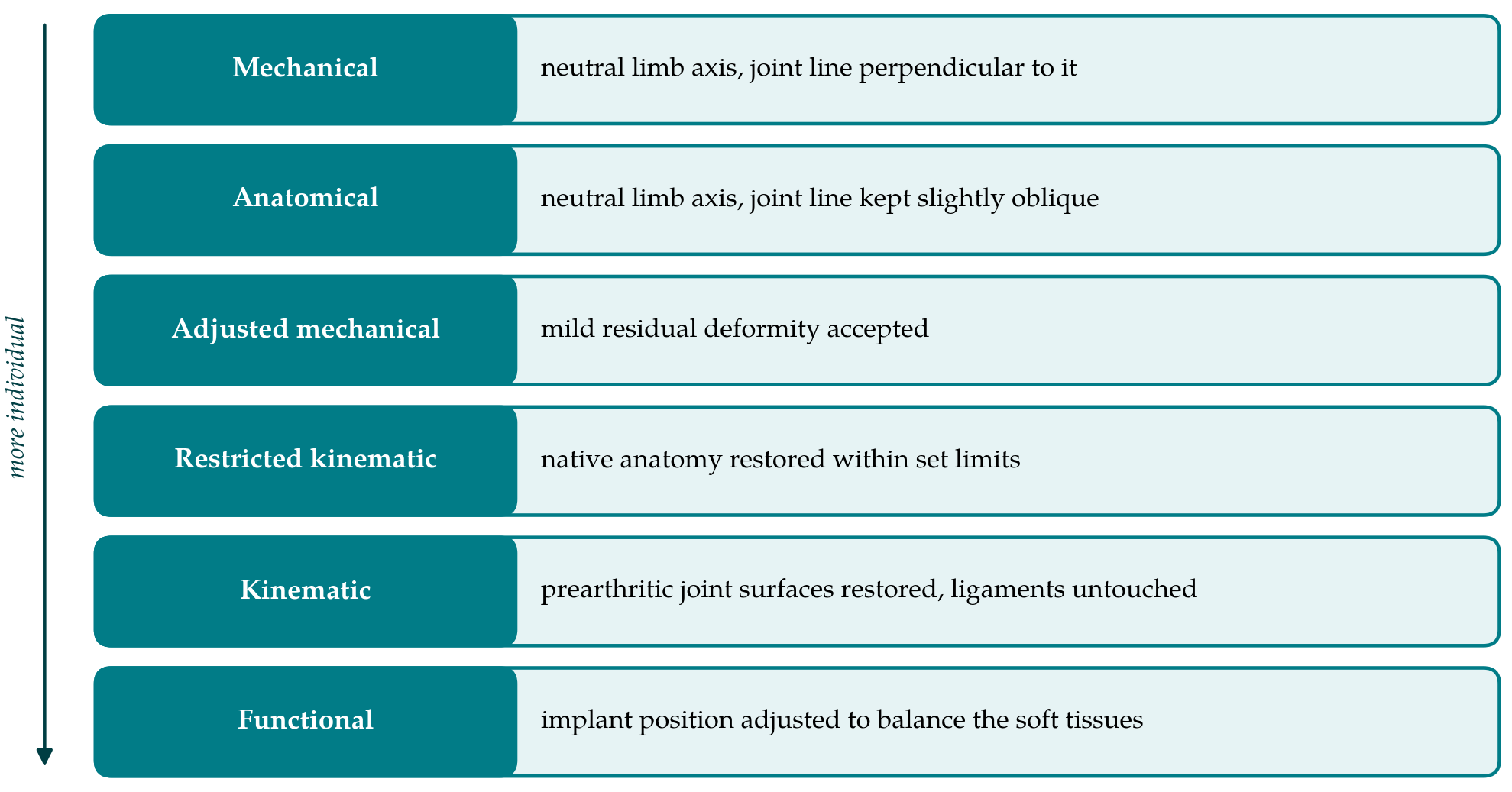
The relevance of this debate to robotics is direct. A mechanical target can be reached tolerably well with conventional jigs. Individualised targets ask the surgeon to place components a degree or two from a patient-specific plan and to quantify soft tissue balance while doing so, and that is hard to do reliably by eye. Robotic and navigated systems are therefore less a rival to the alignment debate than the means by which its newer answers can be delivered and tested (Oussedik et al., 2020).
4. What Robotic Assistance Adds
The best supported claim for robotic assistance is accuracy. Randomised and comparative studies with earlier and current systems have reported fewer outliers in mechanical axis and component position and better gap balance than with conventional instruments (Song et al., 2013; Liow et al., 2014), and a cadaveric study found that robotic-arm assisted bone cuts and final component positions matched the plan more closely than manual cuts (Hampp et al., 2019). This finding is consistent across platforms and is not seriously disputed.
Claims for clinical benefit rest on weaker ground. A prospective cohort study reported less early postoperative pain, earlier functional recovery and shorter hospital stay with a robotic-arm system than with conventional jig-based surgery (Kayani et al., 2018). These are short-term differences from a non-randomised comparison. The longest randomised follow-up available, using an earlier autonomous system, found no difference in functional scores, aseptic loosening or survivorship at a minimum of ten years, and concluded that the added cost was not justified by the outcomes (Kim et al., 2020). Results with an older platform and a mechanical target cannot simply be carried over to current systems used for individualised alignment, but they set the burden of proof where it belongs. Table 1 summarises the state of the evidence by domain.
| Domain | What the literature supports | What remains uncertain |
|---|---|---|
| Accuracy of bone cuts | Closer to plan, fewer alignment outliers Hampp et al., 2019 | Size of the accuracy gain that is clinically meaningful |
| Soft tissue balance | Gaps can be quantified and adjusted before cutting Song et al., 2013 | Which balance target gives the best function |
| Early recovery | Less early pain and shorter stay in cohort studies Kayani et al., 2018 | Whether this holds in randomised comparisons |
| Function and satisfaction | No consistent difference at mid-term follow-up | Effect when combined with individualised alignment |
| Implant survival | No difference at ten years with an early system Kim et al., 2020 | Long-term survival with current systems |
| Learning curve | Operative time improves over early cases Kayani et al., 2019 | Team, as distinct from surgeon, learning |
| Cost | Higher capital and per-case cost | Whether downstream savings offset it |
5. The Learning Curve
A new technology imposes a learning period on the surgeon, the scrub team and the theatre as a whole. For robotic knee replacement the published studies point in a consistent direction. Operative time is longer in the first cases and then falls towards the surgeon's conventional time. One study of a robotic-arm system placed the inflection point for operative time and for the surgical team's reported anxiety within the first handful of cases, and found no learning effect at all for the accuracy of implant positioning or limb alignment (Kayani et al., 2019). Others describe a longer run of cases before operative times match those of manual surgery (Sodhi et al., 2018). The common thread is that what improves with experience is the efficiency of the workflow, while the accuracy of the bone cuts is supplied by the system from the first case.
Three qualifications apply. Learning curve studies come largely from high-volume arthroplasty surgeons, and the curve for a surgeon performing few knee replacements a year is unknown. Operative time is the easiest endpoint to measure but not the most important: pin-site complications, registration errors and the judgement to abandon the robot when the workflow fails are rarely reported. And the studies address learning to execute a plan, not learning to choose one. A surgeon who adopts functional alignment at the same time as the robot is learning two things at once, and the second has no agreed endpoint.
6. Cost
The costs of robotic assistance are concrete. They include the purchase or lease of the system, a service contract, single-use items for each case, preoperative computed tomography for image-based platforms with its radiation dose, and additional theatre time during the learning period. Spread over a high annual volume the capital element per case falls sharply, which is why the economics look quite different in a large elective centre and in a small unit.
The claimed savings are less certain. An analysis of episode-of-care costs in an insured population in the United States reported lower ninety-day costs after robotic-arm assisted surgery, driven by shorter stays, less use of post-acute facilities and fewer readmissions (Cool et al., 2019). Such findings depend on the payment system in which they were observed and on non-randomised comparison, and several of the published economic studies have had industry involvement. Over the long term the case for cost-effectiveness depends on a reduction in revision surgery, and the only long-term randomised evidence does not show one (Kim et al., 2020). Any business case that assumes a lower revision rate is therefore modelling a hope and should say so.
Cost also has a distributional side. If robotic systems improve outcomes, their concentration in well-funded centres will widen differences in care; if they do not, the money is spent at the expense of interventions with better evidence. Either way the question deserves formal health technology assessment and not only a procurement decision.
7. Gaps and Future Work
The central gap is the missing link between accuracy and outcome. Trials have mostly compared robotic with conventional surgery while both aimed at the same mechanical target, a design that tests the tool in the setting where it has least to offer. The more informative comparison is between alignment strategies delivered with the same robotic precision, stratified by the patient's native knee phenotype (MacDessi et al., 2021), with patient-reported function as the primary outcome and follow-up long enough to detect differences in loosening and wear.
Joint registries can supply what trials cannot: survivorship in large numbers of unselected patients, provided they record whether a robot was used and which alignment target was intended. Learning curve research should move beyond operative time to complications and to low-volume surgeons. Economic evaluations should be independent of manufacturers, adopt the perspective of the health system and state explicitly the revision rates they assume.
8. Conclusion
Robotic assistance makes bone preparation in total knee arthroplasty more accurate and gives the surgeon a means of measuring and adjusting soft tissue balance before committing to a cut. Those are real gains in control. They coincide with a period in which the profession no longer agrees on what the knee should be aligned to, and the robot cannot settle that question; it can only make the competing answers testable. The learning curve for operative time is short in experienced hands and does not appear to compromise accuracy. The cost is substantial and certain, and the offsetting savings are neither. Until trials and registries connect precision to better function or longer implant survival, robotic knee replacement is best regarded as a precise instrument whose clinical value is still being established.
Conflict of interest
To be declared by the author(s) before publication.
Funding
To be declared by the author(s) before publication.