1. Introduction
After the financial crisis of 2007 to 2009, British policy makers concluded that institutional shareholders had failed to restrain the banks they owned. The review of bank governance led by Sir David Walker recommended that the principles of engagement then maintained by an investor body be given official standing (Walker, 2009). The Financial Reporting Council issued the UK Stewardship Code in 2010 (Financial Reporting Council, 2010). Japan adopted a code in 2014 (Financial Services Agency, 2014), and the model has since been taken up across Asia, Europe and beyond (Katelouzou and Puchniak, 2022). The European Union placed a similar expectation in legislation, requiring institutional investors and asset managers to publish an engagement policy or explain why they have not (European Union, 2017).
The premise of all these instruments is that institutional investors are capable of acting as engaged owners and need only to be asked. This article takes the opposite view. Investors behaved as they did before the codes for reasons that the codes do not alter, and a decade and more of experience has produced more stewardship reporting without clear evidence of more stewardship. The argument is set out in three parts: the incentives of the industry, the weakness of the enforcement model, and the mismatch between the codes and the ownership structures of most markets. The objections are then considered.
2. What the Codes Ask
The original UK code contained seven principles. Signatories were to disclose a policy on how they would discharge their stewardship responsibilities, manage conflicts of interest, monitor investee companies, set out when they would escalate their activity, be willing to act with other investors, have a voting policy and report periodically on what they had done (Financial Reporting Council, 2010). The code applied on a comply-or-explain basis, and signing it was voluntary for most. Nothing in it required an investor to spend a particular amount, to hold shares for a particular time, or to achieve a result.
Two official reviews reached discouraging conclusions about its effect. The Kay Review described an equity investment chain crowded with intermediaries whose incentives favoured short-term trading over engagement (Kay, 2012). The independent review of the Financial Reporting Council recommended that the code be refocused on outcomes and effectiveness and that serious consideration be given to abolishing it if that could not be achieved (Kingman, 2018). The regulator responded with a substantially revised code that asks signatories to report on activities and outcomes and assesses their reports before listing them (Financial Reporting Council, 2019).
3. Incentives That Exhortation Does Not Reach
The economic case against expecting much from institutional investors is older than the codes. A shareholder who spends resources on improving a company bears the whole cost and receives a share of the gain in proportion to its holding; the remainder goes to other shareholders who spent nothing (Grossman and Hart, 1980). Only a holder with a large stake has reason to act. The diversified institution, by construction, holds a small part of each of many companies. Hirschman's (1970) choice between exit and voice is, for such an investor, weighted towards exit, and Coffee (1991) observed long ago that investors who prize liquidity will not accept the commitments that control requires.
Asset managers add a second layer of agency. They are paid a percentage of assets under management and compete for mandates on performance relative to a benchmark and on price. Engagement that raises the value of a company raises the benchmark as well, so it does nothing for relative performance, and its cost falls on the manager who undertakes it. Bebchuk et al. (2017) set out these incentives formally and conclude that investment managers will tend to underinvest in stewardship and to side with corporate managers more than their beneficiaries would wish. For index funds, which cannot sell and compete almost wholly on fees, the incentive to spend on any one company is weaker still (Bebchuk and Hirst, 2019).
Conflicts of interest reinforce the pattern. Large asset management groups sell pension administration, insurance and banking services to the companies whose shares they hold. A code can require a policy on conflicts. It cannot remove the commercial reason for avoiding a public quarrel with a client. Gilson and Gordon (2013) describe the resulting stance as rational reticence: institutions will vote on proposals that others put to them and will not originate proposals themselves. That description fits the conduct observed before the codes and after them.
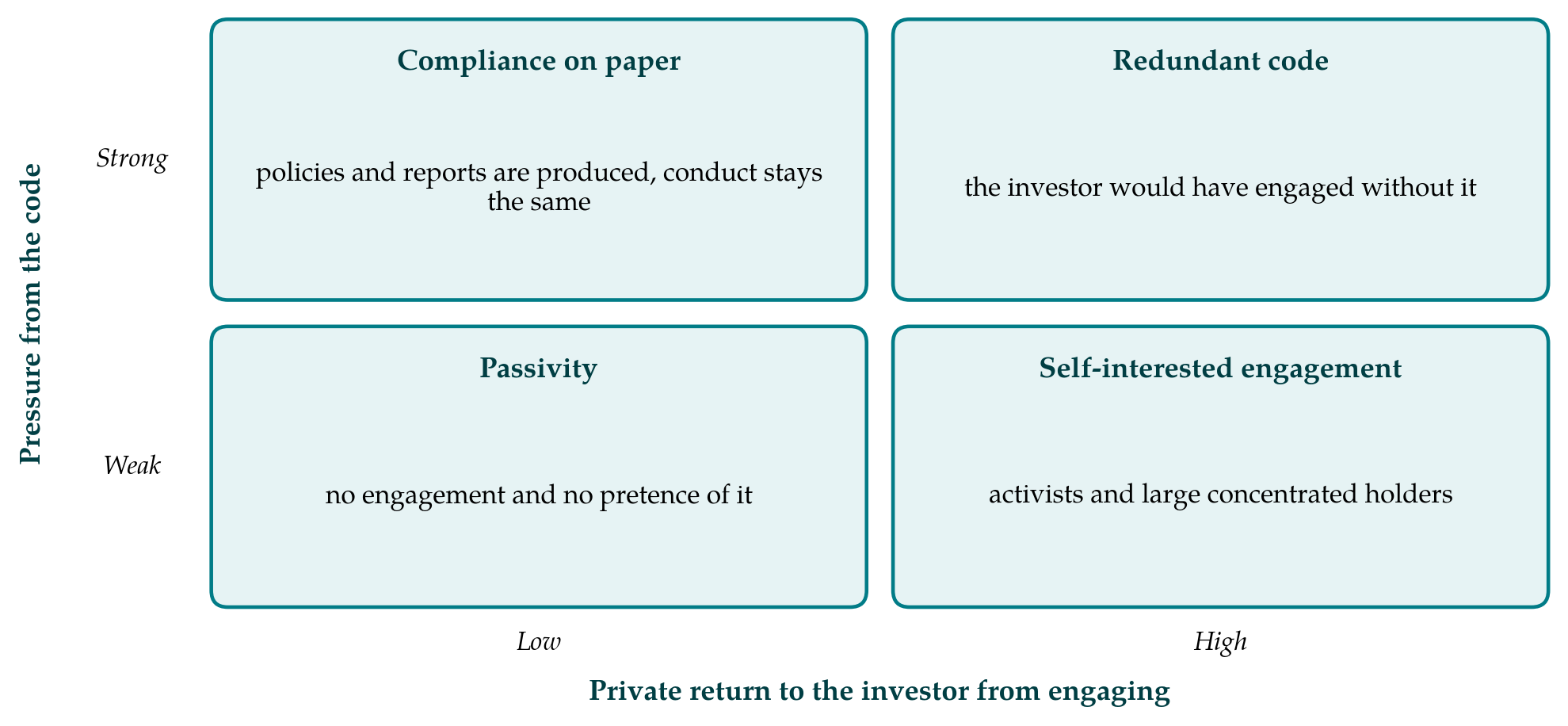
Figure 1 sets the private return from engagement against the pressure a code can apply. Where the private return is high, as for an activist fund or a holder with a concentrated stake, engagement occurs whether or not a code exists. Where it is low, a strong code obtains documents and a weak one obtains nothing. In no quadrant does the code turn a reluctant investor into an engaged one.
4. A Weak Enforcement Model
Comply-or-explain works in corporate governance because someone reads the explanation. A company that departs from a governance code answers to shareholders who can vote against its directors. A stewardship code turns the device on the shareholders themselves, and the audience for their explanations is diffuse. Beneficiaries of pension funds rarely read stewardship reports. Asset owners that select managers could do so, and this is where discipline would have to come from, but many are small and rely on consultants. The regulator's remaining sanction is to remove a name from a list. Table 1 sets the main features of the codes against the reasons each binds weakly.
| Feature of the code | Intended effect | Why its force is limited |
|---|---|---|
| Voluntary signature | Public commitment to stewardship | Signing is cheap and useful for marketing |
| Comply or explain | Flexibility with accountability | Few beneficiaries read or act on explanations |
| Published policies | Transparency about approach | Policies describe intentions and can be boilerplate |
| Conflict-of-interest policy | Protect beneficiaries | Commercial ties to investee companies remain |
| Collective engagement | Overcome the free-rider problem | Coordination costs; acting-in-concert rules deter |
| Periodic reporting | Evidence of activity | Counts of meetings and votes say little about results |
The predictable response to such a regime is to comply in form. Policies are published, voting records are released and engagement meetings are counted. Whether any of it altered a decision in a boardroom is not something the reports are able to show. Reisberg (2015), reviewing the early years of the UK code, questioned whether it was leading anywhere. The reporting burden falls on every signatory alike, whatever its private reasons for engaging or abstaining, which is the pattern Figure 1 predicts.
5. The Wrong Shareholders in the Wrong Markets
The UK code assumed a market in which domestic institutions held most of the shares. Cheffins (2010) pointed out at its launch that this was no longer true of the United Kingdom: the share of British equities held by domestic pension funds and insurers had fallen sharply, and overseas investors, on whom the code had little hold, had taken their place. The code addressed a shrinking class.
Exported, the model fits worse. In most of the jurisdictions that have adopted codes, listed companies have controlling shareholders, and institutional investors are a minority without the votes to change a board. Comparative research finds that codes modelled on the British text have been adopted in such markets for reasons that have little to do with the governance problem the original was designed to address, including signalling to foreign investors and furthering other policy aims of government (Katelouzou and Puchniak, 2022). A code that urges minority investors to hold controllers to account, while leaving the controller's votes intact, asks for an outcome it gives no means to reach.
6. Objections
Four objections deserve an answer. The first is that institutional investors do engage. A survey of institutional investors found that many use private discussions with management and boards, and that they see exit and voice as complements (McCahery et al., 2016). A study of a large investor's environmental, social and governance engagements with United States companies found that successful engagements were followed by positive abnormal returns (Dimson et al., 2015). None of this is disputed here. The point is that this evidence concerns what investors do for their own reasons, much of it in a country with no official stewardship code. It shows that engagement can pay and does not show that codes cause it.
The second objection is that the 2020 UK code answers the criticism by demanding evidence of outcomes and by having the regulator assess reports. This is a real improvement in what is disclosed. Its limit is that an outcome reported by the investor is still a self-assessment, and attribution is hard: companies change for many reasons, and several investors may claim the same result. A more demanding report raises the cost of signing without raising the return to engaging.
The third is that collective action solves the free-rider problem, and the codes encourage it. Collective engagement does happen, but it requires an organiser who bears the cost, and rules on acting in concert and on inside information make some investors wary. The fourth objection is that codes change norms slowly, and that a judgement after a decade or so is premature. That may prove correct. Norms shift most readily, though, when they run with incentives, and the fee pressure on asset managers has grown over the period, not eased.
7. Implications
If the analysis is right, effort spent refining the wording of codes is misdirected. Three other directions look more promising. The first is the asset owner. Pension funds and insurers set the terms on which managers are hired, and a mandate that specifies stewardship resources, pays for them and reviews them changes the manager's calculation in a way that a public code cannot. Regulation of trustees' duties is therefore a better lever than regulation of managers' reports.
The second is information that outsiders can check, in place of narrative. Vote-by-vote disclosure with reasons, and disclosure of the resources devoted to stewardship relative to assets, allow comparison between managers. The third is realism about who will monitor. Where specialised investors with concentrated stakes are willing to do the work of developing proposals, the useful role for diversified institutions is to judge those proposals well, as Gilson and Gordon (2013) argue. In controlled markets, minority protection through independent director elections and related-party transaction rules will do more than any appeal to stewardship.
8. Conclusion
Stewardship codes rest on a diagnosis that institutional investors were inattentive owners and a prescription that they be asked to attend. The diagnosis was fair. The prescription overlooks why the inattention arose. Free-riding, fee competition, relative performance measurement and commercial conflicts make limited engagement the sensible course for most institutions, and a voluntary code enforced by reporting adds little to the other side of the scale. The codes have produced a reporting practice and a vocabulary. Changing conduct will require changing what investors are paid to do, and that depends on those who hire them.
Conflict of interest
To be declared by the author(s) before publication.
Funding
To be declared by the author(s) before publication.