1. Introduction
Every aesthetic surgeon learns early that the choice of patient matters as much as the choice of operation. The classic teaching, set out by Gorney and Martello (1999), weighs the patient's concern against the size of the deformity and warns against operating where great distress attaches to a minor flaw. Rohrich (1999) put the practical lesson bluntly in an editorial urging surgeons to decline more often. The tradition is sound, and it grew up in a world where a patient's idea of how they ought to look came from mirrors, family, magazines and the occasional film.
That world has gone. A person considering surgery today has usually seen thousands of images of faces and bodies selected, edited and ranked by software designed to hold attention, and has probably edited their own. Clinics advertise on the same platforms, and procedures are discussed there with a fluency that owes little to medical advice. This Perspective argues that selection criteria framed for the earlier setting are no longer adequate, and it offers a view of what should be added.
2. What Has Changed
Four developments bear on the consultation. The first is the edited self-image. Applications that smooth skin, narrow noses and enlarge eyes are in everyday use, and clinicians have described patients who present the filtered version of their own face as the goal of treatment (Rajanala et al., 2018). A filtered image is not bound by anatomy, so it can set a target that surgery cannot reach.
The second is optical. A photograph taken at arm's length enlarges the centre of the face, and Ward et al. (2018) showed by geometric modelling that the nose appears appreciably wider in such images than at a conventional portrait distance. A person who studies their face mainly through a phone is therefore studying a distorted record of it.
The third is promotion. Analysis of plastic surgery hashtags on one major platform found that much of the most prominent content was posted by people who were not qualified plastic surgeons (Dorfman et al., 2018). Surgeons advertise there as well. Montemurro et al. (2015) noted some years ago that patients were arriving with opinions formed online before any medical contact.
The fourth is comparison. The theory of social comparison holds that people judge themselves against others in the absence of objective standards (Festinger, 1954). Image-based platforms supply an unending stream of comparators chosen for their appeal. A systematic review found that use of social networking sites is associated with body image concerns, with photo-based activity most implicated (Holland and Tiggemann, 2016).
3. Why Existing Selection Criteria Fall Short
Conventional psychological screening looks for conditions in which surgery is known to do badly. The clearest is body dysmorphic disorder, defined in the current diagnostic manual by preoccupation with perceived defects that others find slight or cannot see, with repetitive behaviours and significant distress (American Psychiatric Association, 2013). It is found more often among people seeking cosmetic procedures than in the general population (Veale et al., 2016), and those who have it rarely benefit from surgery and may be made worse (Crerand et al., 2006). Reviews of outcome add other warning signs, among them unrealistic expectations, previous unsatisfactory procedures and motives centred on a relationship (Honigman et al., 2004).
These criteria identify a small group who should not be operated on. They say little about the much larger group whose mental health is unremarkable but whose request has been shaped by the conditions described above. For such a patient the traditional questions return reassuring answers. The concern is real, the proposed change is technically feasible and expectations sound reasonable. What the questions do not reveal is whether the wish is a settled one or a response to recent exposure, whether the target is a human face or an edited image, and whether satisfaction will survive the next shift in fashion. Table 1 sets the conventional questions beside those that the present setting adds.
| Domain | Conventional question | Added question | Aid or source |
|---|---|---|---|
| Motivation | Is the wish the patient's own? | When and where did the wish first arise? | Honigman et al., 2004 |
| Reference image | Is the goal anatomically achievable? | Is the goal a filtered or selfie-distorted image? | Ward et al., 2018 |
| Psychological state | Is there severe psychiatric illness? | Has a body dysmorphic screen been completed? | Dufresne et al., 2001 |
| Information | Have risks been explained? | What has the patient already been told online? | Montemurro et al., 2015 |
| Timing | Is the patient ready to proceed? | Has time for reflection been allowed? | General Medical Council, 2016 |
| Outcome | Was the patient satisfied? | Was a validated baseline measure recorded? | Klassen et al., 2010 |
4. A Proposal for Selection
The argument of this article is that the surgeon should take an interest in the history of the request and not only its content. Four changes follow, none of which requires new technology.
First, the consultation should include direct questions about the origin and stability of the wish: how long it has been held, what prompted the appointment, which images the patient has in mind and where they came from. A patient who produces an edited photograph should be shown, kindly and concretely, how it differs from what tissue can do, and a patient troubled by their appearance in self-portraits should have the optics explained. These conversations often resolve the request without an operation, which is a good outcome.
Second, screening for body dysmorphic disorder should be routine and not reserved for patients who seem odd. Short questionnaires developed for cosmetic settings exist (Dufresne et al., 2001), take minutes, and catch presentations that a brief conversation misses. A positive screen is a reason for referral to a mental health professional and not a diagnosis made by the surgeon. Figure 1 groups the signals that, on this view, should lead the surgeon to proceed, to pause or to refer.
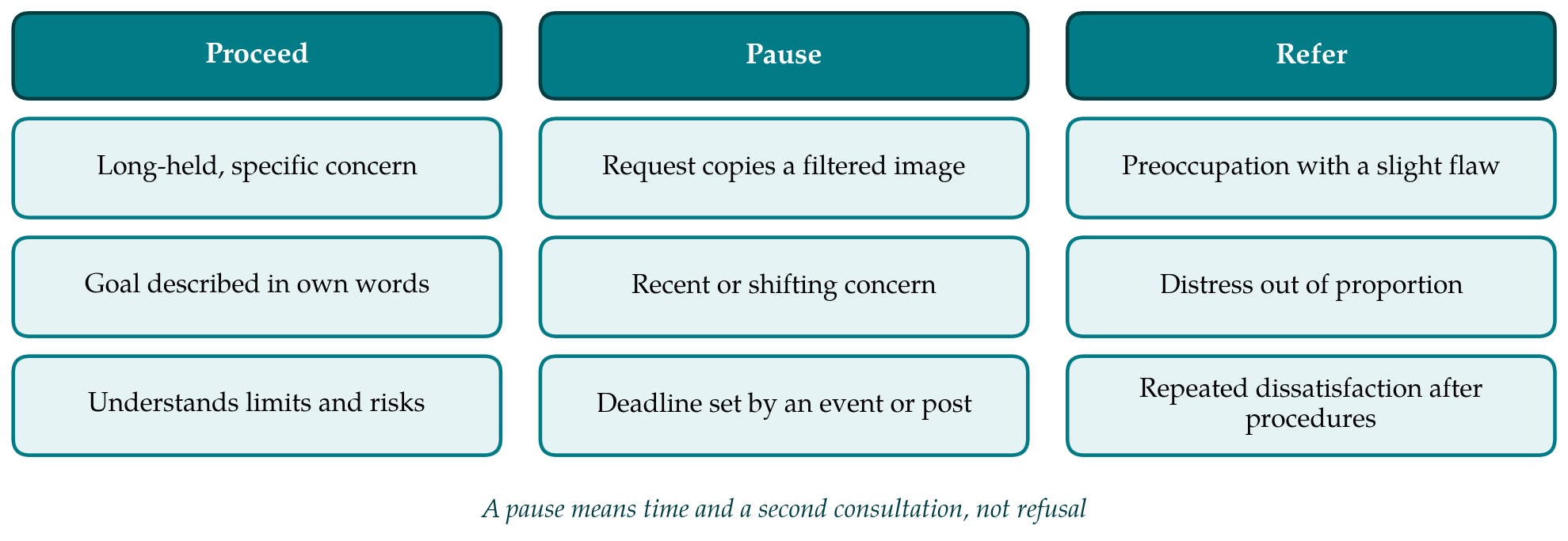
Third, time should be treated as part of selection. Regulatory guidance in the United Kingdom already requires that patients considering cosmetic interventions be given time to reflect before committing (General Medical Council, 2016). A wish formed under the pressure of an event, a trend or a comment online is exactly the kind that a few weeks and a second visit will test.
Fourth, the surgeon's own conduct online belongs to the same ethical account. A practice that posts idealised results, offers time-limited prices or pays for endorsement helps to create the pressures it later claims to assess neutrally. The Nuffield Council on Bioethics made this point about the industry as a whole and called for responsibility on the supply side (Nuffield Council on Bioethics, 2017). Recording a validated patient-reported measure before and after surgery, such as the FACE-Q (Klassen et al., 2010), would let practices learn whether their selection is working.
5. Objections
The strongest objection is from autonomy. Competent adults are entitled to make choices about their bodies for reasons others find poor, and a surgeon who probes the source of a wish may seem to be setting up as judge of which desires are authentic. No desire is formed free of social influence, and the magazine reader of an earlier decade was no more independent than the platform user of this one. The reply is that respect for autonomy, as the standard account has it, requires that a choice be made with understanding and without controlling influence (Beauchamp and Childress, 2019). Helping a patient to see how an image was produced, or to notice that a wish is three weeks old, adds to understanding. It leaves the decision with the patient. The surgeon, for their part, has never been obliged to operate on request.
A second objection is that the evidence is thin. Most research linking social media with body image is cross-sectional and concerns dissatisfaction, not surgical outcome. There is some experimental evidence that viewing images of cosmetically enhanced women increases young women's stated desire for surgery (Walker et al., 2021), but no study has shown that patients whose requests originate online are less satisfied afterward. This is a fair criticism, and it is the reason the proposal is confined to low-cost measures of enquiry, screening and delay. It is also an argument for collecting outcome data, since the question can be answered.
A third objection is practical. A patient asked to wait may go to a provider who asks nothing, and careful practice could then concentrate risk among the least scrupulous. The concern is real where regulation is weak. It argues for common standards across providers, which the Nuffield Council report also called for, and not for the abandonment of standards by those who hold them.
6. Implications
For individual surgeons the implication is a longer first consultation and a willingness to schedule a second. For training, it is that the psychology of appearance, the optics of phone cameras and the mechanics of image editing deserve a place beside anatomy in teaching on patient assessment. For professional bodies, it is that advertising codes and consent standards should be read together, since they govern two ends of one process. For research, the priority is prospective study of whether the origin and duration of a request predict satisfaction, using validated measures and adequate follow-up. Until such studies exist, claims about harm from social media in surgical patients should be made with restraint.
7. Conclusion
Patient selection was designed to protect patients from operations that would not help them and surgeons from results that would satisfy no one. The setting in which patients form their wishes has altered, and selection that ignores it will miss the cases it most needs to find. Asking where a request came from, screening routinely for body dysmorphic disorder, allowing time and practising restraint online are modest steps. They treat the patient as someone whose reasons are worth understanding, which is the opposite of paternalism.
Conflict of interest
To be declared by the author(s) before publication.
Funding
To be declared by the author(s) before publication.