1. Introduction
An engineering consultancy owns little apart from what its people know. Its staff design structures, plant and infrastructure for clients who cannot easily judge the quality of the work, and the firm's reputation rests on a body of experience that is only partly written down. The features that von Nordenflycht (2010) treats as defining a professional service firm, namely high knowledge intensity, low capital intensity and a professionalised workforce, all apply. So does the staffing model typical of such firms, in which a small number of senior engineers supervise the work of a larger number of graduates who are expected to learn the craft as they go.
For most of the profession's history that learning took place in a shared office. Graduates were seated near the people whose work they checked and whose calculations they extended, and a good deal of what they absorbed was never the subject of instruction. Since 2020 many consultancies have adopted hybrid arrangements in which staff divide the week between the office and home, and the days on which a junior and a senior engineer are in the same room have become fewer and less predictable. Firms report that projects are still delivered. The question that concerns this review is a slower one: whether the know-how that used to pass between generations of engineers without anyone arranging it still does so.
The article proceeds from the nature of tacit knowledge in engineering practice, through the channels by which it has moved in co-located offices, to the evidence on what remote and hybrid working does to each channel. It then considers why consultancies are more exposed than other employers and what responses have been proposed, and it ends with the gaps that remain.
2. Scope and Approach
This is a narrative review of the published literature. It does not report a systematic search and makes no claim to completeness. The sources were chosen because they are foundational to the theory of tacit knowledge and situated learning, because they describe engineering and technical work at close quarters, or because they offer the more careful recent evidence on remote and hybrid working. Very little of this research was conducted in engineering consultancies. The review therefore reasons from adjacent settings, chiefly software engineering, information technology services and other knowledge work, and it says so where an inference depends on that step.
3. Tacit Knowledge in Engineering Practice
The term comes from Polanyi (1966), whose summary was that people know more than they can tell. A skilled practitioner attends to the task through a background of particulars that cannot all be brought into focus and stated. Management writing took up the idea through Nonaka (1994) and Nonaka and Takeuchi (1995), who described organisational knowledge creation as a cycle of conversion between tacit and explicit forms and gave the name socialisation to the stage in which tacit knowledge passes directly between people through shared experience. Later authors objected that the word conversion misleads. Tsoukas (2003) argued that tacit knowledge is not explicit knowledge awaiting transcription, and Cook and Brown (1999) distinguished knowledge that is possessed from knowing that is enacted in practice. On either view some of what an experienced practitioner knows is unstated only because nobody has troubled to state it, and some cannot be stated in full at all.
These distinctions matter in engineering. Vincenti (1990) showed from the history of aeronautics that design knowledge includes, beside theory and data, practical considerations and ways of thinking that are learned on the job and seldom codified. Schön (1983) described the designer as holding a reflective conversation with the situation, in which a move is made, its consequences are read and the problem is reframed. In a consultancy the relevant tacit knowledge includes a sense of which load path a contractor will find buildable, which client instruction should be questioned, how much weight a ground investigation report can bear and when a model result is too tidy to be believed. Codes of practice state rules. They do not state when the rules are being stretched.
4. How Tacit Knowledge Has Moved in the Co-located Office
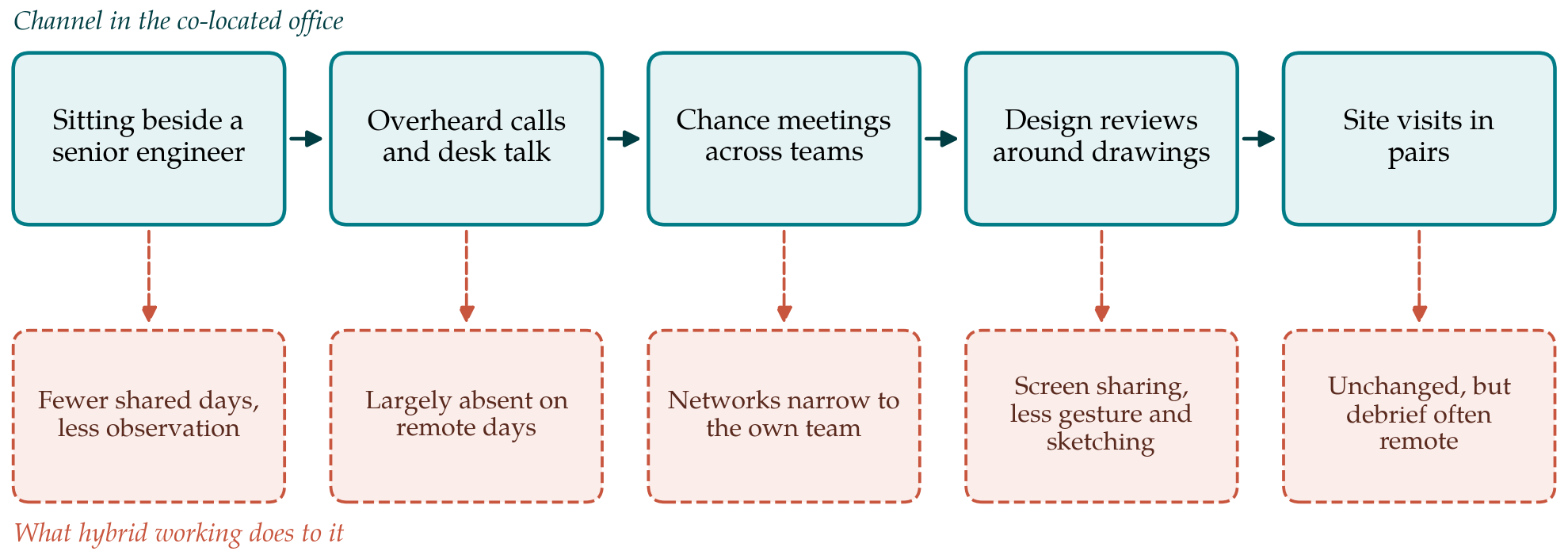
Three channels recur in the literature. Table 1 summarises them, together with a fourth that is specific to engineering, and indicates what the published evidence leads one to expect under hybrid working.
| Channel | How it works | Expected effect of hybrid working | Representative sources |
|---|---|---|---|
| Apprenticeship by proximity | Juniors watch and assist seniors and take on harder tasks by degrees | Fewer shared days reduce observation and prompt correction | Lave and Wenger, 1991; Emanuel et al., 2023 |
| Stories and overheard talk | Problems and their fixes circulate as narrative among practitioners | Little of it survives on remote days | Orr, 1996; Brown and Duguid, 1991 |
| Unplanned encounters | Chance contact links people in different teams and disciplines | Networks become more static and more confined to the team | Allen, 1977; Yang et al., 2022 |
| Reviews around shared artefacts | Drawings and models are argued over with sketching and gesture | Narrower attention and less exploratory talk on video | Brucks and Levav, 2022 |
| Shared context | Colleagues know what others are working on and under what pressures | Context is unevenly held and silence is misread | Cramton, 2001; Olson and Olson, 2000 |
| Joint site and client visits | Juniors see how seniors read a site and handle a client | Visits continue, but the debrief often moves online | Schön, 1983 |
4.1. Apprenticeship and peripheral participation
Lave and Wenger (1991) described learning in a craft as legitimate peripheral participation: the newcomer is admitted to the edge of real work, does simple parts of it, and moves inward as competence and trust grow. Nothing in this account requires a curriculum. It requires access, meaning sight of how the masters work and a part in what they produce. The graduate engineer who checks a senior colleague's calculation, is corrected, and hears why the correction matters is participating in exactly this sense. Tacit knowledge of this kind is drawn out by working together on a concrete task. It is not available on request.
4.2. Stories, overheard talk and communities of practice
Orr (1996) studied photocopier technicians and found that the knowledge which kept the machines running was carried in the stories they told one another about difficult repairs, and that the official documentation was a poor substitute. Brown and Duguid (1991) built on that ethnography to argue that working, learning and innovating are joined in communities of practice whose actual methods differ from the canonical procedures of the organisation. The engineering office has its equivalents: the account of the retaining wall that moved, the remark half heard across the desks that a given software package misbehaves with a given element type. Such talk is not addressed to anyone in particular, which is why a channel that must be opened deliberately does not carry it.
4.3. Unplanned encounters and physical distance
Allen (1977) measured communication in research and development laboratories and showed that the likelihood of regular technical conversation between two engineers falls steeply as the distance between their desks grows. Fayard and Weeks (2007) examined why some shared spaces, such as the photocopier room, generate informal interaction and others do not, and traced it to a combination of proximity, a degree of privacy and a social licence to linger. Hansen (1999) added a finding that bears directly on tacit knowledge: weak ties across units are good for locating useful knowledge, but transferring knowledge that is complex and uncodified needs strong ties, with frequent and close interaction. Szulanski (1996) reached a compatible conclusion from the other direction, finding that the main impediments to transferring practices inside firms were causal ambiguity, the recipient's absorptive capacity and an arduous relationship between source and recipient, and not a lack of motivation.
5. What Remote and Hybrid Working Changes
Figure 1 sets the channels beside the change that the evidence suggests for each. The supporting research falls into three groups: studies of collaboration networks, studies of mentoring and feedback, and studies of what video and text media can carry.
5.1. Collaboration networks
The largest study of the matter is that of Yang et al. (2022), who analysed communication records of employees of a large technology company before and after a firm-wide move to remote work. They found that collaboration networks became more static and more siloed, with fewer ties bridging separate parts of the organisation, and that communication shifted from synchronous to asynchronous media. The authors inferred that acquiring and sharing new information across the network would become harder. This is the pattern that the work of Allen and Hansen would lead one to predict, and it concerns precisely the cross-team ties through which a structural engineer learns what the geotechnical group already knows.
5.2. Mentoring, feedback and the junior engineer
Research on output has been more favourable to remote work than research on learning. Bloom et al. (2015) found in a randomised experiment at a travel agency's call centre that home working raised performance and reduced attrition, although promotion conditional on performance fell. In a later randomised trial of a hybrid schedule among graduate employees of the same company, Bloom et al. (2024) found improved retention and no detectable harm to performance reviews or promotions. Other work points to costs that these measures may register late. Gibbs et al. (2023), using personnel and analytics data from an information technology services firm, reported that working from home was accompanied by longer hours, more time in meetings and less time receiving coaching. Emanuel et al. (2023) studied software engineers and found that those seated near their teammates received more feedback on their code, with the gain concentrated among junior staff and the cost borne in the short-run output of senior staff. The last result states the consultancy's difficulty compactly: mentoring is paid for by the senior engineer today and repaid to the firm years later.
5.3. What the media can carry
Long before the present transition, Olson and Olson (2000) reviewed a decade of studies of distributed work and concluded that distance continued to matter, especially for tightly coupled tasks and for groups without established common ground. Cramton (2001) identified the mutual knowledge problem in dispersed teams: members fail to share contextual information, hold it unevenly and misinterpret silence. More recently Brucks and Levav (2022) showed experimentally that pairs working by video generated fewer creative ideas than pairs in a room, which they attributed to the narrowing of attention to the screen. A design review conducted over a shared screen is a tightly coupled, equivocal task of the kind these authors describe.
6. Why Consultancies Are Particularly Exposed
Several characteristics of the consultancy sharpen the problem. Staff time is charged to projects, so that an hour spent explaining is an hour that must be justified or absorbed, and a hybrid week makes the explaining a scheduled event with a visible cost where it used to be a by-product of sitting together. Work is organised in temporary project teams, which means that the ties a graduate forms are reshuffled with each appointment and that cross-project learning has always depended on the informal office network. Hansen et al. (1999) observed that firms selling customised solutions to unique problems tend to rely on a personalisation strategy, in which knowledge stays with people and is shared through contact, and consultancies in the more bespoke end of engineering fit that description.
There is also a demographic dimension. DeLong (2004) documented the loss of knowledge that occurs when experienced technical staff retire without having passed on what they know, and noted that the loss is seldom visible until a problem arises that only the departed could have recognised. Hybrid working may compound this where the senior engineers closest to retirement are also those who attend the office least. The exposure is delayed by nature. A firm can deliver its current projects on the stock of judgement accumulated before the transition, and the shortfall appears only when the graduates of the hybrid years are asked to exercise judgement of their own.
7. Responses Discussed in the Literature
The responses on offer follow from the diagnosis. If tacit knowledge moves by joint work, then the days in the office should be those on which joint work is done, with juniors and their supervisors attending together and reviews held in person; coordinated attendance matters more than the number of days. If feedback has become costly to seniors, the firm can recognise mentoring in the way it recognises fee earning. If overheard talk has gone, some of it can be reconstructed through open project channels and recorded reviews, although the ethnographic literature warns that documentation of this kind captures the canonical account and misses the working one (Brown and Duguid, 1991). None of these measures has been evaluated in engineering consultancies in the published literature, and they should be read as reasoned proposals.
8. Gaps and Directions for Research
The principal gap is the absence of direct evidence. The strongest studies concern call centres, software development and technology firms, where output is measurable and communication leaves digital traces. Engineering consultancy differs in the length of its feedback cycles, in the physical nature of its subject matter and in its formal routes to professional registration, and findings may not transfer. Longitudinal studies following graduate cohorts who entered before and after the transition, and comparing their progress toward chartered or licensed status and the quality of their reviewed work, would address the question most directly.
A second gap is measurement. Tacit knowledge is by definition hard to observe, and the proxies in use, such as feedback counts or network ties, measure the conditions for transfer and not the transfer itself. A third concerns distribution. The evidence that proximity benefits junior staff most suggests that the costs of hybrid working are unevenly shared, and little is known about how they fall across disciplines, office sizes or staff with different caring responsibilities. Finally, almost nothing has been published on whether the remedies now being adopted, such as anchor days and structured mentoring, restore what was lost or merely restore attendance.
9. Conclusion
The theory of tacit knowledge and the ethnography of technical work agree that judgement is learned by taking part in the work of those who have it. The better recent evidence on remote and hybrid working indicates that it narrows networks, reduces feedback to junior staff and thins the media through which equivocal problems are discussed, while leaving measured output largely unaffected. Put together, these findings support a reasoned expectation that hybrid transitions slow the transfer of tacit knowledge in engineering consultancies and that the effect will surface late. They do not demonstrate it. Until the direct studies are done, firms are best advised to treat co-presence as a scarce resource to be spent on joint work between people at different stages of their careers.
Conflict of interest
To be declared by the author(s) before publication.
Funding
To be declared by the author(s) before publication.