1. Introduction
The textbook division of immunity gives memory to the adaptive arm alone. T and B lymphocytes rearrange their receptor genes, expand as clones when they meet their antigen and leave behind long-lived memory cells; neutrophils, monocytes and macrophages respond quickly through germline-encoded receptors and were long assumed to return to baseline once the stimulus had gone. Vaccines are designed accordingly. Their success is judged by antigen-specific antibody and T cell responses, and an adjuvant is valued for what it does to those responses.
Observations that do not fit this scheme are old. Plants and invertebrates, which have no lymphocytes, resist reinfection better after a first exposure (Kurtz and Franz, 2003). Mackaness (1964) showed that mice recovering from infection with one intracellular bacterium had macrophages with heightened killing capacity against others. In 2011 Netea and colleagues drew such findings together and proposed the term trained immunity for a state of enhanced innate responsiveness that follows a first stimulus and is not specific to it (Netea et al., 2011). The proposal has since been supported by a large experimental literature and has been taken up by vaccinologists, because it suggests that a vaccine might do useful work beyond the antigens it contains.
This review describes the concept, the mechanisms and the clinical evidence, and then asks what follows for the design of vaccines.
2. Scope and Approach
The article is a narrative review of the published literature on trained immunity as it relates to vaccination. It concentrates on mechanistic studies in human cells and volunteers, supported by mouse experiments where these established a point that could not be shown in humans, and on randomised trials and systematic reviews of the non-specific effects of live vaccines. It is selective and does not attempt to list every study. Trained immunity in atherosclerosis, autoinflammatory disease and cancer is touched on only where it bears on vaccine safety or design.
3. From Heterologous Protection to a Defined Concept
The clinical observations came first. Bacille Calmette-Guérin (BCG), a live attenuated strain of Mycobacterium bovis given against tuberculosis, was reported from its early use to reduce infant deaths by more than tuberculosis could explain, and for decades it has been instilled into the bladder to treat superficial bladder cancer, an effect that has nothing to do with mycobacterial antigens (Morales et al., 1976). Epidemiological work in West Africa later revived the question of whether BCG and measles vaccine lower mortality from unrelated infections.
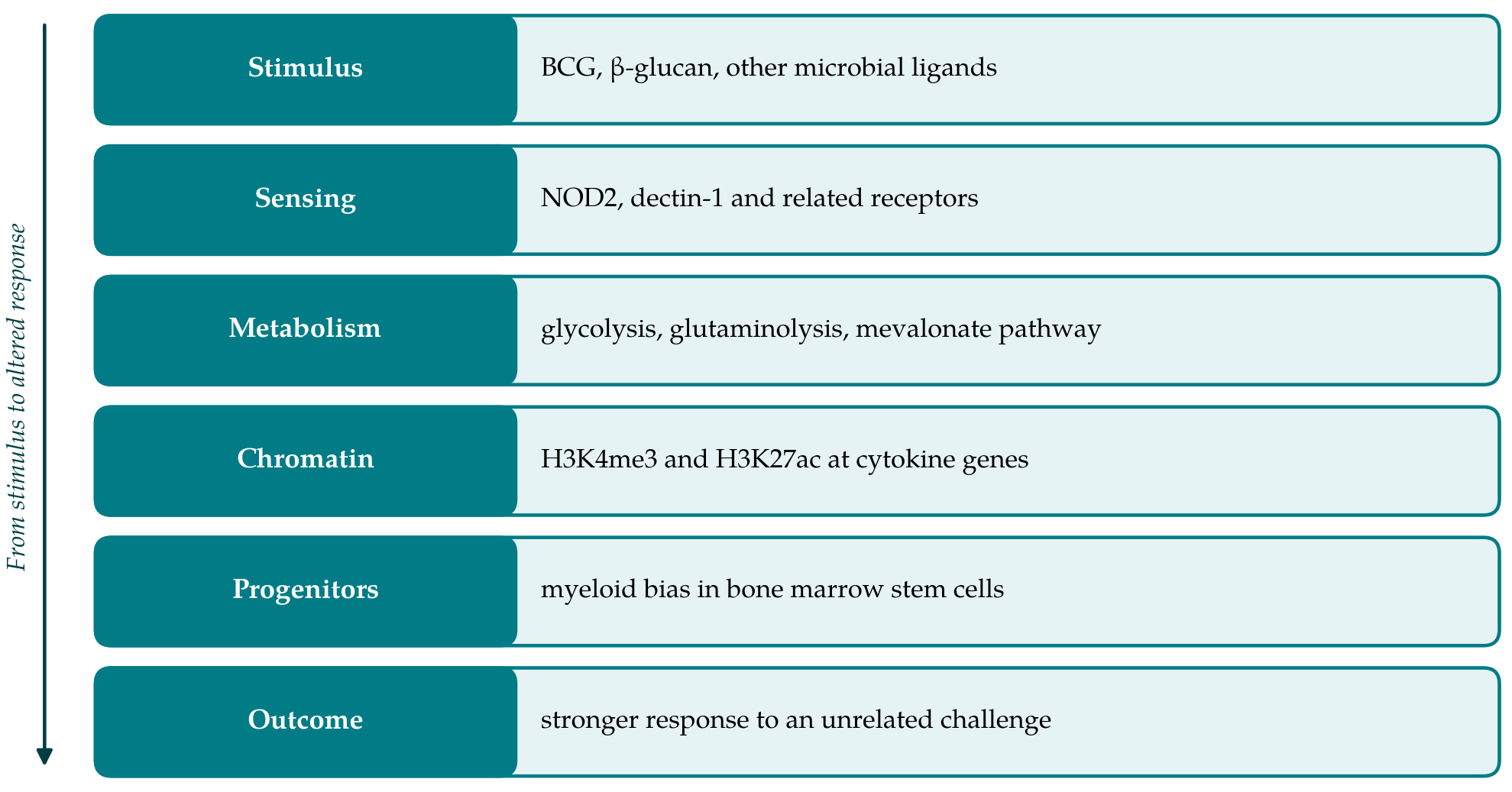
The experimental definition followed. Healthy adults given BCG had monocytes that, for at least three months afterwards, produced more tumour necrosis factor and interleukin-1β when stimulated in the laboratory with unrelated bacteria and fungi; the change was accompanied by increased trimethylation of histone H3 at lysine 4 at the promoters of the corresponding genes, and it depended on the pattern-recognition receptor NOD2. In the same study BCG protected mice lacking T and B cells from a lethal Candida infection (Kleinnijenhuis et al., 2012). A parallel study showed that a low-dose Candida albicans infection, or its cell wall component β-glucan acting through dectin-1, protected lymphocyte-deficient mice against reinfection through reprogrammed monocytes (Quintin et al., 2012). Natural killer cells were shown to expand and persist after cytomegalovirus infection in mice and to respond more strongly on re-exposure (Sun et al., 2009).
It helps to separate trained immunity from neighbouring phenomena. Endotoxin tolerance, in which repeated exposure to lipopolysaccharide silences inflammatory genes through gene-specific chromatin changes, is in a sense its mirror image (Foster et al., 2007). Priming, in which a cell that has not yet returned to rest responds additively to a second signal, and differentiation, in which a cell changes its identity, are different again. A consensus statement has proposed that the term be kept for a lasting functional change, mediated by epigenetic and metabolic rewiring, in cells that have returned to a resting state between the two stimuli (Divangahi et al., 2021).
4. Mechanisms
Three levels of mechanism have been described: changes in chromatin, changes in cellular metabolism that drive them, and changes in bone marrow progenitors that explain how the effect outlasts the short life of a circulating monocyte. Figure 1 arranges them in sequence.
4.1. Epigenetic reprogramming
Genome-wide mapping of human monocytes exposed to β-glucan showed gains of histone marks associated with active promoters and enhancers, H3K4me3, H3K4me1 and H3K27ac, at genes for cytokines and for metabolic enzymes, while monocytes made tolerant with lipopolysaccharide failed to acquire them (Saeed et al., 2014). The marks persist after the stimulus has been removed. A gene left in this open configuration is transcribed faster and more strongly when the cell is next activated. The specificity of training lies here: it is specific to sets of genes, and not to an antigen.
4.2. Metabolic rewiring
Trained monocytes shift from oxidative phosphorylation towards aerobic glycolysis through a pathway involving Akt, mTOR and hypoxia-inducible factor 1α, and blocking that pathway prevents training (Cheng et al., 2014). Metabolism and chromatin are linked through intermediates. Fumarate, which accumulates when glutamine is fed into the tricarboxylic acid cycle, inhibits histone demethylases of the KDM5 family and so preserves H3K4 methylation (Arts et al., 2016). Mevalonate, an intermediate of cholesterol synthesis, induces training through the insulin-like growth factor 1 receptor, and monocytes from patients with mevalonate kinase deficiency, who accumulate it, show a trained phenotype (Bekkering et al., 2018). These findings identify points at which training might be induced or dampened pharmacologically (Mulder et al., 2019).
4.3. Central and tissue-resident training
Monocytes circulate for about a day, yet the trained phenotype in vaccinated volunteers lasts for months. The explanation is that the progenitors are altered. In mice, BCG reaching the bone marrow changed the transcriptional programme of haematopoietic stem cells, biased them towards myeloid output and yielded macrophages better able to control Mycobacterium tuberculosis (Kaufmann et al., 2018). β-glucan had
comparable
effects
on
myeloid
progenitors,
dependent
on
interleukin-1β
and granulocyte-macrophage colony-stimulating factor (Mitroulis et al., 2018). Training can also arise locally: after a respiratory viral infection in mice, alveolar macrophages acquired a long-lasting memory phenotype that required help from T cells in the form of interferon-γ (Yao et al., 2018). That last finding is a reminder that innate and adaptive memory are not separate systems but interacting ones.
5. Clinical Evidence on Non-Specific Effects of Vaccines
Whether these laboratory findings translate into fewer infections in people is the question that matters for vaccine policy, and it has proved contentious. Studies in West Africa have reported lower all-cause mortality after BCG and measles vaccination than the burden of those two diseases could explain, including a randomised trial of BCG at birth in low-birth-weight infants (Aaby et al., 2011). Such studies are open to confounding, because the children who are vaccinated early differ from those who are not. A review commissioned by the World Health Organization judged the evidence for a beneficial non-specific effect of BCG and measles vaccine on mortality to be consistent but of low to very low certainty, and called for randomised trials (Higgins et al., 2016).
Randomised trials have since been run, with results that cut both ways. In older adults in Greece, BCG given at hospital discharge lengthened the time to a new infection, mostly respiratory (Giamarellos-Bourboulis et al., 2020). During the pandemic, several trials asked whether BCG would protect health care workers against coronavirus disease 2019; the largest of them, BRACE, found no reduction (Pittet et al., 2023). The discrepancy may lie in the populations, the BCG strain, the interval before challenge or the outcome measured, and it illustrates how far the field is from being able to predict when training will help. Table 1 sets the main lines of evidence beside one another.
| Line of evidence | Typical observation | What it supports | What it leaves open |
|---|---|---|---|
| Invertebrate and plant studies | Resistance improves without lymphocytes (Kurtz and Franz, 2003) | Innate memory is ancient | Relevance to human vaccines |
| Human volunteer studies | Monocyte cytokine output rises for months (Kleinnijenhuis et al., 2012) | Training occurs in people | Link to clinical protection |
| Mechanistic cell work | Histone marks and glycolysis shift (Saeed et al., 2014) | A molecular basis exists | Which targets are safe to use |
| Progenitor studies | Myeloid bias in marrow stem cells (Kaufmann et al., 2018) | Durability beyond monocyte lifespan | How long the bias lasts in humans |
| Field studies in West Africa | Lower all-cause mortality after live vaccines (Aaby et al., 2011) | A possible population effect | Confounding by who is vaccinated |
| Randomised trials | Benefit in some settings, none in others (Pittet et al., 2023) | Effects are context dependent | Which contexts, and why |
6. What This Means for Vaccine Design
The first implication is about adjuvants. Adjuvant selection has been guided by the antigen-specific response it produces, and the innate stimulation involved has been treated as a means to that end. If some adjuvants also leave myeloid cells and their progenitors reprogrammed, then a vaccine could be formulated to provide a period of broad resistance alongside specific immunity. β-glucans, muramyl dipeptide and other NOD2 ligands are the obvious candidates, and nanoparticle carriers have been used experimentally to direct such agents to myeloid cells and their precursors (Mulder et al., 2019). The corollary is that induction must be measurable: an immunogenicity programme built only on antibody titres will not detect it.
The second is about using live vaccines for their breadth. BCG, oral polio vaccine and measles vaccine are inexpensive, widely licensed and already given to millions. If a defined, time-limited period of heightened innate resistance follows them, they could in principle be deployed at the start of an outbreak of a pathogen for which no specific vaccine exists. The BRACE result shows that this cannot be assumed (Pittet et al., 2023). It would need to be demonstrated for the pathogen, the population and the interval in question.
The third concerns the interaction between the two forms of memory. Trained innate cells present antigen and secrete cytokines, and the quality of that early signal shapes the T cell response that follows, so a vaccine that trains myeloid cells may also change the adaptive response to its own antigens. Heterologous effects of this kind could be exploited, for example in the elderly, whose weak responses to vaccination are partly a failure of innate activation (Netea et al., 2020). They could also work the other way, and the direction has to be established rather than assumed.
7. Unresolved Questions and Risks
Duration is the first unknown. Human studies report altered monocyte function for several months and in some cases a year; how the effect decays, and whether it can be boosted, is not established. Dose and route matter: intravenous BCG protects macaques against tuberculosis far better than the intradermal route, which indicates that where the stimulus is delivered determines which progenitor and tissue compartments are reached (Darrah et al., 2020). Host variation is substantial, with sex, age, genetic background and the microbiome all associated with the size of the response, so that a population average may hide people in whom nothing is induced.
There are risks as well. A state of heightened inflammatory responsiveness is not benign in every setting. Trained immunity has been implicated in the persistent activation of myeloid cells in atherosclerosis (Bekkering et al., 2018), and an induced bias towards myelopoiesis in people with cardiovascular or autoinflammatory disease would need careful study. Live vaccines used for their non-specific effects carry their own contraindications, particularly in immunocompromised recipients. Finally, the field needs agreed assays. Without a standard way to say that an intervention has trained innate cells, and by how much, comparison between trials is guesswork, and the consensus definitions proposed by Divangahi et al. (2021) are only a first step.
8. Conclusion
Trained immunity has made a solid case that innate cells carry a form of memory, that it is written in chromatin and sustained through metabolic rewiring and changes in bone marrow progenitors, and that vaccines already in use can induce it. Translating the idea into vaccine design is at an early stage. The clinical trials so far show benefit in some settings and none in others, and the reasons for the difference are not understood. The practical agenda is clear enough: standard measures of training, studies that pair immunological endpoints with clinical ones, attention to dose and route, and honest assessment of who might be harmed by a more reactive myeloid compartment. If those are addressed, the prospect of vaccines designed for breadth as well as specificity is a reasonable one.
Conflict of interest
To be declared by the author(s) before publication.
Funding
To be declared by the author(s) before publication.