1. Introduction
Tomato, cucumber, lettuce, pepper and the brassica vegetables are harvested as fresh leaves or fruit, often within days of the last spray, and are grown in dense canopies or humid protected structures that suit foliar pathogens well. Botrytis cinerea, the cause of grey mould, attacks more than two hundred host species and is notorious for its capacity to adapt to fungicides (Williamson et al., 2007). Powdery mildews, the leaf spots and blights caused by Alternaria species, and a range of other fungi add to the burden.
Biological control, defined by Cook and Baker (1983) as the reduction of inoculum or disease-producing activity of a pathogen by one or more organisms other than man, has a long history on roots and a shorter and more difficult one on leaves. Andrews (1992) set out the reasons three decades ago: the leaf surface is exposed, short of nutrients and quick to change, and an introduced antagonist must establish there before the pathogen does. Commercial products based on single strains have since reached the market, but inconsistency in the field has remained the standard complaint (Fravel, 2005).
Applying several organisms together is an old proposal for dealing with that inconsistency, and it has gained new momentum from microbiome research, which treats the leaf community and not the single strain as the unit that protects the plant (Massart et al., 2015). This review asks how well the case for phyllosphere consortia is supported, with vegetable crops and their fungal leaf diseases in view.
2. Scope and Approach
The article is a narrative review of the published literature. It draws on reviews and primary studies of leaf-surface microbiology, of the modes of action of foliar biocontrol agents, of experiments and models that combine agents, and of synthetic microbial communities. It was not compiled by a formal database search, and it does not attempt a quantitative synthesis. Because much of the mechanistic work on leaf communities has been done on Arabidopsis thaliana and much of the early work on mixtures on strawberry and other non-vegetable hosts, such studies are included where they establish a principle, and the host is always named.
3. The Leaf Surface as a Habitat
A leaf offers its colonists ultraviolet radiation, rapid swings in temperature and humidity, and a waxy cuticle through which sugars and amino acids leak slowly and unevenly. Bacteria are the most numerous inhabitants, and they live mostly in aggregates at the bases of trichomes, around stomata and along the grooves between epidermal cells, where water and nutrients collect (Lindow and Brandl, 2003). Using bacterial cells engineered to report the sugars they encounter, Leveau and Lindow (2001) showed that nutrient availability differs greatly from one site on a leaf to the next. Competition for nutrients on the leaf is therefore local.
Culture-independent surveys have shown that leaf bacterial communities are dominated by a limited number of groups, among them Methylobacterium, Sphingomonas and Pseudomonas, along with yeasts and filamentous fungi (Vorholt, 2012). On field-grown lettuce the composition of the community changed with season and location (Rastogi et al., 2012). Interactions within the community are structured: in Arabidopsis, a few so-called hub taxa were found to have a disproportionate effect on which other microbes colonised the leaf (Agler et al., 2016).
4. How Phyllosphere Antagonists Suppress Fungal Pathogens
Four broad mechanisms are recognised, and most agents use more than one. Table 1 summarises them and notes what a second or third organism might contribute to each.
| Mechanism | Representative agents | Possible gain from a consortium | Source |
|---|---|---|---|
| Competition for nutrients and space | Yeasts and epiphytic bacteria | Members with different nutrient preferences leave fewer gaps | Lindow and Brandl, 2003 |
| Antibiosis | Bacillus species producing lipopeptides | Several compounds with different targets act together | Ongena and Jacques, 2008 |
| Mycoparasitism | Ampelomyces quisqualis on powdery mildews | Parasite reduces sporulation while a partner blocks new infection | Kiss, 2003 |
| Induced resistance | Trichoderma, Pseudomonas and Bacillus strains | Host defence adds a layer that does not depend on leaf contact | Pieterse et al., 2014 |
| Interference with pathogenicity | Trichoderma harzianum against Botrytis | Slows lesion expansion when infection has already begun | Elad, 2000 |
Competition is the mechanism most particular to the leaf. A necrotroph such as B. cinerea depends on external nutrients, from pollen, senescent petals or wounds, to germinate and penetrate, and an organism that removes those nutrients first can prevent infection without producing any toxin. Antibiosis is best documented for Bacillus species, whose surfactin, iturin and fengycin lipopeptides inhibit fungi directly and, in the case of surfactin and fengycin, can also elicit host defences (Ongena and Jacques, 2008). Mycoparasites attack the pathogen itself; those of the powdery mildews, which grow on the outside of the leaf and are accessible throughout their life, were reviewed by Kiss (2003).
Induced systemic resistance, in which a beneficial microbe primes the plant to respond faster to later attack, has been characterised mainly for root-colonising bacteria and fungi (Pieterse et al., 2014). Work with T. harzianum against grey mould and other greenhouse diseases pointed to induced resistance and, in addition, to interference with the pathogen's hydrolytic enzymes (Elad, 2000). Assigning a mode of action is harder than it looks. Bélanger et al. (2012) showed how often the accepted explanation for an agent turned out to be incomplete once it was examined closely, and Köhl et al. (2019) argued that knowing the mechanism matters for risk assessment and registration as well as for efficacy.
5. From Single Strains to Consortia
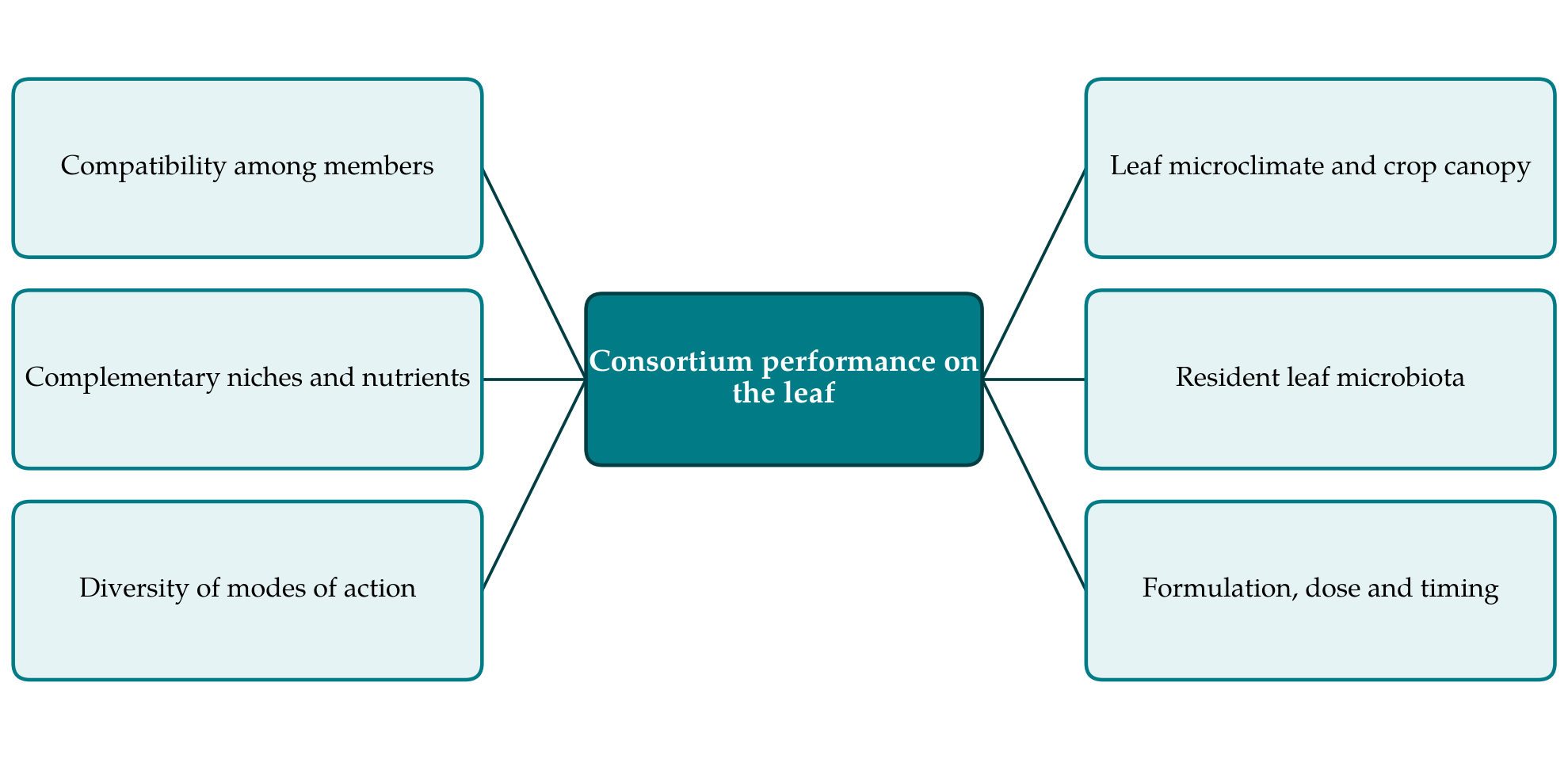
The argument for mixtures rests on two ideas. The first is insurance: organisms differ in the temperature and humidity at which they are active, so that a mixture should keep working across a wider range of conditions. The second is complementarity: agents with different mechanisms should intercept the pathogen at different stages. Figure 1 gathers the factors that the literature identifies as deciding whether these benefits are realised on a leaf.
5.1. Experimental evidence for combinations
The best known test of the insurance idea is the work of Guetsky et al. (2001) on grey mould of strawberry leaves. A yeast and a bacterium, each effective under a different part of the range of temperature and humidity tested, gave more consistent suppression when applied together than either gave alone. A second study from the same group attributed the benefit to the fact that the two organisms relied on different mechanisms, so that conditions unfavourable to one mechanism left the others operating (Guetsky et al., 2002). The gain was in reliability more than in the highest level of control achieved.
Greenhouse vegetables are the setting in which such combinations are easiest to use. Temperature and humidity are partly under the grower's control, the crop is valuable, and biological control of insects is already routine, which favours products compatible with it. Paulitz and Bélanger (2001) reviewed biological control in greenhouse systems and noted both the opportunity and the fact that foliar diseases had proved less tractable than root diseases.
5.2. Limits shown by theory and by surveys of the literature
Enthusiasm for mixtures should be set against the analysis of Xu et al. (2011). Using epidemiological models and a survey of published experiments, they concluded that combinations of biocontrol agents were rarely synergistic; in most reported cases the mixture performed no better than its best member, and antagonism between agents was common. Their models indicated that a combination is most likely to help when its members act by different mechanisms and do not compete with or inhibit each other. The practical lesson is that a consortium has to be designed and tested as a consortium; it cannot be assembled by pooling strains that each did well alone.
6. Designing Consortia From the Leaf Microbiota
A different line of work starts from the observation that the native leaf community already protects the plant. Ritpitakphong et al. (2016) found that the microbiota of Arabidopsis leaves contributed to resistance against B. cinerea, and that the protection could be transferred with the microbes. Reviews of microbiota-mediated disease resistance now treat protection as a property that emerges from the community as a whole (Vannier et al., 2019).
Large culture collections of leaf and root bacteria from Arabidopsis have made it possible to reassemble defined communities on germ-free plants and to add or remove members at will (Bai et al., 2015). A seven-member synthetic community assembled on maize roots illustrates what can be learned: removing one particular member led to the loss of most of the others, identifying it as a keystone (Niu et al., 2017). On tomato leaves, Berg and Koskella (2018) showed that the protection a synthetic phyllosphere community gave against a bacterial pathogen depended on the dose of the community and was lost when the plants were fertilised. That result, although obtained with a bacterial and not a fungal pathogen, is a direct warning that crop nutrition can cancel a microbiome-based effect.
For vegetable pathologists the implication is a change in the order of work. The conventional procedure screens isolates one at a time for antagonism and combines the winners. The community-based procedure asks first which members persist together on the leaf of the crop in question, then which assemblies exclude or suppress the pathogen, and only then which mechanisms are responsible. Hub taxa of the kind described by Agler et al. (2016) are of particular interest, because an organism that shapes the rest of the community may be a better foundation for a consortium than the strongest inhibitor on an agar plate.
7. Formulation, Delivery and Regulation
A consortium that works on a growth-chamber plant still has to be manufactured, stored and sprayed. Each member needs its own fermentation process, and the members must survive in a common formulation without one overgrowing or inhibiting the others. Bacteria that form endospores, such as Bacillus, are far easier to formulate than non-sporing Gram-negative epiphytes or yeasts, which is one reason the commercial market is weighted towards them. Establishment on the leaf after spraying is uncertain for any introduced organism, and repeated application is the rule (Andrews, 1992).
Registration adds a further cost. In most jurisdictions each microbial strain in a plant protection product is assessed as an active substance, so that a product with several strains carries a correspondingly heavier dossier (Köhl et al., 2019). Fravel (2005) identified the expense of development and registration relative to the size of the market as a general brake on biocontrol; consortia multiply it. These considerations favour small consortia of two or three well-characterised members over larger assemblies, whatever the ecological argument for diversity.
8. Gaps and Future Work
Several gaps stand out. Most mechanistic knowledge of leaf communities comes from Arabidopsis, and comparable culture collections and gnotobiotic systems for tomato, cucumber or lettuce are only beginning to be assembled. Experiments on mixtures have usually compared a combination with its components at a single dose, which cannot distinguish a true interaction from a simple dose effect; the designs recommended by Xu et al. (2011) would resolve this. And the interaction between consortia and the conditions of commercial production, including fertiliser regime, cultivar, fungicide programme and the beneficial arthropods already in use, has scarcely been examined.
There is also a question of targets. Powdery mildews are biotrophs that take nothing from the leaf surface and are unlikely to be controlled by nutrient competition, whereas Botrytis and Alternaria depend on it. A consortium designed for one disease will not necessarily serve for another.
9. Conclusion
The case for phyllosphere consortia against fungal leaf diseases of vegetables is sound in principle and only partly supported in practice. Mixtures of organisms with different mechanisms and different environmental tolerances can make control more dependable, and the resident leaf microbiota is known to contribute to plant protection. Against this, combinations chosen without regard to compatibility often do no better than a single good strain, and the costs of production and registration rise with every member added. The most promising route is the deliberate design of small, defined communities whose members are known to coexist on the target crop, tested under the nutrient and climate regimes of real production.
Conflict of interest
To be declared by the author(s) before publication.
Funding
To be declared by the author(s) before publication.