1. Introduction
At a conventional four-leg intersection the paths of vehicles cross, merge and diverge at 32 points, of which 16 are crossing conflicts. A single-lane roundabout reduces the total to eight and has no crossing conflicts at all (Robinson et al., 2000). On urban streets this geometry is valued for capacity and for calming traffic. On rural roads with speed limits of 80 km/h or more its significance is different. A side impact at such speeds is frequently fatal, and the philosophy known as Vision Zero argues that where conflicts of this kind cannot be eliminated, speed must be brought down to a level the human body tolerates (Tingvall and Haworth, 1999). The roundabout does both at once.
Road authorities were nevertheless cautious about using roundabouts on high-speed roads. The design requires a driver travelling at open-road speed to slow to a fraction of it, and a driver who fails to do so meets a raised island. Whether the gain from removing right-angle collisions outweighs this new hazard is an empirical question, and one on which a substantial literature now exists. This review brings that literature together for the specific case of rural, high-speed intersections.
2. Scope and Approach
The review is narrative. It draws on published before-and-after evaluations, cross-sectional crash models, meta-analyses and design guidance known to the field, with emphasis on studies that deal with rural or high-speed sites or report them separately. It does not claim a systematic search, and it reports no new analysis. "High-speed" is used as the source studies use it, generally meaning approach speed limits of about 80 km/h (50 mph) and above. Effects are described in qualitative terms, because estimates differ between studies with the mix of sites and prior control and should be read in the original sources.
3. Why Roundabouts Are Expected to Improve Safety
The expected mechanisms are summarised in Figure 1. The first is geometric: with no crossing movements, the right-angle and opposing left-turn collisions that produce most deaths at rural intersections cannot occur in their usual form, and the collisions that remain are low-angle merges and rear-end impacts. The second is speed. Deflection of the entry path round the central island limits circulating speed to that of a tight curve, so the energy available in any collision is a small part of what it would be at a stop-controlled crossing. The third is the driving task. An entering driver gives way to one stream from one direction, a simpler judgement than selecting a gap in two fast opposing streams, and there is no signal to overlook or run (Rodegerdts et al., 2010).
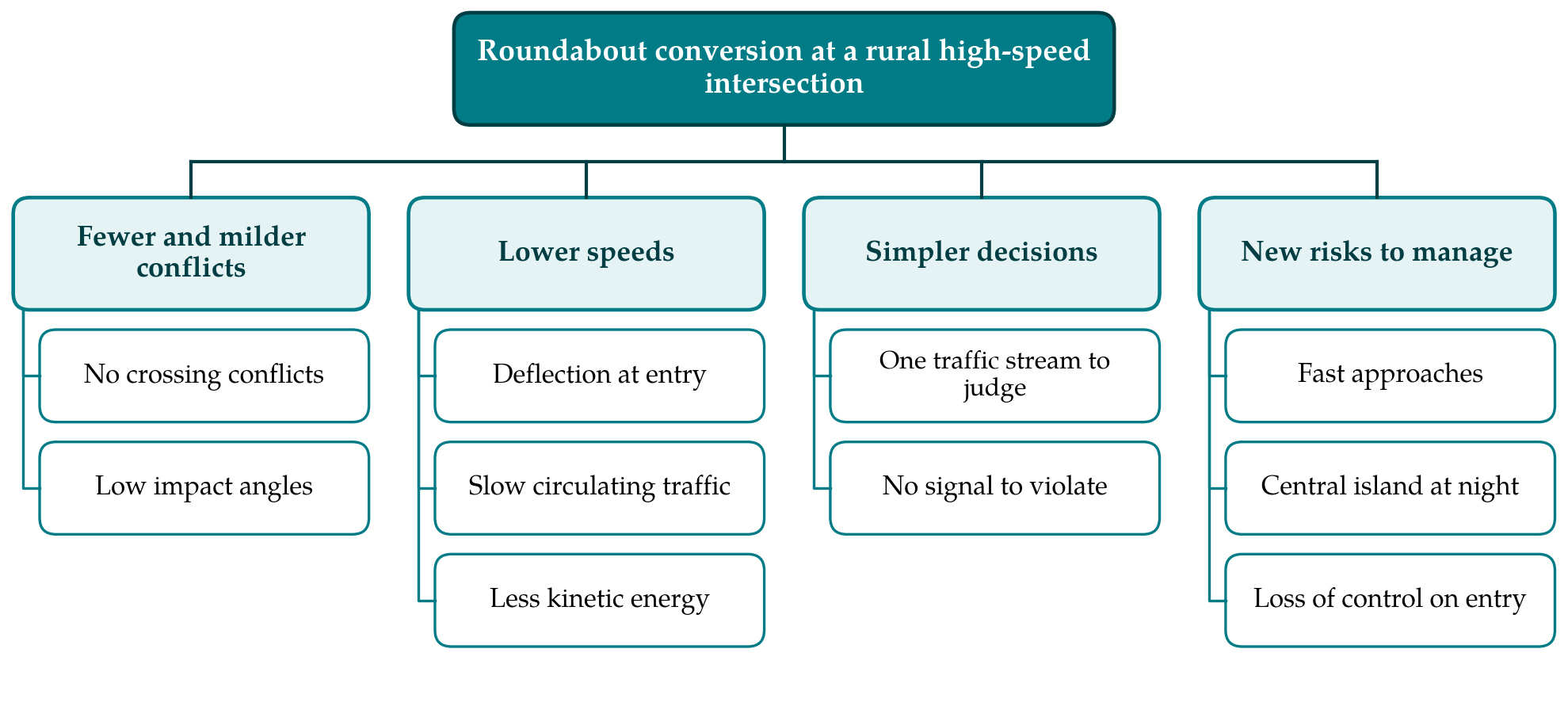
The same figure records the risks the conversion introduces. Approaching traffic must shed a great deal of speed over a short distance, and drivers who are inattentive, impaired or unfamiliar with the road may enter too fast. The relation between entry geometry and crashes was quantified early in British research, which found entry-circulating and single-vehicle crashes to depend on entry path curvature, entry width and approach curvature (Maycock and Hall, 1984). Later work in Flanders, examining why some roundabouts perform worse than others, also found variation linked to traffic exposure and to design features (Daniels et al., 2010).
4. Methodological Issues in Evaluating Conversions
Intersections are usually converted because they have a poor crash record. A site chosen after a run of bad years will tend to have fewer crashes afterwards whether or not anything is done, the phenomenon of regression to the mean, and a simple before-and-after comparison credits that improvement to the treatment. Traffic volumes and general crash trends also change over the study period. Hauer (1997) set out the logic of observational before-and-after studies and the empirical Bayes method, which combines the site's own crash count with the prediction of a safety performance function fitted to similar untreated sites to estimate what would have happened without the conversion (Hauer et al., 2002).
The method is now standard. It underlies the predictive procedures of the AASHTO (2010) manual, including the base models for rural two-lane roads developed earlier (Harwood et al., 2000), and it is the approach recommended for deriving crash modification factors (Gross et al., 2010). Studies that do not control for regression to the mean generally report larger benefits, a pattern documented in the meta-analytic literature (Elvik, 2003). Table 1 lists the principal sources drawn on in this review together with their method, so that their findings can be weighed accordingly.
| Source | Setting | Method | Relevance to rural high-speed sites |
|---|---|---|---|
| Persaud et al. (2001) | United States, urban and rural | Empirical Bayes before-after | Rural stop-controlled conversions reported as a group |
| Rodegerdts et al. (2007) | United States | Empirical Bayes before-after; crash models | Separate estimates by setting and prior control |
| Isebrands (2009) | United States, rural | Before-after crash analysis | Confined to high-speed rural intersections |
| Isebrands and Hallmark (2012) | United States, rural | Statistical before-after models | Rural high-speed roadways; crash prediction |
| De Brabander et al. (2005) | Flanders, Belgium | Before-after with comparison group | Effects reported by speed limit of the roads |
| Elvik (2003) | Studies outside the United States | Meta-analysis | Effect by severity and prior control |
| Elvik (2017) | International | Meta-analysis with meta-regression | Updated summary effects; study quality |
Two further difficulties are particular to rural sites. Fatal crashes at any one intersection are rare events, so that even a dangerous crossing may record none in a study period, and effects on the most severe outcomes can be estimated only by pooling many sites or by using injury crashes as a proxy. Reporting is also uneven by severity: crashes with injury are recorded far more completely than those with damage only, and the threshold for reporting differs between jurisdictions and changes over time. Comparisons of total crash counts between studies are therefore less reliable than comparisons of injury crashes, and the review gives the latter more weight.
5. Evidence on Crash Frequency and Severity
The findings are arranged here by the kind of outcome studied.
5.1. Injury and fatal crashes
The first large evaluation in the United States applied the empirical Bayes method to conversions from stop and signal control and found substantial reductions in all crashes and much larger reductions in injury crashes, with fatal and incapacitating injuries reduced most of all (Persaud et al., 2001; Retting et al., 2001). The national study that followed, with a larger sample, confirmed the direction and showed that the greatest benefits occurred at rural sites previously controlled by stop signs on the minor road (Rodegerdts et al., 2007). These are precisely the high-speed crossings at which severe right-angle crashes concentrate.
Studies restricted to high-speed rural sites give the same picture more directly. Isebrands (2009) examined rural roundabouts on roads with high approach speeds and reported marked falls in injury crashes and the near-disappearance of angle crashes, and a subsequent statistical analysis with crash prediction models supported those results (Isebrands and Hallmark, 2012). European evidence agrees. In Flanders, reductions in injury crashes were found to be greater at intersections on roads with higher speed limits than on lower-speed roads (De Brabander et al., 2005; De Brabander and Vereeck, 2007). Meta-analyses that pool many national studies conclude that the effect grows with severity, being largest for fatal crashes and smaller for slight injuries (Elvik, 2003; Elvik, 2017; Elvik et al., 2009).
5.2. Property-damage and total crashes
The effect on crashes without injury is less clear. Several of the meta-analytic summaries find that property-damage crashes fall little or even rise after conversion, particularly at larger roundabouts with several lanes (Elvik, 2003; Elvik et al., 2009). This is consistent with the mechanism: a roundabout exchanges a small number of violent collisions for a possibly larger number of minor ones. For a rural authority whose concern is death and serious injury the exchange is favourable, but total crash counts are a poor measure of it, and evaluations that report only totals understate the benefit.
5.3. Prior control and comparison with signals
Most rural conversions replace two-way stop control. Where a rural high-speed intersection is already signalised, the alternative to a roundabout is retention of the signal, and the relevant comparison changes. Gross et al. (2013) evaluated conversions from signals and found reductions in injury crashes, though with more variation between sites than for stop-controlled conversions. High-speed signalised intersections carry their own well-known risks of red-light running and of rear-end crashes in the dilemma zone, which a roundabout avoids.
6. The Crashes That Remain and Their Design Implications
Analyses of crash types at existing roundabouts show what a conversion leaves behind. In a study of roundabouts in Maryland, single vehicles running off the road or striking the central island formed a large share of crashes, many of them at night and on higher-speed approaches, and excessive entry speed was the common factor (Mandavilli et al., 2009). The British models had already pointed to approach and entry geometry as the governing variables (Maycock and Hall, 1984).
Design guidance for high-speed approaches follows from these observations. The second edition of the United States guide recommends making the roundabout visible from a distance, extending splitter islands well back along the approach, and, where needed, introducing successive curves that bring speed down in stages before the entry, together with landscaping of the central island that blocks the view through and signals that the road does not continue straight (Rodegerdts et al., 2010). Lighting, advance signing and transverse markings are the usual supplements. The published evaluations seldom isolate the contribution of any one of these measures, and their individual effects on crashes are less well established than the effect of conversion as a whole.
7. Gaps in the Evidence
Four gaps deserve mention. Multilane roundabouts on rural divided highways are less studied than single-lane layouts, and the available evidence suggests smaller benefits and more minor crashes. Heavy vehicles, which form a high proportion of rural traffic, face rollover risk on tight circulating curves, and few evaluations separate them. Pedestrians and cyclists are rare at most rural sites but not absent; research in urban and mixed settings has found that cyclists may not share the benefit that motorists enjoy (Daniels et al., 2008), and the question has hardly been examined at high-speed locations. Finally, most studies follow sites for only a few years. An area-wide urban programme in Sweden was followed up for speed and conflicts as well as crashes (Hydén and Várhelyi, 2000), but whether driver familiarity erodes or reinforces the effect on rural roads over a decade or more is not settled.
There is also a need for evaluations from low- and middle-income countries, where rural intersections are often uncontrolled, vehicle fleets and driver behaviour differ, and the published estimates, drawn mainly from North America, Europe and Australasia, may not transfer directly.
8. Conclusion
The published evidence supports roundabout conversion as one of the most effective treatments available for rural high-speed intersections. Studies using sound before-and-after methods agree that fatal and injury crashes fall sharply, that the benefit is greatest for the most severe outcomes and at formerly stop-controlled crossings, and that the early fear of creating a worse hazard has not been borne out. The residual problem is the driver who arrives too fast, and it is addressed through approach geometry, conspicuity and lighting. Property-damage crashes may not decline, so the case rests on severity. Better evidence on multilane layouts, heavy vehicles, vulnerable users and durability of effect would refine design practice without altering that central finding.
Conflict of interest
To be declared by the author(s) before publication.
Funding
To be declared by the author(s) before publication.