1. Introduction
A reef fishery on the coast of East Africa or Madagascar is not one fishery but several laid over one another. Basket traps, handlines, spearguns, gillnets and beach seines are worked from dugout canoes, outrigger boats and on foot. Octopus and sea cucumber are gleaned at low tide. The catch may contain scores of species and passes through traders at the beach within hours of landing. No fisheries department in the region has the staff to license, inspect and record activity of this kind site by site, and for decades most of it went unmanaged in any effective sense.
Co-management, the sharing of authority and responsibility between government and resource users, was proposed as the remedy (Sen and Nielsen, 1996). It has been adopted widely in the Western Indian Ocean since the late 1990s, and its institutional forms are now written into national law or policy in several countries (Cinner et al., 2012a). The international instrument on small-scale fisheries endorses the same direction (FAO, 2015). Comparative work suggests that such arrangements can improve both livelihoods and the state of the resource (Gutiérrez et al., 2011; Cinner et al., 2012b), although outcomes vary a great deal and the evidence base in developing countries has been judged thin (Evans et al., 2011).
Practical handbooks exist (Pomeroy and Rivera-Guieb, 2006), but they are general and long. This article offers a compact framework aimed at one situation: a fisheries officer, a non-governmental organisation or a community leadership wishing to set up or repair co-management for a single reef fishery in the region. It proposes a sequence of steps and the reasoning for each. It does not describe a particular site and reports no results.
2. Background
The framework draws on three bodies of work: the theory of common-pool resources, the comparative literature on co-management outcomes, and the institutional arrangements already present in the region.
2.1. Theory of the commons
Ostrom (1990) showed from a large set of long-lived cases that communities can govern shared resources without either privatisation or central control, and identified design principles common to the institutions that lasted: clear boundaries, rules matched to local conditions, participation of users in making the rules, monitoring, graduated sanctions, accessible means of resolving conflict, recognition by government of the right to organise, and nesting within larger structures. A later review of a wide body of empirical studies found the principles well supported and proposed refinements (Cox et al., 2010). Ostrom's subsequent framework for analysing social-ecological systems provides a vocabulary for describing a fishery in terms of its resource system, resource units, users and governance (Ostrom, 2009).
2.2. What comparative studies show
The global analysis of co-managed fisheries by Gutiérrez et al. (2011) found that strong community leadership was the attribute most consistently associated with success, followed by individual or community quotas, social cohesion and the presence of protected areas. A study of co-managed coral reef sites across the Indo-Pacific, including East Africa and Madagascar, reported that most resource users perceived benefits, that outcomes were better where institutions conformed to Ostrom's principles, and that benefits tended to favour the better off (Cinner et al., 2012b). The last finding is a warning that a co-management design has to attend to who gains and who loses.
Co-management also changes with time. Berkes (2009) describes it as a process of joint problem-solving in which trust and knowledge build up, and the concept of adaptive co-management links the sharing of power to learning from the results of management (Armitage et al., 2009). Chuenpagdee and Jentoft (2007) argue that much of what determines success happens before formal implementation, in what they call step zero: who had the idea, who was consulted, and whose interests the initiative was seen to serve.
2.3. Arrangements in the region
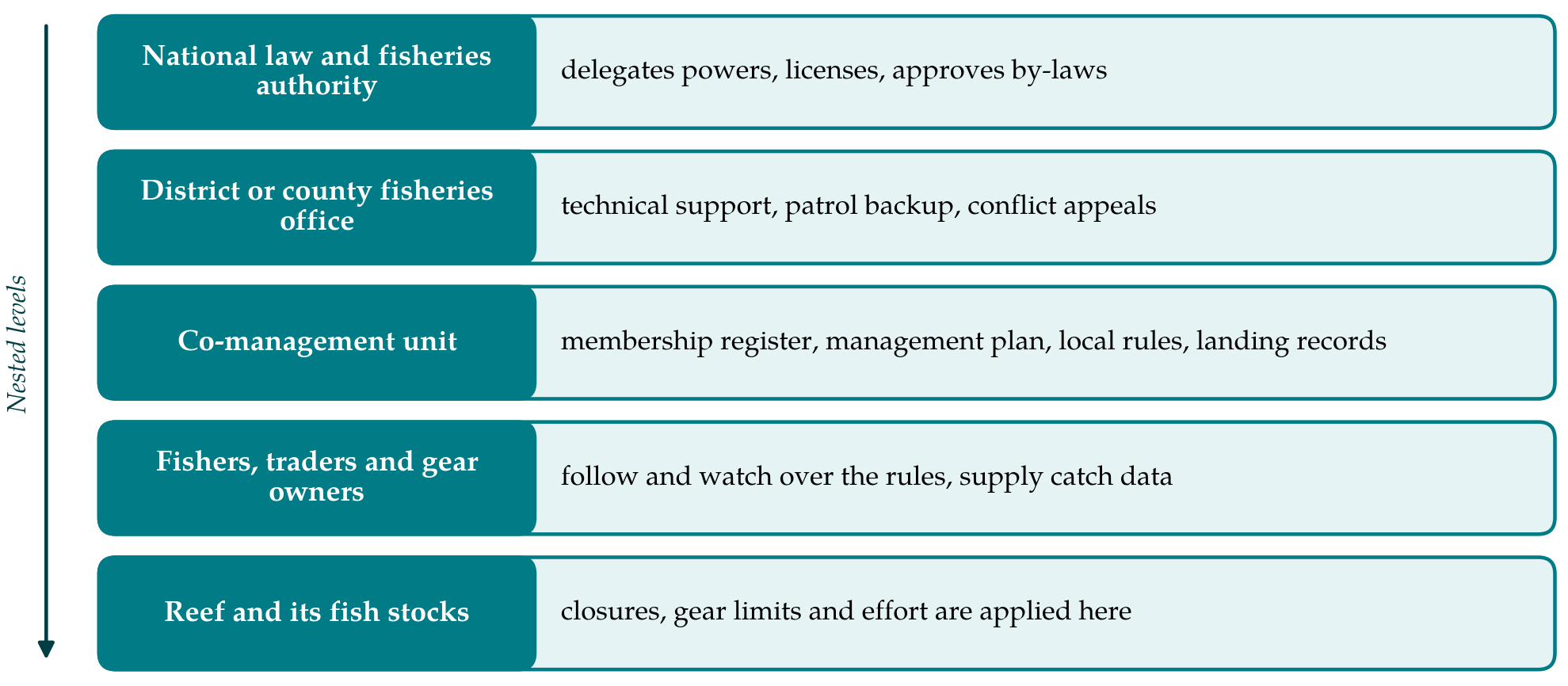
Legal forms differ between countries. Kenya provides for beach management units, associations of fishers, traders and boat owners at a landing site with powers to make by-laws (Republic of Kenya, 2007), and mainland Tanzania has a similar institution. Mozambique recognises community fishing councils. In Madagascar, local rules are commonly given force through dina, customary social conventions that can be ratified by the courts. The comparative accounts of Cinner et al. (2009) and Rocliffe et al. (2014) describe these forms and the rapid spread of locally managed marine areas across the region. The relation between the levels involved is shown in Figure 1.
3. The Proposed Framework
The framework has seven steps, listed in Table 1 with the output expected from each. They are presented in sequence, but the last step returns to the earlier ones, and in a fishery where an arrangement already exists the work may properly begin at step seven.
| Step | Main task | Output |
|---|---|---|
| 1. Establish readiness | Identify who is asking for change, who is affected and who may object | Stakeholder list; agreed convening body |
| 2. Characterise the system | Describe reef, species, gears, users, markets and existing rules | Fishery profile and map of fishing grounds |
| 3. Define unit and standing | Fix boundaries and membership; register under the applicable law | Registered unit; boundary description; member register |
| 4. Select rules | Agree a few rules on gear, areas and seasons that members can observe | Management plan and by-laws |
| 5. Monitor | Record landings, effort and fish lengths; record compliance | Landing-site data sheets; periodic summaries |
| 6. Enforce and resolve | Set graduated sanctions, patrol duties and an appeal route | Sanction schedule; record of cases |
| 7. Review and adapt | Compare indicators with objectives on a fixed cycle; revise rules | Review report; amended plan |
3.1. Step 1: Establish readiness
The first step is to find out whether the conditions for co-management exist at all. Following Chuenpagdee and Jentoft (2007), the questions are who initiated the proposal, what problem they believe it will solve, and whether the fishers concerned share that view. A stakeholder analysis should identify gear groups, migrant fishers, traders, women gleaners and processors, village authorities, tourism operators and the relevant government offices. A convening body acceptable to all of them is agreed before any rule is discussed. If the initiative is seen as belonging to an outside organisation or to one faction, the later steps are unlikely to hold.
3.2. Step 2: Characterise the fishery
A short fishery profile is prepared with the users, organised under the headings of the social-ecological systems framework (Ostrom, 2009). It covers the extent and condition of the reef and adjoining habitats, the main species caught and their broad life-history types, the gears and the number of people using each, seasonal patterns, the destinations of the catch, and the rules already observed, customary as well as statutory. Participatory mapping of fishing grounds is a core output. The purpose is a shared description that every party recognises, and so the profile should be presented back to the community for correction.
3.3. Step 3: Define the unit and its legal standing
Boundaries and membership come next. The area should correspond as nearly as possible to the grounds actually fished from the landing site, and neighbouring communities who fish the same grounds must be party to the agreement or the boundary will be contested. Membership rules need to state how seasonal and migrant fishers are treated. The unit is then constituted under whichever national instrument applies, since recognition by government is what allows local rules to be enforced against outsiders (Ostrom, 1990; Pomeroy and Rivera-Guieb, 2006). The degree of authority delegated, on the spectrum from consultative to cooperative arrangements described by Sen and Nielsen (1996), should be written down explicitly.
3.4. Step 4: Select a small set of rules
The rules chosen should be few, visible and suited to a multispecies fishery in which catch limits are impracticable. Candidates are restrictions on destructive or unselective gears such as beach seines, permanent closed areas, periodic closures, and seasonal or size protection for particular species. Periodic closures for octopus in south-west Madagascar are a well-documented example of a narrowly targeted measure that produced benefits fishers could see soon after the grounds reopened and that has been credited with encouraging broader management (Oliver et al., 2015). A rule of that kind is a sensible first choice, because early visible returns build support for measures whose benefits come more slowly.
3.5. Step 5: Set up participatory monitoring
Monitoring serves the review in step seven and should be designed backwards from it. Trained members of the unit record landings by gear and species group on sampled days, together with the number of fishers and boats active. Length measurements of a few indicator species allow simple indicators to be tracked, such as the proportion of mature fish in the catch (Froese, 2004). Compliance is recorded alongside catch. Data sheets must be simple enough to be kept up without outside funding, and summaries should be reported to members regularly.
3.6. Step 6: Provide for enforcement and dispute resolution
Rules that are not enforced erode the willingness of those who comply. The design principles call for sanctions that begin lightly and increase with repetition, applied by people accountable to the users, and for a cheap and quick way of settling disputes (Ostrom, 1990; Cox et al., 2010). The unit should set out who patrols, what a patrol may do, how an offence is recorded, the schedule of sanctions and the route of appeal to the fisheries office. The point at which a case passes from the unit to the state, as with offenders from outside the community or the use of prohibited gear, should be agreed in advance with the authorities.
3.7. Step 7: Review and adapt
At a fixed interval, annually in most cases, the unit and the fisheries office examine the monitoring summaries against the objectives of the plan and decide whether rules should be kept, changed or dropped. This is the learning element of adaptive co-management (Armitage et al., 2009). The review should also ask the distributional question raised by Cinner et al. (2012b): which groups have borne the costs of the rules and which have received the benefits. Changes are recorded in an amended plan, and the cycle resumes.
4. Fitting the Framework to Practice
Three adjustments are likely to be needed in use. Where a beach management unit or similar body already exists on paper but is inactive, the work starts with a review of why, and steps one and three are revisited before new rules are considered. Where several landing sites share one reef, the units need a joint forum, since a closure observed by one village and fished by another will fail. And where funding comes from a time-limited project, the monitoring and patrol duties should be set from the start at a level the unit can sustain from its own revenue, such as landing fees, after the project ends.
5. Limitations and What Remains to Be Shown
The framework is assembled from published theory and comparative evidence and has not been applied or tested in this article. Its steps are individually well grounded, but their combination and order are a judgement. An evaluation would need to follow sites using the framework and comparable sites that do not, recording indicators of the resource, of fisher income and of compliance from before the intervention, a design that the co-management literature has seldom achieved (Evans et al., 2011).
Some constraints lie outside any local design. Co-management cannot by itself resolve a shortage of alternative livelihoods, pressure from growing coastal populations, or damage to reefs from warming seas. It also depends on the continued willingness of the state to delegate authority and to back local decisions when they are challenged. The framework assumes that willingness; where it is absent, the obstacle is political and not methodological.
6. Conclusion
Reef fisheries of the Western Indian Ocean are too dispersed and too varied to be managed from the centre, and the legal means for sharing management with fishing communities are in place across much of the region. The seven-step framework proposed here is intended to help turn those provisions into working arrangements at single sites, by attending in order to readiness, description, legal standing, rules, monitoring, enforcement and review. It awaits application, and its usefulness should be judged by evidence gathered at the sites where it is tried.
Conflict of interest
To be declared by the author(s) before publication.
Funding
To be declared by the author(s) before publication.