1. Introduction
Textbooks present protein folding as a settled matter with a short history: Anfinsen showed that sequence determines structure, chaperones were later found to help, and computers can now predict the result. Each clause is true, and the summary is still misleading, because it hides how often the field changed its mind about what needed explaining. In the 1960s the puzzle was where the information for the fold came from. In the 1970s it was how the chain found the fold in finite time. In the 1980s it was why cells contained abundant proteins whose apparent job was to assist a process believed to need no assistance. Since the 1990s attention has moved from folding itself to the failure of folding, and from single proteins in dilute buffer to whole proteomes inside living cells.
This review follows those shifts in order. Its purpose is historical and conceptual: to show which ideas were replaced, which were merely qualified, and which arguments from older papers still deserve to be read. Readers who want mechanistic detail on particular chaperone families are referred to the specialist reviews cited along the way.
2. Approach
The account is a narrative review built on landmark primary papers and on a small number of authoritative syntheses. It does not attempt a comprehensive survey of a literature that now runs to many thousands of papers, and no systematic search was carried out. Sources were selected because they introduced a term, an experiment or an argument that later workers treated as a reference point. Selection of this kind favours the famous over the merely correct, and some contributions that mattered at the time are certainly missing.
3. Sequence as the Only Instruction
The modern subject starts with bovine pancreatic ribonuclease. When its four disulfide bonds were reduced and the chain unfolded in urea, the enzyme lost all activity; when the denaturant was removed and the thiols allowed to reoxidise, activity returned (Anfinsen et al., 1961). Because eight cysteines can pair in more than a hundred ways and only one pairing is native, recovery of activity meant that the chain itself selected the right arrangement. Anfinsen later generalised the result as the thermodynamic hypothesis: the native structure of a protein in its normal environment is the one in which the free energy of the whole system is lowest, and is therefore fixed by the amino acid sequence (Anfinsen, 1973).
Two features of this work are often forgotten. The first is that spontaneous reoxidation of ribonuclease was slow, far slower than the appearance of active enzyme in the cell, and Anfinsen's group went looking for a catalyst and found an enzyme that shuffles disulfide bonds. The founding experiments of self-assembly thus already contained a helper protein. The second is that the hypothesis is a statement about equilibrium. It says where the chain ends up and is silent on the route and on the time taken.
4. The Search Problem and the Rise of Pathways
The silence was broken by Levinthal (1968), who pointed out that a chain of even modest length has so many possible conformations that a random search for the lowest-energy one could not finish in the lifetime of the universe, whereas real proteins fold in seconds or less. His own conclusion was that folding must follow a pathway, a defined series of partly structured intermediates that guides the chain. For two decades the experimental programme of the field was the hunt for those intermediates, pursued with stopped-flow kinetics, hydrogen exchange and the trapping of disulfide-bonded species.
The pathway view was challenged from two directions. Small single-domain proteins were found that fold in an apparently two-state manner with no populated intermediate at all. And theorists working with the statistical mechanics of heteropolymers argued that Levinthal's calculation assumed a flat energy surface. If native-like contacts are on average more stable than others, the surface is a funnel: there are many routes downhill, the search is biased from the start, and intermediates are kinetic traps on a rugged slope and not obligatory stations (Bryngelson et al., 1995; Dill and Chan, 1997). The landscape picture did not refute pathways so much as demote them to a special case, and it supplied the language in which misfolding would later be discussed.
5. The Arrival of Chaperones
While physical chemists studied refolding in the test tube, three unrelated lines of biology were accumulating observations that did not fit unassisted self-assembly. They are summarised with the other major shifts in Table 1.
| Period | Prevailing idea | What prompted the change | Key sources |
|---|---|---|---|
| 1960s | Sequence alone specifies the native fold | Refolding of reduced ribonuclease | Anfinsen, 1973 |
| 1970s | Folding follows a defined pathway | The conformational search argument | Levinthal, 1968 |
| 1980s | Some proteins need helpers to assemble | Nucleoplasmin, heat shock proteins, Rubisco binding protein | Ellis, 1987 |
| 1990s | Folding as descent on a funnelled landscape | Two-state folders and polymer theory | Dill and Chan, 1997 |
| 1990s | Chaperonins enclose single chains | Structures of GroEL and its GroES complex | Xu et al., 1997 |
| 2000s | Misfolding is a general hazard | Amyloid formation by unrelated proteins | Dobson, 2003 |
| 2000s onward | Proteome integrity is a regulated network | Ageing and disease models | Balch et al., 2008 |
5.1. Three converging observations
The first line began with Ritossa (1962), who saw new puffs on the polytene chromosomes of Drosophila larvae after a rise in temperature. The proteins made from those loci were identified about a decade later, and the heat shock response turned out to be universal. What the heat shock proteins did remained unclear until Pelham (1986) proposed that the 70 kDa family binds exposed hydrophobic surfaces on damaged or unassembled proteins and releases them using the energy of ATP.
The second line came from the assembly of nucleosomes. Histones and DNA mixed at physiological ionic strength precipitate, yet in Xenopus egg extracts they assemble correctly, and the factor responsible was an acidic protein, nucleoplasmin, that bound histones and handed them to DNA without becoming part of the product. Laskey et al. (1978) called it a molecular chaperone, because it prevented improper liaisons between charged surfaces.
The third line ran through bacteriophage genetics and plant biochemistry. Mutations in the groE genes of Escherichia coli blocked assembly of phage lambda heads (Georgopoulos et al., 1973). In chloroplasts, newly made large subunits of Rubisco were found bound to another abundant protein before they joined the holoenzyme. Sequencing showed that the chloroplast protein and bacterial GroEL were homologues, and the family was named the chaperonins (Hemmingsen et al., 1988).
5.2. A concept that met resistance
Ellis (1987) drew these threads together and extended Laskey's term to a class: proteins that assist the correct non-covalent assembly of other polypeptides without being components of the final structure. The proposal was not welcomed everywhere. To many it seemed to contradict the principle of self-assembly, and the word itself was thought frivolous. The objection rested on a misreading. Chaperones, as Ellis defined them, carry no steric information about the final fold. They act on kinetics, by lowering the chance that a folding chain meets another sticky chain first, and leave the thermodynamic hypothesis untouched.
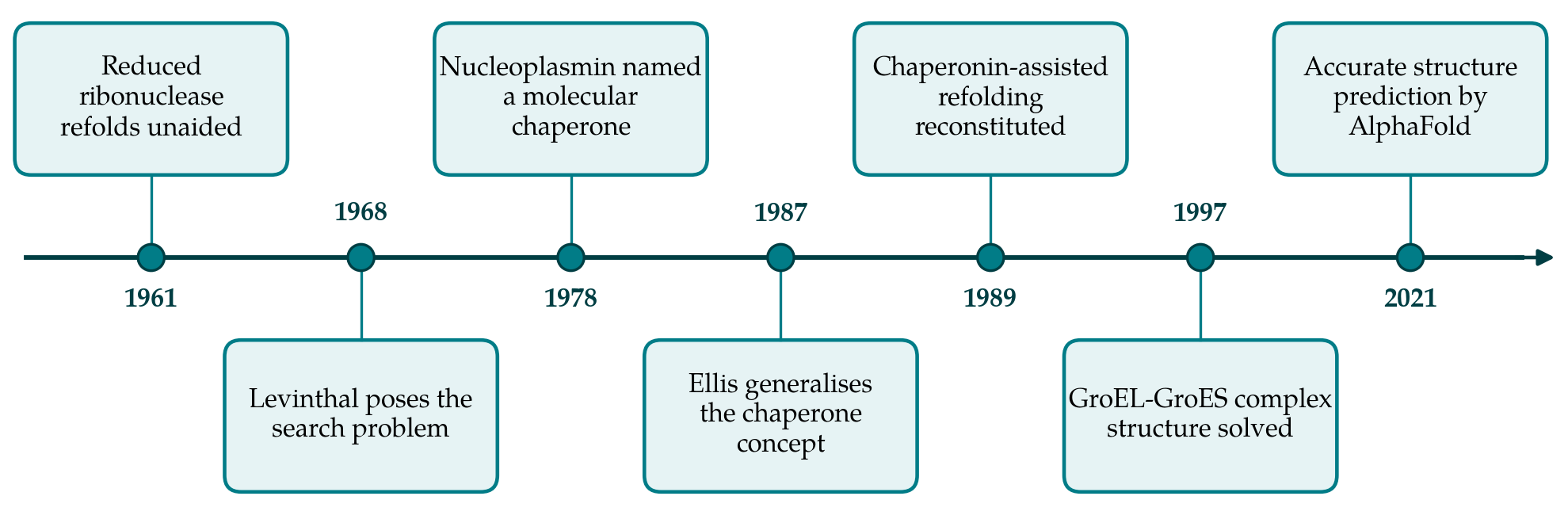
Experiment soon made the point concrete. Proteins imported into yeast mitochondria were found to depend on the matrix chaperonin hsp60, and folding of an imported monomeric protein was shown to occur on hsp60 in a reaction that needed ATP hydrolysis (Ostermann et al., 1989). In the same year bacterial Rubisco was refolded from a denatured state in vitro, with the yield of active enzyme depending on GroEL, GroES and Mg-ATP (Goloubinoff et al., 1989). Figure 1 places these events on a single line with the earlier and later landmarks.
6. Machines and Mechanisms
The 1990s converted the chaperone concept into mechanism. For the chaperonins the decisive results were structural. The crystal structure of GroEL revealed two stacked rings of seven subunits, each ring enclosing a cavity lined at its mouth with hydrophobic residues (Braig et al., 1994). The structure of the complex with GroES and ADP showed that binding of the lid doubles the volume of the cavity and turns its lining hydrophilic (Xu et al., 1997). A substrate chain captured on the hydrophobic rim is thus released into an enclosed, polar chamber where it can fold as a single molecule, shielded from all others, for the duration of one ATPase cycle. The chamber was aptly nicknamed the Anfinsen cage: inside it the chain does what Anfinsen said it would.
The Hsp70 system works without enclosure. An Hsp70 binds short extended hydrophobic segments, its affinity for them is switched by ATP binding and hydrolysis, and the cycle is driven by J-domain co-chaperones and nucleotide exchange factors (Mayer and Bukau, 2005). In the cytosol the two systems operate in series. Nascent chains meet Hsp70 first, and only a minority of proteins, typically those with complex topologies, pass on to the chaperonin (Hartl, 1996).
A further revision concerned aggregates. They had been regarded as dead ends, removable only by proteolysis. Glover and Lindquist (1998) showed that yeast Hsp104, working with Hsp70 and Hsp40, extracts polypeptides from aggregates and returns them to a foldable state. Chaperones could therefore reverse aggregation as well as prevent it, which widened the concept considerably.
7. From Folding to Proteostasis
Refolding experiments are done in dilute solution. The interior of a cell is nothing like that. Its total macromolecule concentration is high enough that excluded-volume effects strongly favour any association, productive or not, a point pressed by Ellis (2001) under the heading of macromolecular crowding. Add the facts that chains emerge from the ribosome vectorially, N-terminus first, and that many domains cannot complete their fold until the whole sequence is available, and the need for a class of proteins that hold unfinished chains becomes obvious in a way it never was from the test tube (Balchin et al., 2016).
In parallel the study of amyloid changed the status of misfolding. Fibrils with the same cross-beta architecture were found to form from proteins unrelated in sequence or native fold, including proteins never linked to disease, which led Dobson (2003) to argue that the amyloid state is a generic property of polypeptide backbones and that native folds are maintained against it. On this view the cell does not simply fold its proteins once. It manages, continuously, a population that is always at some risk. The term proteostasis was introduced for that management: the integrated control of synthesis, folding, trafficking and degradation (Balch et al., 2008). Chaperones are one arm of the network, alongside the ubiquitin-proteasome system and autophagy, and the capacity of the whole declines with age (Hartl et al., 2011).
8. Disorder, Prediction and the Present Picture
Two developments of the past twenty-five years complicate the tidy statement that sequence gives structure gives function. Many proteins, or long regions of them, have no stable structure in isolation and are functional in that state, folding only on binding a partner if at all (Wright and Dyson, 1999). For them the thermodynamic hypothesis still holds, but the lowest free-energy state is an ensemble and not a single fold.
The second development is the success of machine learning in predicting folded structures from sequence with accuracy often comparable to experiment (Jumper et al., 2021). This is a vindication of Anfinsen in the plainest sense: the information is in the sequence, and a sufficiently trained model can read it. It is not a solution to the folding problem as Levinthal framed it. The predictors infer the end state from evolutionary and structural patterns and say little about the route, the rate, the intermediates or the likelihood of misfolding in a cell, which are the questions chaperone biology exists to answer.
9. Open Questions
Several matters remain unsettled. Whether the chaperonin cage only isolates its substrate or also accelerates folding by confinement is still argued. How chaperones choose among folding, holding and handing a client to degradation is understood for a few cases and not in general. The division of labour among the many Hsp70 co-chaperones in human cells is only partly mapped. And the degree to which folding on the ribosome differs from refolding of the full-length chain is being worked out one protein at a time. None of these questions could have been posed in the vocabulary of 1961.
10. Conclusion
Sixty years on, the proposition that a protein's sequence determines its native structure stands as firmly as when it was first stated. What has changed is everything around it. The route to the native state is now pictured as a biased descent with many paths and some traps. The cell is understood as a place where the traps are deep and frequent. A large and conserved set of proteins is known to exist for the purpose of keeping chains out of them or pulling them back. The history is worth knowing because the early papers were right in ways that are easy to overstate, and their limits are exactly where the later discoveries were made.
Conflict of interest
To be declared by the author(s) before publication.
Funding
To be declared by the author(s) before publication.