1. Introduction
The observation that towns are warmer than the country around them is among the oldest in climatology, and its physical causes are well understood. Built surfaces absorb and store more solar energy than vegetated ones, street canyons trap radiation and slow the loss of heat to the night sky, impervious ground sheds water that would otherwise evaporate, and buildings and vehicles release waste heat (Oke, 1982). The result is an urban heat island, most pronounced in air temperature on calm, clear nights and in surface temperature on sunny days.
For cities in the tropics the phenomenon carries particular weight. Background temperatures are high in every month, so any urban increment is added to conditions already near the limits of comfort, and high humidity restricts the body's ability to lose heat by sweating. Sherwood and Huber (2010) showed that there is an upper bound of wet-bulb temperature beyond which the human body cannot dissipate its own metabolic heat, and the humid tropics lie closer to that bound than any other inhabited region. Yet tropical cities have long been under-represented in urban climate research (Roth, 2007), and guidance on mitigation has largely been imported from the mid-latitudes.
Two measures dominate that guidance: raising the solar reflectance of roofs and increasing tree cover. Both were set out together in an influential paper by Akbari et al. (2001), and both now appear in the heat action plans of many cities. This review considers what the published evidence says about each, with attention to the features of tropical climates and tropical cities that may strengthen or weaken the case.
2. Scope and Approach
The article is a narrative review. It draws on the published literature in urban climatology, building physics and urban forestry, including foundational papers, earlier reviews, field studies from tropical cities and numerical modelling. No systematic search was carried out and the selection reflects a judgement about which sources best illuminate the question. Green roofs, cool pavements and water bodies are mentioned only where they help to interpret the evidence on the two measures of interest. The review is concerned with outdoor and indoor heat exposure and does not attempt an economic appraisal.
3. The Physical Basis for Mitigation
The urban surface energy balance partitions net radiation and anthropogenic heat among sensible heating of the air, latent heat consumed in evaporation, and storage in the fabric of the city (Oke et al., 2017). Mitigation measures work by changing one of these terms. Taha (1997) identified albedo, evapotranspiration and anthropogenic heat as the three levers available. A reflective roof reduces the net radiation absorbed. A tree intercepts sunlight before it reaches the ground and walls, and diverts part of the energy it absorbs into evaporating water. Each acts on a different surface at a different height.
It is also necessary to say which heat island is meant. The surface heat island seen by satellite thermal sensors is largest by day and reflects the temperature of roofs, roads and tree crowns viewed from above. The canopy-layer heat island measured by thermometers at street level is largest at night (Voogt and Oke, 2003). A measure can sharply reduce one and barely alter the other. Comparison across cities is further complicated by the choice of rural reference, a problem that the local climate zone scheme addresses by classifying measurement sites according to their structure and surface cover (Stewart and Oke, 2012).
4. Heat Islands in Tropical Settings
Roth (2007) reviewed urban climate research in tropical and subtropical regions and found the body of work small and uneven in quality. Where heat island intensities had been measured they were generally lower than in temperate cities of comparable size, and they varied with the seasonal cycle of rainfall, tending to be larger in the dry season when the surrounding countryside is dry and cools quickly at night. Observations in Singapore, one of the better studied equatorial cities, show a nocturnal heat island that peaks some hours after sunset and differs among land uses and seasons (Chow and Roth, 2006).
Background climate shapes the daytime picture as well. Zhao et al. (2014) found that in humid regions the daytime heat island is strengthened because cities are aerodynamically smoother than the tall vegetation around them and so shed heat to the atmosphere less efficiently. Manoli et al. (2019) explained much of the variation in heat island intensity among cities worldwide by population and mean precipitation. Their analysis implies that in wet tropical climates, where the surroundings already evaporate freely, adding vegetation to the city yields diminishing returns in air temperature, and that measures based on reflectance, shade and ventilation deserve corresponding emphasis. These findings caution against assuming that a result from a dry or temperate city will hold in a humid one.
5. Cool Roofs
A cool roof combines high solar reflectance with high thermal emittance, so that it absorbs little sunlight and readily radiates the heat it does absorb. White coatings and membranes are the simplest form. Coloured products that reflect strongly in the near-infrared part of the spectrum are also available.
5.1. Effects on the building
The effect at the scale of the building is not in dispute. A dark roof in full sun becomes far hotter than the air, and a reflective one stays close to air temperature, which reduces the heat conducted into the rooms below. In air-conditioned buildings this lowers cooling energy use and peak electricity demand. Levinson and Akbari (2010) estimated the savings for commercial buildings across the United States and noted that they are partly offset in cold climates by additional heating in winter. In the tropics there is no heating season, so the saving is not offset. In buildings without air conditioning the benefit appears as lower ceiling and indoor temperatures on the top floor, which is of direct importance where housing is low-rise, lightly built and roofed with thin sheet materials.
5.2. Effects on the city
Whether cool roofs cool the air in the streets is a harder question, and the answer comes mainly from numerical models. A review of this literature concluded that widespread increases in roof albedo lower ambient temperature, with the size of the effect depending on how much of the urban surface is treated (Santamouris, 2014). Simulations of a metropolitan region in the eastern United States found that the reduction in near-surface heat island scaled roughly with the fraction of roofs converted (Li et al., 2014). At continental scale, modelling indicated that cool roofs could offset much of the warming expected from urban expansion, while altering regional rainfall in some places (Georgescu et al., 2014).
Global climate models add nuance. Oleson et al. (2010) simulated white roofs worldwide and obtained a reduction in the urban heat island, and Jacobson and Ten Hoeve (2012) argued that local cooling from white roofs need not translate into cooling of the global climate. For a city planner the more practical limitation is geometric. A roof exchanges heat with the air at roof level. In low-rise districts that air mixes readily down to the street. In districts of tall buildings it does not, and the pedestrian gains little. Cool roofs are thus best matched to the extensive low-rise residential and industrial areas that make up much of the tropical urban fabric.
5.3. Durability in humid climates
Reflectance is not permanent. Bretz et al. (1998) described how dust, soot and weathering reduce the albedo of light-coloured roofing, with most of the loss occurring early in the life of the surface, and how washing restores part of it. Warm, wet climates add biological growth: algae and fungi colonise roofs that stay damp. A programme that paints roofs once and does not provide for cleaning or recoating will therefore deliver less than its design value within a few years. Glare for occupants of neighbouring taller buildings is a further consideration in mixed-height districts.
6. Tree Canopy
Trees modify the urban climate through two processes that are often conflated. Shade reduces the solar radiation reaching people, paving and walls. Transpiration converts absorbed energy into latent heat. Their relative importance changes with climate, and that change is the key to judging trees in the tropics.
6.1. Evidence for cooling
A systematic review of empirical studies found that urban parks and other green areas were on average about one degree Celsius cooler by day than built-up sites, while noting that most studies were observational and that the distance over which the cooling extends was poorly established (Bowler et al., 2010). Measurements in the streets and courtyards of a hot-summer Mediterranean city attributed most of the cooling under trees to shading (Shashua-Bar and Hoffman, 2000). Ziter et al. (2019), using sensors mounted on bicycles in a temperate city, showed that the daytime cooling from canopy is non-linear and is greatest where cover exceeds about forty per cent at the scale of a city block. In Singapore, a survey of air temperature across the island found the coolest conditions near large green areas and the warmest in the central business district (Wong and Yu, 2005).
6.2. What changes in humid heat
In humid air the vapour pressure deficit that drives transpiration is small, so the evaporative contribution to cooling is limited, and the water vapour that is released adds to the humidity people experience. Shade is unaffected. Human thermal comfort outdoors by day is governed largely by radiant load, and a person under a dense crown receives far less solar and reflected radiation than one in the open even when the air temperature differs little. Design guidance for tropical cities accordingly gives priority to shading of pedestrian spaces and to preserving air movement (Emmanuel, 2005). The implication is that the air temperature reductions reported in much of the literature understate what trees offer in the tropics by day, while crediting them with an evaporative effect that may be small.
Trees also have costs to the urban climate. A closed canopy over a street reduces the view of the sky from the ground and so slows radiative cooling after sunset, and foliage lowers wind speed. In a climate where night-time relief and ventilation are valuable, crown form, spacing and pruning height matter as much as the number of trees planted.
6.3. Practical constraints
Canopy takes years to develop and needs rooting space that dense districts seldom provide. In seasonally dry tropical climates trees may shed leaves or close their stomata in the hottest months unless they are irrigated, and the cooling obtained from urban vegetation depends on the water available to it (Coutts et al., 2013). Storm damage, conflict with overhead cables and the uneven distribution of existing canopy between wealthy and poor districts are recurring themes in practice.
7. Comparing and Combining the Two Measures
Set side by side, the two measures have little in common beyond their purpose. Table 1 summarises the contrasts that emerge from the literature reviewed above.
| Aspect | Cool roofs | Tree canopy |
|---|---|---|
| Main mechanism | Reflect solar radiation at roof level | Shade people and surfaces; transpire water |
| Where cooling is felt | Top-floor rooms and the air above roofs | At street level beneath and near the crown |
| Time to take effect | Immediate on application | Years, as crowns mature |
| Behaviour in humid climates | Unaffected by humidity; soiling and biological growth lower reflectance | Shade persists; transpiration is limited; air flow may fall |
| Main continuing need | Periodic cleaning and recoating | Rooting space, water and pruning |
| Key sources | Akbari et al., 2001; Santamouris, 2014 | Bowler et al., 2010; Ziter et al., 2019 |
The contrasts point to complementary roles. Cool roofs protect the occupants of the building, especially those on the top floor of low-rise housing, and they do so at once and at low cost. Trees protect people outdoors, on the routes they walk and in the places they wait and trade. Where single-storey buildings stand among mature trees the two interact, since shade on a roof reduces what reflectance has left to do. Figure 1 groups the main effects of each measure and the conditions on which both depend.
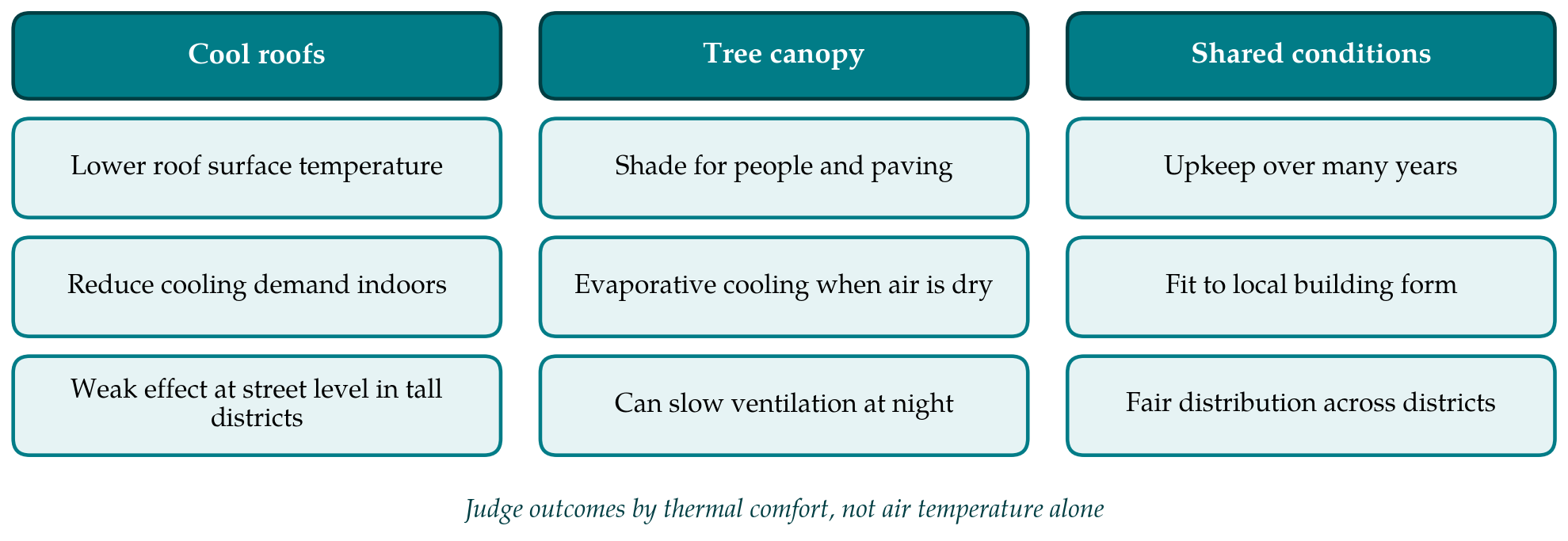
A common weakness in the evaluation of both measures is the reliance on air temperature as the outcome. Air temperature is easy to measure and to model, but it captures neither the radiant relief provided by shade nor the indoor conditions beneath a roof. Indices of thermal comfort that combine air temperature, humidity, wind and radiation give a fuller account, and in humid climates they can rank interventions differently from air temperature alone.
8. Gaps and Future Work
Several gaps follow from the review. Field measurements from tropical cities remain scarce compared with model studies, and those that exist are concentrated in a few wealthy locations. Long-term records of the reflectance of roofing materials under humid tropical exposure would allow maintenance needs to be planned realistically. For trees, measurements that separate shade from transpiration, and that follow conditions through the night, are needed to settle how canopy should be arranged where ventilation is scarce. Studies of indoor temperature in unconditioned low-income housing before and after roof treatment would address the population with the most to gain. Finally, almost all modelling treats the two measures separately, and their combined effect in districts of realistic form has received little attention.
9. Conclusion
Cool roofs and tree canopy both have a sound physical basis and a supporting literature, but neither transfers to the tropics unchanged. Cool roofs lose nothing in a climate without winter and gain relevance where low-rise, lightly roofed housing is common, provided their reflectance is maintained. Trees remain valuable chiefly for their shade, and their arrangement must respect the need for air movement and night-time cooling. Planners in tropical cities are better served by asking where people are exposed to heat, indoors and out, and choosing the measure that acts at that place, than by ranking the two against each other on air temperature.
Conflict of interest
To be declared by the author(s) before publication.
Funding
To be declared by the author(s) before publication.