1. Introduction
When two people begin to share a home they also begin to share a set of tasks that nobody is paid to do. How those tasks are divided has been studied for half a century, and the central finding has been stable: women in different-sex couples do more of the routine housework and care than men, the gap has narrowed, and it has not closed (Bianchi et al., 2000; Coltrane, 2000). Hochschild (1989) gave the pattern its best known name, the second shift, and showed that couples manage it through stories they tell about themselves as much as through any explicit agreement.
The employment conditions under which this literature was written are changing. A growing share of young adults in cities earn some or all of their income through digital platforms that match workers with customers for discrete tasks: a ride, a delivery, an hour of cleaning, a piece of online work. Platforms describe this as work without a boss or a rota. Scholars of labour have been more cautious, describing an arrangement in which the firm keeps control of pay and access to work while passing the risk of idle time to the worker (Vallas and Schor, 2020).
This article asks what the published literature implies for household roles when one or both partners in a young urban couple work in this way. The question is worth posing because the standard explanations of the division of labour turn on exactly the things that platform work alters: when each partner is at home, how much each earns and how reliably, and whether paid work is visible to the other partner as work.
2. Scope and Approach
This is a narrative review of published scholarship. It draws on research monographs, review articles and frequently cited empirical studies in sociology, economics and labour studies, most of them concerned with North America, Europe and Australia, which is where the two literatures are densest. It does not report a systematic search and makes no claim to completeness. Because studies that observe platform workers together with their partners are few, much of the argument proceeds by reading the platform literature against well established findings on non-standard schedules and insecure work, and the article marks where it is extrapolating.
3. Explaining Who Does What at Home
Three explanations dominate the field, and reviews written a decade apart organise the evidence around the same three (Coltrane, 2000; Lachance-Grzela and Bouchard, 2010). The time availability account holds that housework is done by whoever has more hours free of paid work. The relative resources account treats the division as the outcome of bargaining, in which the partner with higher earnings or better outside options can decline unwelcome tasks. Its economic ancestors are the specialisation model of Becker (1981), in which couples allocate each partner to the sphere where that partner is more productive, and the bargaining models that replaced the assumption of a single household interest with two parties whose fallback positions matter (Lundberg and Pollak, 1996).
The third account begins from the observation that the first two predict more symmetry than is found. West and Zimmerman (1987) argued that gender is something accomplished in everyday conduct, and housework is one of the places where it is accomplished. Brines (1994) reported that men who depended economically on their wives did less housework, not more, and read this as a display of gender under threat. Later work described the same pattern as the neutralisation of deviance from gender norms, and Bittman et al. (2003) found in Australian data that women's housework fell as their share of income rose only up to the point of equal earnings. Table 1 summarises the three accounts and the expectation each would generate for a household that includes a platform worker.
| Explanation | Core claim | Expectation for platform work | Key sources |
|---|---|---|---|
| Time availability | Unpaid work goes to the partner with more free hours | Self-scheduled hours let the worker cover more tasks at home | Bianchi et al., 2000 |
| Specialisation | Each partner concentrates where productivity is higher | The partner with the weaker wage takes platform work and the home | Becker, 1981 |
| Bargaining | Earnings and outside options set bargaining power | Volatile, low earnings weaken the worker's position | Lundberg and Pollak, 1996 |
| Doing gender | Housework displays and confirms gender | Effects differ sharply by the gender of the platform worker | West and Zimmerman, 1987; Brines, 1994 |
| Cognitive labour | Planning and monitoring are work, unevenly held | Being reachable at home draws the planning role to the worker | Daminger, 2019 |
A later refinement matters for what follows. Daminger (2019) distinguished the cognitive part of household labour, which consists of anticipating needs, identifying options, deciding and monitoring, from the physical execution of tasks, and showed that women carry more of the anticipating and monitoring even in couples who share execution. Cognitive labour is portable and interruptible. It attaches readily to whoever is nearby and appears to be available, which is precisely how a partner logged in to an application at home may appear.
4. What Platform Work Does to Time
The claim that platform work is flexible is partly true, and the literature is specific about the limits. Platform workers generally choose when to log in. They do not choose when work is available or what it pays. Rosenblat and Stark (2016) described how a ride-hailing platform steers drivers towards particular hours and places through variable pricing, ratings and selective disclosure of information, so that formal freedom over hours coexists with strong inducements. Wood et al. (2019), studying remote online work, found that algorithmic management gave workers autonomy over place and pace while also producing long, irregular and unsocial hours, because work had to be taken when clients offered it.
Research on conventional employment gives reason to think the distinction between control and unpredictability decides how a schedule lands at home. Where employees gained real control over when they worked, conflict between work and family fell (Kelly et al., 2011). Where hours were set at short notice by the employer, as in much retail and food service, workers reported more conflict, more stress and worse sleep (Henly and Lambert, 2014; Schneider and Harknett, 2019). Platform work has features of both. The worker decides, but decides in response to demand that peaks at mealtimes, evenings and weekends, which are the hours when households eat, children are home and partners in standard jobs are free.
Older work on non-standard hours is therefore relevant. Presser (2003) showed that in dual-earner couples where partners worked different shifts, fathers took on more childcare, simply because they were the parent present, but also that such schedules were associated with strain on the relationship. Clawson and Gerstel (2014) added that unpredictability spreads through a web of people: one person's late change forces changes on partners, relatives and co-workers, and the capacity to push the adjustment onto someone else follows lines of class and gender. The partner whose time is treated as more elastic absorbs the shock.
5. Earnings, Dependence and Bargaining
The second feature is money. Insecure work has been described as the defining change in employment relations of recent decades (Kalleberg, 2009), and platform work is one of its plainest forms: pay by the task, no guaranteed hours, costs carried by the worker. The most useful finding of the platform literature for the study of households is that experience varies with dependence. Schor et al. (2020) found that people who used platforms to supplement another income reported more satisfaction and more autonomy than those who relied on the platform for their living, who were more exposed to its pressures. The same job, in other words, is a different thing in a household that can do without it and in one that cannot.
Read through the bargaining account, this implies two quite different households. Where platform earnings are a supplement, they may raise the worker's contribution without displacing anything, and the hours can be chosen to suit the home. Where they are the worker's main income, low and variable pay weakens the fallback position on which bargaining power rests, while pressure to chase demand removes the flexibility that was supposed to compensate. Sociological work on household money adds that income is not a single pool. Couples mark particular earnings for particular uses, and money from different sources is not treated as interchangeable (Zelizer, 1994). Whether irregular platform income is treated as a wage or as extra money is likely to affect how much it counts when tasks are negotiated, and this has not been examined directly.
6. Gender and the Place of Work
Platform work is segregated by gender in ways that mirror the wider labour market. Ride-hailing and courier work are done mostly by men and are carried out away from home. Domestic and care tasks arranged through platforms, and a good deal of online task work, are done largely by women, some of it from home and around care responsibilities (Gray and Suri, 2019). Milkman et al. (2021) reported that platform-based grocery and food delivery in the United States drew many women who valued it because it could be fitted around caring for family members. Flexibility in this case does not reorganise the household. It is the means by which an existing allocation of care is kept in place while income is added.
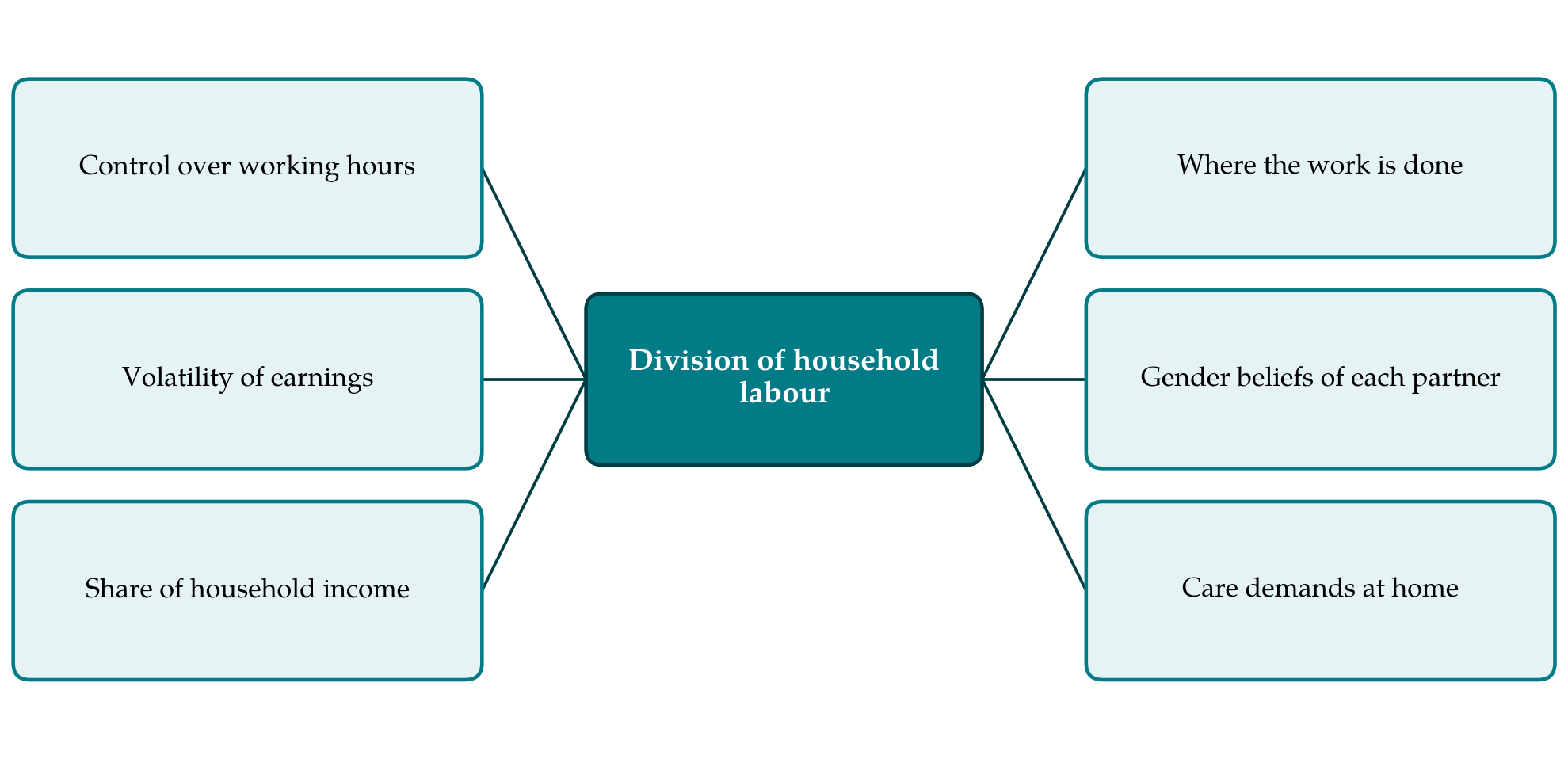
Figure 1 gathers the conditions that the literature suggests stand between platform work and the division of labour at home. None works alone. A man who drives in the evenings and depends on the income is absent at the busiest domestic hours and may, on the evidence of the gender display studies, resist housework more as his earnings fall behind his partner's. A woman doing online tasks from the kitchen table is present, interruptible and easily treated as the default parent and planner. The same contractual form thus points in opposite directions.
Work done at home has a further property: it is hard to see. Hochschild (1989) described an economy of gratitude in which partners weigh what each gives and is thanked for. Tasks performed on a phone in short bursts between other activities may not register as a working day with either partner, and so may earn little credit in that economy.
7. Young Couples and the Setting of Routines
Early adulthood is when domestic routines are laid down, and it is also when platform work is most common. Gerson (2010) found that most young adults she interviewed wanted an egalitarian partnership, and that when they doubted it could be achieved, women and men fell back on different plans: women towards self-reliance, men towards a modified version of the breadwinner arrangement. England (2010) argued that change in gender relations has been uneven because women have had strong incentives to enter male domains while men have had few to enter female ones. Insecure work is a setting in which such fallback positions are likely to be activated, since the conditions for sharing equally, two predictable schedules and two reliable incomes, are missing.
City life sharpens these pressures. Couples who set up home on platform earnings in expensive cities may be doing so with little slack in either time or money and often at a distance from relatives, which leaves less room to buy services, to call on kin or to experiment with who does what. Routines adopted under such constraints can harden into expectations before either partner has consciously chosen them.
8. Gaps and Directions for Research
The clearest gap is that the two literatures seldom meet. Studies of platform work take the individual worker as the unit and treat the household as background. Studies of housework classify employment by hours and earnings, and rarely record how hours are scheduled or how predictable pay is. Research designed around the couple would need to hear from both partners, since accounts of who does what are known to differ between them, and would benefit from time diaries that capture the fragmented character of platform hours. It would also need to separate supplemental from dependent platform work, and work done at home from work done outside it.
Three further limits of the existing evidence should be stated. Most of it concerns different-sex couples, and little is known about same-sex households. Most of it comes from high-income countries, although platform work is expanding fast in cities of the global South where household forms and the availability of kin differ. And almost all of it is cross-sectional, so it cannot show whether arrangements adopted early persist once one partner moves into standard employment.
9. Conclusion
The published literature does not support the view that platform work, by loosening the working day, loosens gendered household roles. It suggests a more conditional picture. Flexibility helps where the worker truly controls hours and does not depend on the income, and those are the households with the least need of help. Where platform work is the main livelihood, its hours follow demand and its pay is uncertain, and established findings on unpredictable schedules, bargaining and gender display all point towards strain and towards the reproduction of familiar divisions. Whether young couples find ways around these pressures is an open empirical question that awaits research with the couple at its centre.
Conflict of interest
To be declared by the author(s) before publication.
Funding
To be declared by the author(s) before publication.