1. Introduction
Atrial fibrillation matters chiefly because of stroke. The Framingham investigators showed long ago that it raises the risk of stroke about fivefold and that the share of strokes attributable to it climbs with age (Wolf et al., 1991). Anticoagulation reduces that risk substantially, and because the arrhythmia is often silent, finding it early has an obvious attraction. That reasoning has driven two decades of interest in screening.
In the past few years a form of screening has arrived that nobody commissioned. Wrist-worn devices use photoplethysmography to detect an irregular pulse in the background, and many can record a single-lead electrocardiogram on demand. Very large studies run with the manufacturers have shown that the approach is workable at scale (Perez et al., 2019; Lubitz et al., 2022). The devices are bought by the public, worn for most of the day and night, and generate alerts without any clinician having asked a question. Each alert then becomes somebody's clinical problem.
This Perspective takes the position that the resulting referrals are best understood as the output of an unplanned screening programme, and that they should be handled by the standards applied to screening and not by the reflexes applied to a new diagnosis. It sets out the argument, considers the objections, and suggests how responsibility might be shared.
2. How an Alert Becomes a Referral
An irregular pulse notification is a statement about pulse intervals. It is not an electrocardiographic diagnosis. In the largest study of a smartwatch algorithm only a small fraction of participants received a notification, and among those who then wore an electrocardiographic patch about a third showed atrial fibrillation during the following week (Perez et al., 2019). The agreement between a notification and a simultaneous patch recording was good; the lower yield on later monitoring reflects how intermittent the arrhythmia is in such people. Single-lead tracings recorded on a watch are more specific, but automated classification leaves a sizeable share unclassified, and those need a clinician to read them (Bumgarner et al., 2018).
Guidelines are clear that the diagnosis requires documentation on an electrocardiogram, whether a standard 12-lead recording or a single-lead tracing of at least 30 seconds reviewed by a physician (Hindricks et al., 2021). The practical guide of the European Heart Rhythm Association on digital devices repeats the point and distinguishes carefully between pulse-based detection and electrocardiographic confirmation (Svennberg et al., 2022). The person holding the watch, however, sees the words atrial fibrillation on a screen, reads about stroke, and asks to see a cardiologist. The first clinician consulted often has no agreed pathway to follow and no easy way to view the tracing, and refers onward.
3. Evidence Built on Different Patients
The central difficulty is that the evidence on device-detected arrhythmia comes from people who resemble wearable owners very little. Table 1 summarises the main sources.
| Source | Who was studied | How detected | Bearing on wearable alerts |
|---|---|---|---|
| Healey et al., 2012 | Older patients with pacemakers or defibrillators | Implanted device | Subclinical episodes linked to stroke; population unlike watch owners |
| Svendsen et al., 2021 | People aged 70 to 90 with a risk factor | Implanted loop recorder | More detection and treatment, no significant fall in stroke |
| Svennberg et al., 2021 | Invited 75- and 76-year-olds | Intermittent handheld ECG | Small net benefit from organised screening of the old |
| Kirchhof et al., 2023 | Older patients with atrial high-rate episodes | Implanted device | Anticoagulation gave no clear benefit and more bleeding |
| Healey et al., 2024 | Older patients with subclinical episodes | Implanted device | Fewer strokes with anticoagulation, more major bleeding |
| Perez et al., 2019 | Self-selected smartwatch owners, mostly young | Pulse alert, then ECG patch | Feasible at scale; no data on clinical outcomes |
The observation that short, asymptomatic atrial arrhythmias carry stroke risk came from patients with pacemakers and defibrillators, in whom episodes longer than six minutes were associated with a higher rate of stroke and embolism (Healey et al., 2012). A later analysis of the same cohort found the excess risk concentrated in those whose longest episode exceeded 24 hours (Van Gelder et al., 2017). These were elderly people with structural heart disease severe enough to need a device.
Two randomised trials have since tested anticoagulation for such episodes, again in older patients with implanted devices. One found no significant reduction in its composite cardiovascular end point and more bleeding (Kirchhof et al., 2023); the other found fewer strokes and systemic emboli with anticoagulation, at the price of more major bleeding (Healey et al., 2024). The balance is narrow even in a high-risk population. Screening trials point the same way. Continuous monitoring with an implanted loop recorder in people aged 70 to 90 tripled the detection of atrial fibrillation and the use of anticoagulants without a significant reduction in stroke (Svendsen et al., 2021), whereas an invitation to intermittent recording at age 75 or 76 yielded a small net benefit (Svennberg et al., 2021). The United States Preventive Services Task Force judged the evidence insufficient to recommend for or against screening adults without symptoms (US Preventive Services Task Force, 2022).
None of these studies enrolled the typical wearable owner. Someone in their forties with no cardiovascular disease who is monitored for most of every day will sooner or later show brief arrhythmia that would never have come to light otherwise, and nothing in the literature establishes that treating it does more good than harm. The more intensive the monitoring, the lower the burden of disease it finds, and the weaker the inference from older trials becomes.
4. The Argument: Sort on Confirmation and Risk
Wilson and Jungner (1968) set out the conditions a screening programme should meet, among them an understood natural history, an agreed policy on whom to treat, and facilities for diagnosis and treatment. Wearable-detected arrhythmia in low-risk adults meets none of these fully. A further hazard is overdiagnosis, the detection of a real abnormality that would never have caused harm, which is well described in cancer screening (Welch and Black, 2010) and applies with equal force to a paroxysmal arrhythmia found by continuous surveillance. A person given the label acquires anxiety, repeated tests and sometimes a drug with a bleeding risk, in exchange for a benefit that has not been demonstrated in people like them.
The position argued here is that two questions are enough to sort almost every alert, and that neither needs a specialist. The first is whether atrial fibrillation has been confirmed on a tracing of diagnostic quality. The second is whether the person's stroke risk is raised on a clinical score such as CHA2DS2-VASc (Lip et al., 2010). Figure 1 sets out the four combinations. A confirmed arrhythmia in a person at raised risk is clinical atrial fibrillation and should be managed as the guidelines direct. An unconfirmed alert in a person at raised risk justifies prompt confirmation, since that person stands to gain from treatment. A confirmed arrhythmia in a person at low risk needs attention to symptoms, blood pressure, alcohol, weight and sleep, with no anticoagulant on the score alone. An unconfirmed alert in a low-risk person without symptoms needs an explanation and little else.
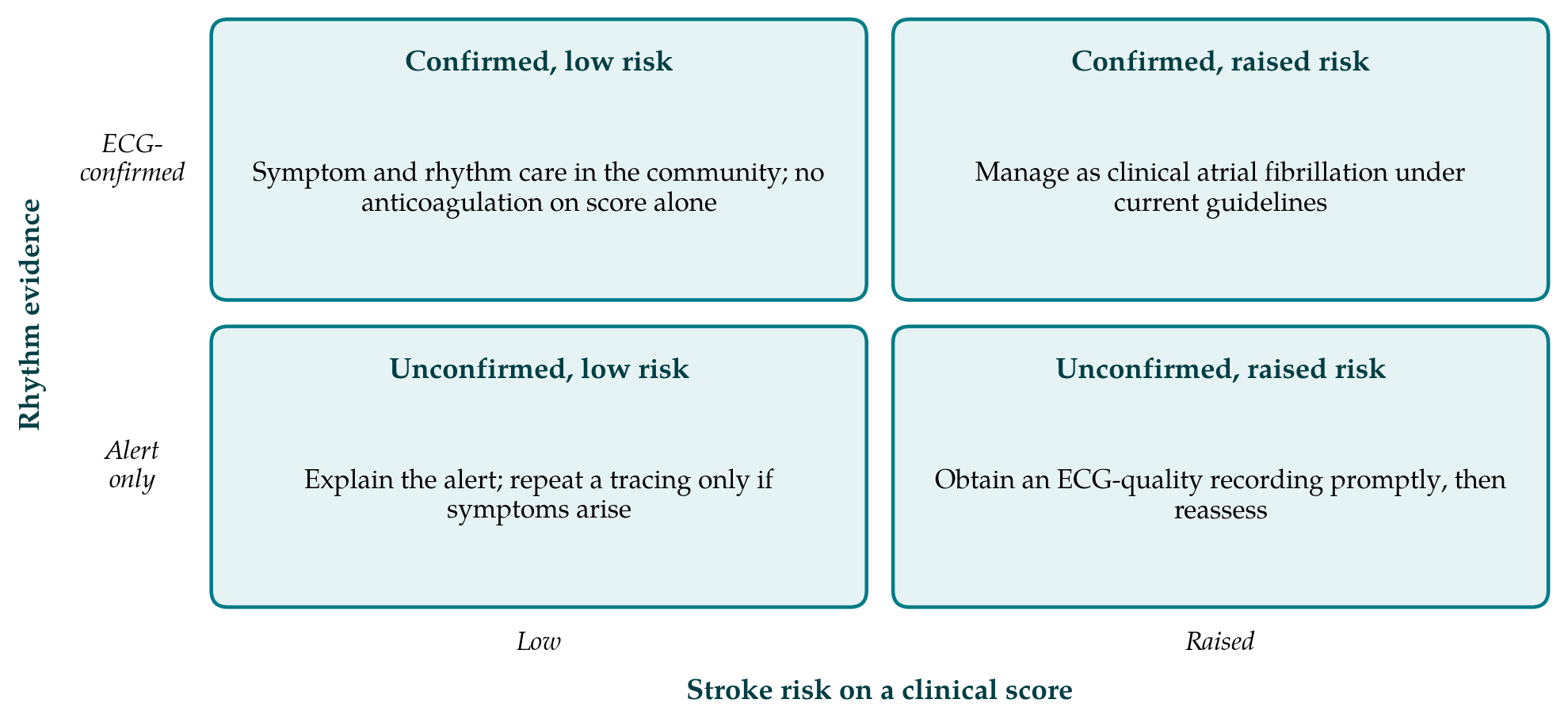
Recent guidelines already move in this direction. The American guideline grades its recommendations on anticoagulation for device-detected episodes by their duration together with the clinical risk score (Joglar et al., 2024), and the latest European guideline keeps electrocardiographic confirmation as the threshold for diagnosis while acknowledging the uncertainty surrounding short device-detected episodes (Van Gelder et al., 2024). What is missing is the operational step: a pathway that applies those principles before the referral letter is written.
5. Counter-arguments
The strongest objection is that some alerts are the first sign of an arrhythmia that will cause a stroke, and that a restrictive pathway will miss them. This is true, and it is the reason the proposed sorting gives priority to people at raised clinical risk. The objection has less force for those at low risk, in whom the absolute chance of stroke is small whatever the rhythm and in whom guidelines would not advise anticoagulation even after a conventional diagnosis.
A second objection is that people have bought these devices precisely to learn about their hearts, and that telling them an alert needs no action is paternalistic. The answer is that respect for autonomy requires accurate information, including the information that an alert is a probability and not a diagnosis and that the benefit of acting on it is unproven in their circumstances. Many people, properly informed, will be content. Those who are not can still be assessed, but the assessment need not begin in a specialist clinic.
A third objection is that the technology is improving and that today's false alarms will disappear. Better algorithms will reduce false positives, yet they will also find more true, brief, low-burden arrhythmia, which is the harder problem. Greater accuracy sharpens the question of what to do with a correct finding of uncertain meaning; it does not answer it.
6. Implications
For services, the implication is a shared pathway agreed between primary care and cardiology, in which a trained nurse, pharmacist or general practitioner reviews the tracing, applies the two questions and refers only those who fall into the categories that need specialist input. Electronic advice from a cardiologist on a submitted tracing can replace many face-to-face appointments. For manufacturers, the implication is that the wording of alerts and the accompanying information should make plain what has and has not been established, and that tracings should be exportable in a form a clinician can read without special software.
For researchers, the priority is outcome data in the people who actually wear these devices. Detection rates and positive predictive values are known. What remains unknown is the stroke risk attached to a given burden of wearable-detected arrhythmia at a given age, and whether treating it changes that risk. Registries that link alerts to later events, and trials that randomise the response to an alert, would address the gap. Until such data exist, caution about labelling and treating low-risk people is the defensible course.
7. Conclusion
Wearable rhythm monitors have created screening without a screening programme. The referrals they generate rest on evidence drawn from older and sicker patients, and applying that evidence to healthy adults risks overdiagnosis while crowding out people with established disease. Sorting alerts by electrocardiographic confirmation and clinical stroke risk, largely outside specialist clinics, would direct attention to those most likely to benefit. The approach is an argument from existing evidence and guideline principles, and it should be revised as outcome data from wearable users accumulate.
Conflict of interest
To be declared by the author(s) before publication.
Funding
To be declared by the author(s) before publication.