1. Introduction
For a quasi-projective scheme X, the Hilbert scheme of points Hilbn(X) constructed by Grothendieck (1961) parametrises closed subschemes of X of finite length n. When X is a smooth irreducible surface, Fogarty (1968) proved that Hilbn(X) is smooth and irreducible of dimension 2n. The statement fails in both directions away from smooth surfaces. Iarrobino (1972) showed that Hilbn of affine space of dimension at least three is reducible for large n, the precise threshold in small cases was found by Cartwright et al. (2009), and Jelisiejew (2020) showed that in high dimension these schemes can be as badly behaved as any scheme.
Singular surfaces sit between the two worlds. Their Hilbert schemes of points are needed, for instance, in the study of quotient singularities and of degenerations of smooth surfaces, and the natural first question is whether Hilbn(X) is still irreducible. This note does not prove anything new. It writes down the standard dimension count at a singular point, extracts from it explicit conditions under which irreducibility fails, and sets these beside the positive results in the literature. Throughout, X is an irreducible surface over the complex numbers, p is a closed point with maximal ideal m in the local ring, and e is the embedding dimension at p, the dimension of m/m2.
2. The Principal Component and the Evidence From Curves
The smooth locus U of X is a smooth irreducible surface, so Hilbn(U) is irreducible of dimension 2n by Fogarty's theorem. Its closure in Hilbn(X) is an irreducible component, the principal or smoothable component, and its general point is a set of n distinct points. The scheme Hilbn(X) is irreducible exactly when every subscheme of length n is a limit of reduced ones. On a smooth surface the essential input is the theorem of Briançon (1977) that the subschemes of length n supported at a single point form an irreducible family of dimension n − 1, far too small to fill a component.
Curves show what to expect when singularities are allowed. For an integral curve whose singularities are planar, Altman et al. (1977) proved that the Hilbert scheme of n points is irreducible of dimension n, and Rego (1980) treated the closely related compactified Jacobian. At a point of embedding dimension three or more the conclusion fails already for two points: the subschemes of length two supported at that point are the lines in the Zariski tangent space, a family of dimension at least two, and it cannot lie in the two-dimensional principal component because none of its members is reduced. Embedding dimension, measured against the dimension of the variety, is thus the quantity to watch. Table 1 gathers the cases discussed in this note.
| Variety | Irreducible for all n | Reason or source |
|---|---|---|
| Curve with planar singularities | Yes | Altman et al., 1977 |
| Curve with a point of embedding dimension 3 or more | No, fails from two points on | Tangent directions at the point |
| Smooth surface | Yes | Fogarty, 1968 |
| Surface with rational double points | Yes | Zheng, 2017; Craw et al., 2021 |
| Surface with a point of embedding dimension 5 or more | No, fails from three points on | Grassmannian count, first layer |
| Surface in a smooth threefold with a point of multiplicity 5 or more | No, fails for 27 points | Grassmannian count, fourth layer |
| Smooth variety of dimension 3 or more | No, fails for large n | Iarrobino, 1972 |
3. A Dimension Count at a Singular Point
Every vector subspace of m/m2 is the image of an ideal I with m2 contained in I and I contained in m, and the quotient of the local ring by I has length one more than the codimension of the subspace. The subschemes of length n obtained in this way are therefore parametrised by the Grassmannian of subspaces of codimension n − 1 in a space of dimension e, which is irreducible, closed in Hilbn(X), and of dimension (n − 1)(e − n + 1). All its members are non-reduced when n is at least 2. If this dimension is at least 2n, the family cannot be contained in the principal component: an irreducible closed subset of an irreducible variety of the same dimension is the whole variety, and the principal component has reduced members. Figure 1 displays the comparison.
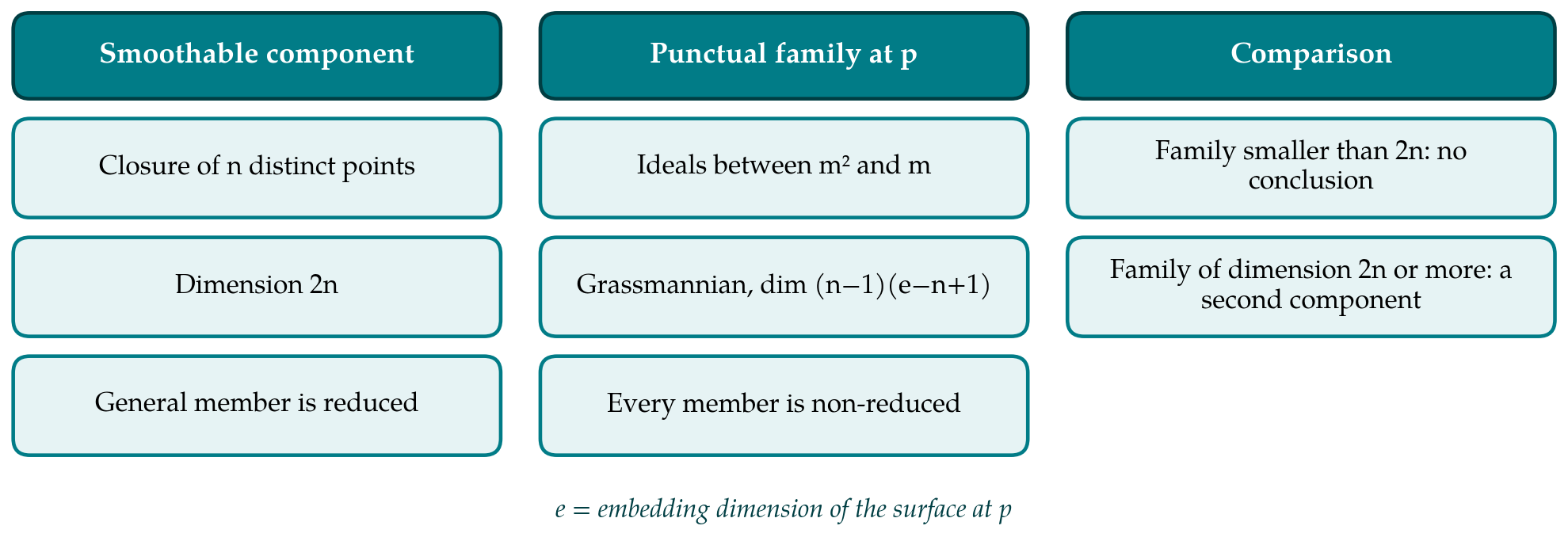
For three points the Grassmannian has dimension 2(e − 2), which reaches the value 6 of 2n when e = 5. Hence Hilb3(X) is reducible whenever X has a point of embedding dimension at least five, and adding n − 3 further points away from p gives a family of dimension 2n of non-reduced subschemes, so that Hilbn(X) is reducible for every n from 3 onwards. By the formula of Artin (1966), a rational surface singularity of multiplicity μ has embedding dimension μ + 1. The count therefore applies to all rational singularities of multiplicity at least four, the simplest being the cone over the rational normal quartic curve. For e = 3 and e = 4 the first layer gives families of dimension at most 2 and 4, below 2n in every case, and no conclusion.
Deeper layers behave in the same way, as in Iarrobino's original argument. Ideals lying between mk+1 and mk correspond to subspaces of mk/mk+1, whose dimension is governed by the Hilbert function of the singularity. If X is a surface in a smooth threefold and p has multiplicity at least 5, then the quotient by m4 has length 1 + 3 + 6 + 10 = 20 and m4/m5 has dimension 15, exactly as for the threefold. Subspaces of codimension 7 give subschemes of length 27 in a family of dimension 7 × 8 = 56, which exceeds 2n = 54. Hypersurface singularities are thus not immune: the cone over a smooth plane quintic has a reducible Hilbert scheme of 27 points. In general it is the growth of the Hilbert function, that is the multiplicity, that decides the matter for large n.
4. Rational Double Points and a Lower Bound
For rational double points the count is silent, and in fact the Hilbert scheme is irreducible. Zheng (2017) proved this for quasi-projective surfaces with at worst rational double points, and Craw et al. (2021) identified the Hilbert scheme of points on a Kleinian quotient singularity, with its reduced structure, with a Nakajima quiver variety, from which they obtain that it is irreducible and normal and has symplectic singularities.
A simple observation shows why hypersurface singularities are the favourable case. Suppose X is a Cartier divisor in a smooth threefold Y. A subscheme of Y of length n lies in X exactly when the equation of X restricts to zero on it, so Hilbn(X) is the zero locus in Hilbn(Y) of a section of a tautological vector bundle of rank n. Wherever Hilbn(Y) is irreducible of dimension 3n, which by Cartwright et al. (2009) includes all n up to 8, every component of Hilbn(X) has dimension at least 2n. A component other than the principal one would consist of subschemes meeting the singular locus, and for isolated singularities it is excluded as soon as the subschemes of length k supported at a singular point form a family of dimension less than 2k for each k up to n. This is a finite check on punctual Hilbert schemes, in the spirit of Briançon's theorem, and it is the form in which the problem for a given singularity is most naturally posed.
5. Conclusion
The irreducibility of Hilbert schemes of points on a singular surface is controlled by the size of the punctual families at the singular points, and the crudest of these families already settles many cases. Embedding dimension five or more forces a second component from three points onwards, large multiplicity does the same for hypersurface singularities at higher length, and rational double points are known to cause no reducibility at all. The singularities in between, starting with rational triple points and with hypersurface singularities of multiplicity three and four, are where a systematic answer is still missing from the literature.
Conflict of interest
To be declared by the author(s) before publication.
Funding
To be declared by the author(s) before publication.