1. Introduction
Metformin hydrochloride is dispensed in enormous quantity, usually as immediate-release tablets of several hundred milligrams taken twice or three times a day for many years (Graham et al., 2011). Most of what is dispensed is generic, made by many manufacturers and distributed through supply chains of varying length. Concern about the quality of medicines reaching patients, particularly where regulatory inspection is thin, is well founded: the World Health Organization has documented substandard and falsified products across many therapeutic classes (WHO, 2017), and the field literature on anti-infective quality established the pattern of investigation that other classes have since followed (Newton et al., 2006).
The natural response is a sampling survey: buy packs of several brands from pharmacies in a few cities, run a dissolution test, and compare. Such studies are inexpensive and easy to publish, and they are frequently done badly. The weaknesses are usually in the design rather than in the laboratory work, and they are decided before any tablet is bought. This note discusses those decisions for the particular case of metformin. It reports no testing and presents no data.
2. Why Metformin Is an Awkward Subject for Such a Survey
Under the Biopharmaceutics Classification System of Amidon et al. (1995), metformin hydrochloride is a highly soluble compound whose absorption is limited by permeability rather than by dissolution. A conventional immediate-release tablet of a highly soluble salt will normally release almost all of its content within a short time in aqueous media, and regulatory guidance treats such rapid release as a condition under which an in vivo bioequivalence study may be waived (FDA, 2017). Two consequences follow for survey design. Products that are made competently will differ from one another very little, so the survey is measuring the tail of a distribution rather than a spread. And a product that does fail is failing for a manufacturing or storage reason, such as over-compression, an unsuitable disintegrant or exposure to heat and humidity, rather than because the molecule is difficult.
This does not make the exercise pointless, but it changes what the exercise is for. A dissolution survey of metformin is best understood as a screen for gross defects in a population of products, not as a comparison of therapeutic performance. A survey designed as though small differences in release rate were clinically meaningful will over-interpret its own findings, because for a compound of this class such differences are unlikely to affect absorption.
3. Decisions to Settle Before Sampling
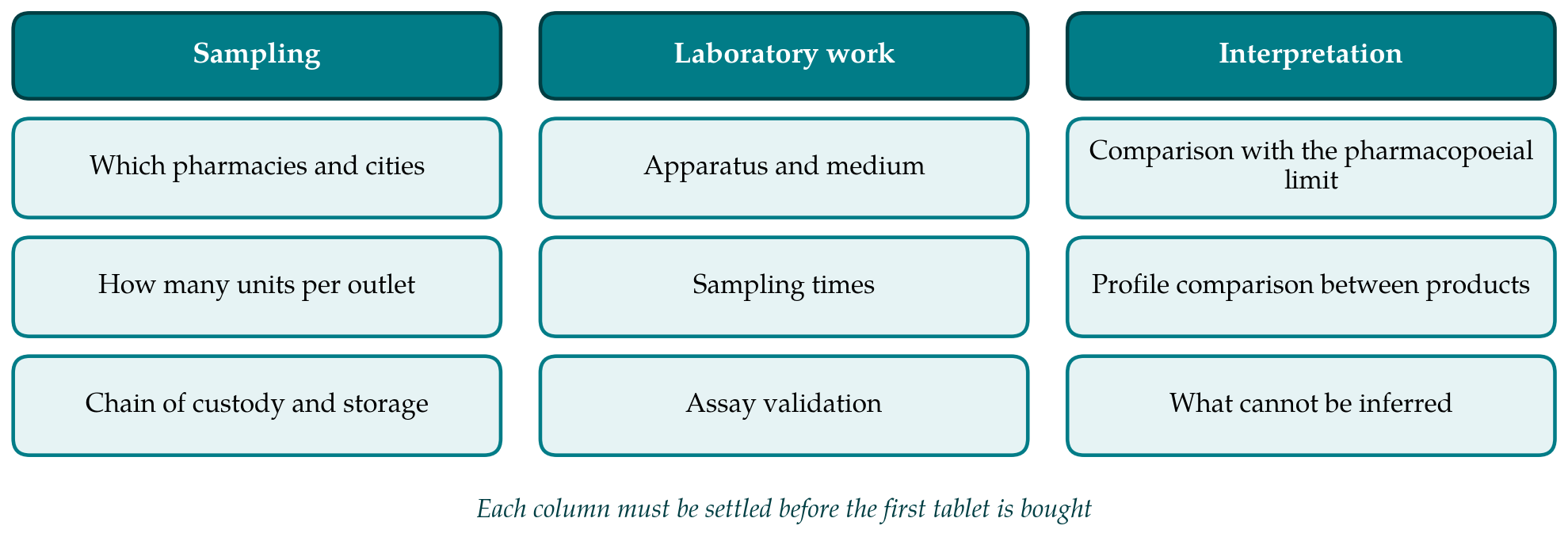
Table 1 lists the decisions a comparative survey must make, the choice usually taken and what each choice determines. Figure 1 groups the same decisions into the three domains in which they fall. Two deserve emphasis. The first is the sampling frame. Pharmacies chosen for convenience in three cities do not represent a national supply, and the resulting sample supports statements about those outlets and nothing wider; a sampling approach of the kind proposed for medicine quality field surveys by Newton et al. (2009) should be adopted and described, including whether the purchaser was blinded to the study and whether packs were bought as an ordinary customer would buy them. The second is the number of units. Pharmacopoeial acceptance for dissolution is staged, beginning with six units and proceeding to twelve and twenty-four where the first stage does not pass (USP, 2023), so a survey that tests six tablets per product and reports a failure without completing the staged procedure has not demonstrated a failure at all.
| Decision | Usual choice | What it determines |
|---|---|---|
| Sampling frame | Convenience outlets in each city | The population the findings can describe Newton et al., 2009 |
| Units per product | Six, sometimes without later stages | Whether a failure can be claimed at all USP, 2023 |
| Handling after purchase | Transport at ambient temperature | Whether the result reflects the pharmacy or the journey ICH, 2003 |
| Apparatus and speed | Paddle apparatus at moderate speed | Hydrodynamics and the risk of coning |
| Medium | Buffer specified in the monograph | Comparability with the compendial limit |
| Sampling times | A single endpoint, or several | Whether a profile can be compared at all |
| Comparison method | Pass or fail, or a similarity factor | The claim that can be made Shah et al., 1998 |
Handling between purchase and testing is the decision most often left unrecorded. Tablets bought in a hot city, carried in a vehicle and held for weeks before testing have experienced conditions that the stability data supporting the product never covered (ICH, 2003). Unless storage and transport are controlled and reported, a poor result cannot be attributed to the manufacturer rather than to the investigators.
4. What the Result Can and Cannot Support
If a single endpoint is measured, the only legitimate comparison is with the acceptance criterion in the monograph, applied through its staged procedure. Comparing products with one another requires profiles with several sampling points, and even then the standard tools are limited. The similarity factor described by Moore and Flanner (1996) and adopted in regulatory practice (Shah et al., 1998) is insensitive when both products release their content rapidly, because only one point above the high release level may be used in the calculation. For a rapidly dissolving compound such as metformin, guidance accepts a demonstration that both products release essentially all of their content within a short time as sufficient, and the similarity factor then adds nothing (FDA, 2017).
Nor does a dissolution result speak directly to what a patient absorbs. Dissolution is a surrogate, useful as a quality control test and, under defined conditions, as a basis for waiving an in vivo study, but the relationship between in vitro release and plasma exposure must be established rather than assumed (Dressman et al., 1998; Anand et al., 2011). For a compound whose absorption is limited by permeability, differences in release rate between compliant products are unlikely to appear in plasma at all.
A finding of genuine concern therefore has a defined form: a product that fails the compendial procedure, with the staged acceptance completed, on units whose handling is documented, assayed by a validated method, and preferably confirmed on a second pack of a different batch obtained independently. Anything less should be reported as a signal prompting further work, and communicated to the national regulatory authority rather than published as a finished judgement on a manufacturer.
5. Conclusion
A retail dissolution survey of generic metformin is worth doing as a screen for gross defects, and worth designing carefully for that purpose alone. The sampling frame should be described honestly, the staged pharmacopoeial procedure followed before any failure is claimed, handling between purchase and test documented, and the interpretation held to what a surrogate test of a highly soluble compound can support. A survey built on those terms yields a modest, defensible statement about the products on sale in the outlets visited, which is more useful than a larger claim that the method cannot bear.
Conflict of interest
To be declared by the author(s) before publication.
Funding
To be declared by the author(s) before publication.