1. Introduction
Most drug candidates that enter development never reach patients, and unexpected toxicity is among the commonest reasons. An analysis of the pipelines of four large pharmaceutical companies found safety problems, non-clinical toxicology above all, to be the leading cause of project termination (Waring et al., 2015). The tests meant to catch such liabilities, cultured cell lines and studies in rodents and a second species, are imperfect guides. In the survey by Olson et al. (2000), animal studies anticipated most human toxicities overall but did less well for some organs, the liver among them, and hepatic injury is a frequent cause of late failure and of withdrawal after marketing.
Organ-on-chip devices, also called microphysiological systems, were conceived partly as an answer. They culture human cells in microfabricated channels under continuous perfusion, often with two tissue types separated by a porous membrane and subjected to forces that mimic breathing, peristalsis or blood flow (Bhatia and Ingber, 2014). The promise is a human-relevant test that sits between the simplicity of a culture dish and the complexity of an animal, in keeping with the long-standing aim of replacing, reducing and refining animal use (Russell and Burch, 1959).
The field has now existed long enough for sober assessment. Several chips are sold commercially, pharmaceutical companies have evaluated them in-house, and legislation in the United States has removed the statutory insistence on animal tests before first-in-human trials. Yet chips have not displaced conventional assays in routine safety screening. This review describes what the platforms can do for toxicity testing, what evidence supports their predictive value, and which obstacles, technical and institutional, stand between a persuasive demonstration and a qualified regulatory tool.
2. Scope and Approach
The article is a narrative review of the published literature, organised around the organs most relevant to drug attrition and the stages through which a new test method passes on its way to regulatory use. It relies on primary reports of influential devices, on evaluation studies conducted with or by industry, on consensus papers from stakeholder workshops, and on earlier reviews (Esch et al., 2015; Low et al., 2021; Ingber, 2022). It does not attempt a systematic search and gives no pooled performance figures, since the studies differ too much in design to be combined. Disease modelling and efficacy testing, large subjects in their own right, are left aside except where they bear on safety.
3. What a Chip Adds to Cell Culture
Hepatocytes in a conventional dish lose their characteristic functions within days. Cytochrome P450 activity falls and polarity is lost, and with them goes the capacity to form the reactive metabolites responsible for much drug-induced injury. One early remedy was architectural. Khetani and Bhatia (2008) patterned islands of primary human hepatocytes among supportive fibroblasts and obtained cultures whose metabolic competence lasted for weeks, which made repeated dosing possible. Three-dimensional spheroids pursue the same aim by self-assembly and have been tested against sizeable sets of hepatotoxic and safe drugs (Proctor et al., 2017).
Chips add two features that static formats lack. The first is flow. Perfusion supplies nutrients and oxygen, removes waste, exposes endothelium and epithelium to physiological shear, and allows drug concentrations to rise and fall as they do in plasma instead of sitting at a fixed level. The second is the engineered tissue interface. The lung device of Huh et al. (2010) placed alveolar epithelium and capillary endothelium on opposite faces of a flexible membrane and stretched it rhythmically; cyclic strain changed the tissue's inflammatory response to nanoparticles in a way that static culture had not shown. That experiment supplied the argument on which the field rests: mechanical and multicellular context alters toxicological responses, so leaving it out risks missing them.
4. Organ Models Used in Safety Testing
Table 1 lists the organ models most often applied to toxicity questions, the readouts they offer and the principal weakness of each.
| Organ model | Typical cells | Toxicity readouts | Principal limitation |
|---|---|---|---|
| Liver | Primary hepatocytes with endothelial, Kupffer and stellate cells | Albumin output, enzyme release, steatosis, bile transport | Donor variability; scarce primary cells |
| Kidney proximal tubule | Primary tubular epithelium under luminal flow | Injury markers, transporter-dependent uptake | Other nephron segments seldom modelled |
| Heart | Stem cell-derived cardiomyocytes | Beat rate, contractility, electrical activity | Immature, fetal-like phenotype |
| Intestine | Caco-2 or organoid-derived epithelium | Barrier integrity, absorption | Cell line origin; microbiota hard to sustain |
| Lung | Alveolar or airway epithelium with endothelium | Barrier leak, cytokine release | Mainly relevant to inhaled compounds |
| Linked multi-organ | Two or more of the tissues above | Metabolite-driven and systemic effects | Scaling, shared medium, complexity |
4.1. Liver
The liver has received the most attention, for obvious reasons. A widely used design places primary hepatocytes in one channel and sinusoidal endothelial cells, with or without Kupffer and stellate cells, in the other. Jang et al. (2019) built matching chips from rat, dog and human cells and showed that they reproduced species-specific hepatotoxicities, including patterns of injury such as steatosis, cholestasis and fibrosis that depend on the non-parenchymal cells. Species-matched chips have a use beyond prediction: they allow an animal finding of uncertain human relevance to be examined in the corresponding human tissue.
4.2. Kidney, heart and intestine
For the kidney, proximal tubule cells cultured under luminal flow form a polarised epithelium with primary cilia and transporter activity closer to the native tubule, and respond to cisplatin in a manner that depends on those transporters (Jang et al., 2013). Cardiac chips mostly use cardiomyocytes derived from induced pluripotent stem cells, aligned into tissue that beats and responds to drugs affecting rate and rhythm (Mathur et al., 2015). Intestinal chips subject an epithelial layer to flow and cyclic deformation, which promotes villus-like differentiation and permits co-culture with bacteria (Kim et al., 2012). Each has shown responses to reference toxicants. Fewer have been evaluated against large blinded sets of compounds.
4.3. Linked organs
Much toxicity involves more than one organ: a metabolite formed in the liver injures the kidney, or intestinal absorption determines hepatic exposure. Multi-organ platforms connect tissue compartments through a shared circulating medium. Maschmeyer et al. (2015) maintained intestine, liver, skin and kidney equivalents on one chip for four weeks, robotic systems have since coupled as many as eight vascularised chips (Novak et al., 2020), and pharmacokinetic parameters for test drugs have been estimated from such linked systems by computational scaling (Herland et al., 2020). The intellectual appeal is plain. So are the difficulties: organs must be sized relative to one another, a single medium must sustain all of them, and each added tissue multiplies the opportunities for failure (Wikswo et al., 2013).
5. Evidence of Predictive Value
The strongest published test of a chip for safety prediction is the study by Ewart et al. (2022). Several hundred human liver chips were dosed in blinded fashion with 27 drugs of known clinical hepatotoxicity status, following evaluation guidelines proposed by an industry consortium (Baudy et al., 2020). The chips detected the large majority of the hepatotoxic drugs, which had passed animal testing before causing injury in patients, and did not flag any of the non-toxic comparators. The authors went on to estimate the economic value of avoiding late failures if such a model were used routinely.
The result is encouraging and needs careful reading. The compound set is small and made up of drugs with unambiguous clinical histories, whereas a screening tool meets mostly compounds whose liabilities are subtle or absent. The study was conducted by the manufacturer of the chip. Performance depended on correcting nominal doses for drug lost to the device material. And one study with one platform in one organisation says little about transferability. These points are not peculiar to this work. They describe the distance between a demonstration and a qualification, which is where most of the field now sits (Low et al., 2021).
6. Translational Bottlenecks
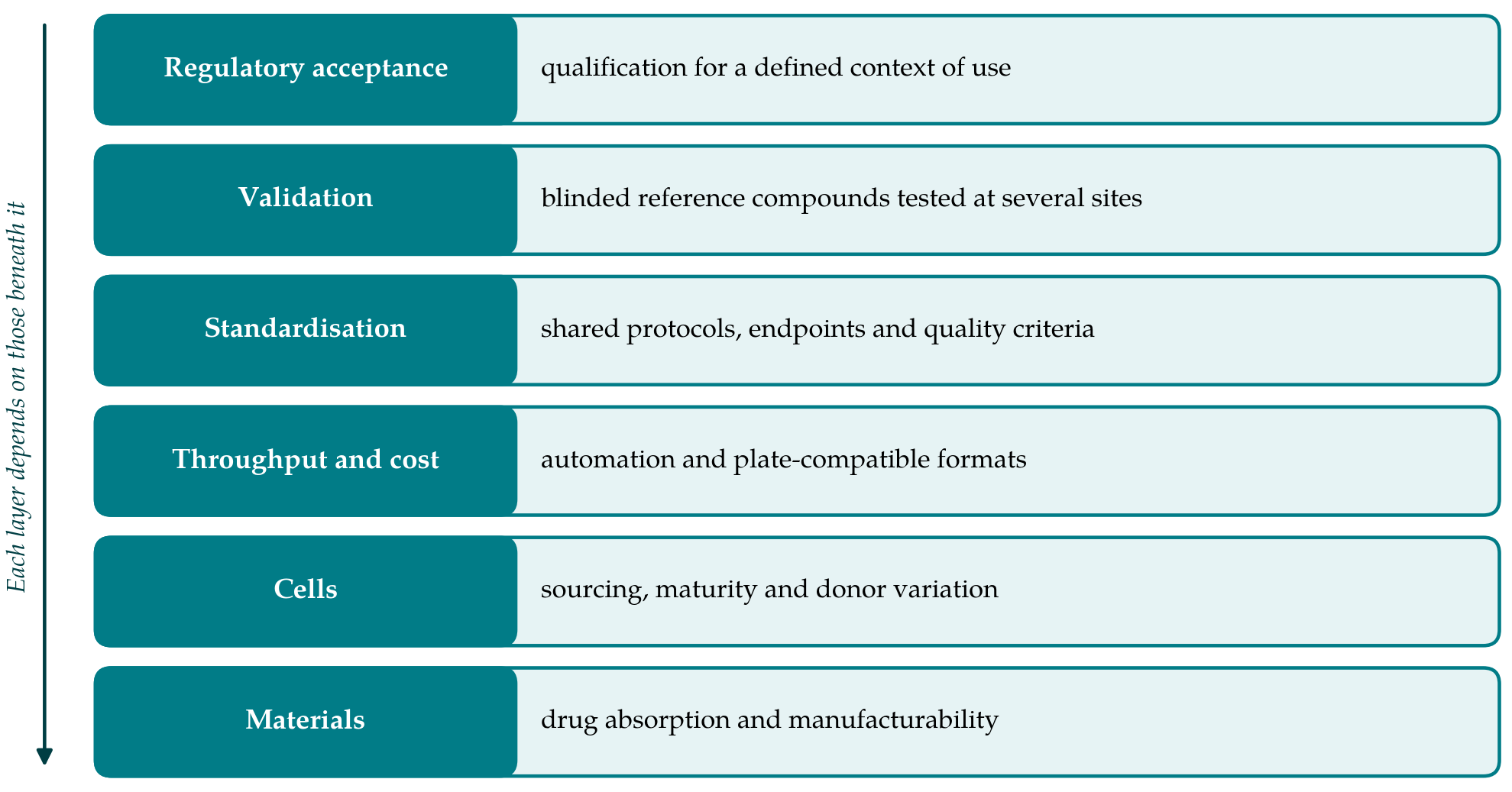
The obstacles to wider use can be arranged as a stack, shown in Figure 1, in which each layer must hold before the one above it can be trusted. Problems at the base, in materials and cells, propagate upwards into irreproducible biology and finally into regulatory hesitation.
6.1. Materials and drug loss
Most research chips are cast in polydimethylsiloxane, a silicone that is transparent, permeable to gases and easy to mould. It also absorbs small hydrophobic molecules, as Toepke and Beebe (2006) pointed out early on, and many drugs are small and hydrophobic. The concentration reaching the cells may then be a fraction of the concentration applied, and the fraction differs from compound to compound (van Meer et al., 2017). Workarounds exist: measuring concentrations in the effluent, modelling the loss, coating the channels, or switching to thermoplastics. Each adds work, and the alternative materials give up the gas permeability or elasticity that made silicone attractive in the first place.
6.2. Cells
A chip is only as human as the cells in it. Primary hepatocytes and tubular cells are scarce, costly and variable between donors, and a lot that performs well cannot be reordered indefinitely. Cell lines are consistent but often lack the metabolic enzymes that matter. Induced pluripotent stem cells promise an unlimited, genetically defined supply, yet their derivatives tend to resemble fetal tissue more than adult tissue, a recognised weakness of cardiomyocytes and hepatocyte-like cells alike (Ingber, 2022). Donor variation is itself informative, given that idiosyncratic toxicity affects a minority of patients, but capturing it requires many donors, and that collides with throughput.
6.3. Throughput, cost and standardisation
Early safety screening handles compounds by the thousand in multi-well plates. A chip experiment handles tens, takes weeks and requires trained staff. Chips are therefore better placed later in the pipeline, for mechanistic follow-up of a few candidates, than as a first filter. Even there, comparison between laboratories is hampered by the variety of designs, media, flow rates and endpoints. Stakeholder workshops have repeatedly called for agreed performance criteria and lists of reference compounds (Marx et al., 2016; Marx et al., 2020), and the industry guidelines for liver models were a concrete step in that direction (Baudy et al., 2020).
6.4. Qualification and regulatory acceptance
Regulators do not approve a technology in the abstract. They accept data from a method for a stated context of use: a particular question, in a particular class of compound, at a particular stage. The FDA Modernization Act 2.0 removed the legal requirement that animal studies precede human trials and named microphysiological systems among the admissible alternatives (United States Congress, 2022). The law permits; it does not qualify. A sponsor who submits chip data in place of an animal study must still persuade reviewers that the model is fit for that purpose, and the evidence for doing so, reproducibility across sites above all, is thin. In practice chips are currently used alongside animal studies, to explain or to prioritise, and not instead of them.
7. Gaps and Future Work
The most useful next step is probably the least glamorous: independent evaluation of existing liver and kidney chips in several laboratories, against larger blinded compound sets that include many negatives, with full reporting of failed runs. Such studies would establish reproducibility and realistic predictive values, and would show whether chips outperform simpler three-dimensional cultures by enough to justify their cost. Comparative work of this kind is rare, since developers have little incentive to fund trials against cheaper competitors.
On the technical side, non-absorbing materials compatible with mass manufacture, integrated sensors that replace end-point assays with continuous readouts, and better protocols for maturing stem cell derivatives would each remove a known weakness. Immune components are largely missing from current models, although immune mechanisms underlie much idiosyncratic injury. Linked multi-organ systems remain research instruments. Their path to regulatory use is longer, and it may prove more productive to combine single-organ data through physiologically based modelling than to build ever larger physical assemblies (Herland et al., 2020).
8. Conclusion
Organ-on-chip platforms have shown that human cells kept under flow and mechanical load reproduce toxic responses that static cultures and, in some instances, animals miss. For the liver in particular there is now a blinded evaluation suggesting real predictive value. The distance between that evidence and routine regulatory use is set by drug absorption into device materials, the supply and maturity of human cells, low throughput, a lack of shared standards, and the absence of multi-site validation for defined contexts of use. These are problems of engineering, logistics and evidence, and none appears insuperable. For the present the realistic role of the technology is as a mechanistic complement to established tests, with replacement of specific animal studies a prospect that depends on validation work still to be done.
Conflict of interest
To be declared by the author(s) before publication.
Funding
To be declared by the author(s) before publication.