1. Introduction
Respiratory distress syndrome is a disease of surfactant deficiency. The link between the surface properties of lung extracts and hyaline membrane disease was drawn by Avery and Mead (1959), and two decades later Fujiwara et al. (1980) showed that instilling surfactant into the airways of affected infants improved gas exchange. For the next quarter of a century surfactant and the endotracheal tube travelled together: the infant was intubated, given surfactant and ventilated. Each part of that package has since been questioned. Trials of nasal continuous positive airway pressure (CPAP) from birth showed that many very preterm infants could be managed without routine intubation (Morley et al., 2008; SUPPORT Study Group, 2010), and professional guidance now treats CPAP as the starting point for respiratory support (Committee on Fetus and Newborn, 2014).
Starting on CPAP creates a new problem. An infant with genuine surfactant deficiency who is left on CPAP alone may deteriorate, and intubating that infant late forfeits the advantage of early treatment. Less invasive surfactant administration (LISA), also described as minimally invasive surfactant therapy (MIST), is an attempt to resolve the dilemma by delivering surfactant through a thin catheter while the infant breathes spontaneously on CPAP. The technique has been studied chiefly in infants born before 32 weeks. This review is concerned with those born a little later, at 32 and 33 completed weeks, who are conventionally described as moderately preterm. They are far more numerous than extremely preterm infants, they are often cared for outside tertiary centres, and decisions about their respiratory care are made with less direct evidence than is commonly assumed.
2. Scope and Approach
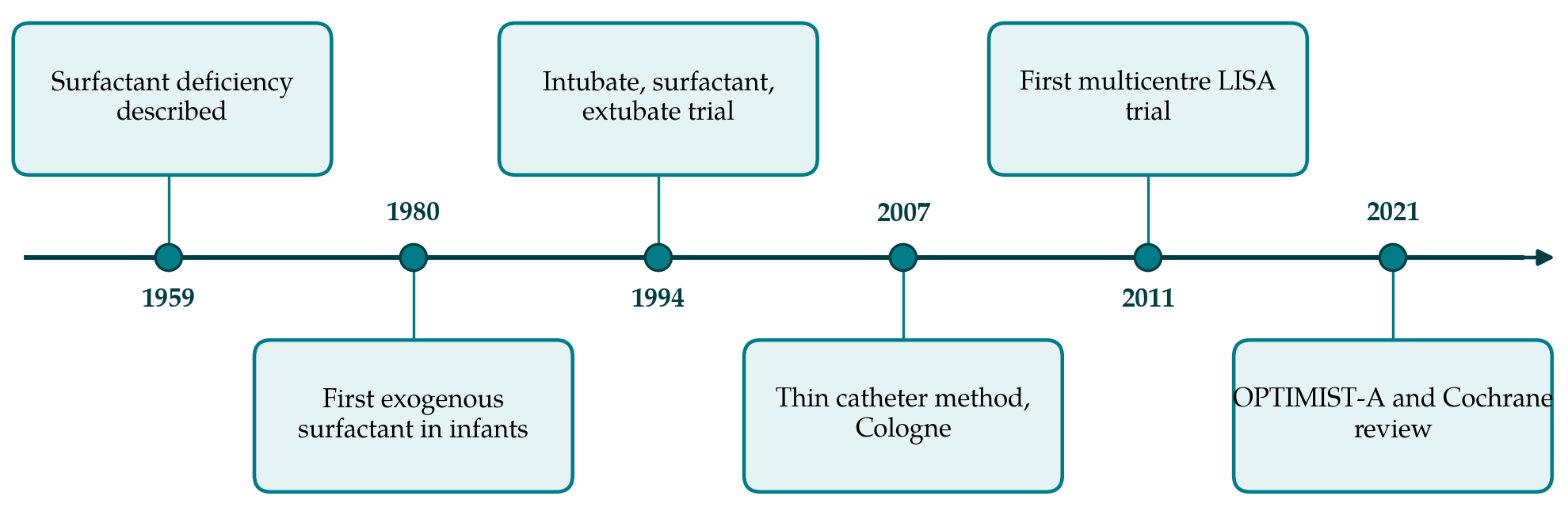
This is a narrative review of the published literature. It draws on the randomised trials of thin-catheter surfactant, the principal meta-analyses, observational reports that bear on technique and safety, and the current European consensus guideline. No formal search protocol was registered and no pooled estimates are calculated here; where a quantitative synthesis is referred to, it is the published one. The trials are discussed by the gestational age of the infants they enrolled, because the central question is one of applicability. Findings are described in words and readers are referred to the original reports for effect sizes. Figure 1 places the main developments in sequence.
3. From Intubation to the Thin Catheter
The first step away from prolonged ventilation was the approach reported by Verder et al. (1994), in which infants on nasal CPAP were briefly intubated, given surfactant and extubated again. Known as INSURE (intubate, surfactant, extubate), it reduced the need for subsequent mechanical ventilation when compared with later selective surfactant and continued ventilation (Stevens et al., 2007). INSURE still requires laryngoscopy, an endotracheal tube, usually premedication, and a period of positive pressure inflations, and a proportion of infants cannot be extubated promptly.
Kribs et al. (2007) in Cologne described a different idea: a fine feeding tube, guided through the vocal cords with Magill forceps under direct laryngoscopy, through which surfactant is given slowly while CPAP continues and the infant breathes. Dargaville et al. (2011) in Hobart developed a variant using a semi-rigid vascular catheter that can be passed without forceps, and reported its use in infants of 25 to 32 weeks (Dargaville et al., 2013). The two methods differ in equipment and in habits of premedication, but share the essential features: spontaneous breathing is preserved, the glottis is not held open by a tube, and no positive pressure breaths are delivered. Purpose-made catheters have since become available, and the practical aspects of the procedure have been reviewed by Herting et al. (2019).
4. What the Trials Show
Table 1 summarises the main randomised trials and the Cochrane review. They fall into three groups according to the infants enrolled, and the pattern of results differs between them in ways that matter for the moderately preterm infant.
| Source | Gestation enrolled | Comparison | Main finding as reported |
|---|---|---|---|
| Göpel et al., 2011 | 26 to 28 weeks | LISA against standard care on CPAP | Fewer infants needed mechanical ventilation |
| Kanmaz et al., 2013 | Below 32 weeks | Thin catheter against INSURE | Less early ventilation; less bronchopulmonary dysplasia |
| Kribs et al., 2015 | 23 to 26 weeks | LISA against intubation and ventilation | Primary outcome not different; more survival without major complications |
| Olivier et al., 2017 | 32 to 36 weeks | MIST against continued CPAP | Fewer infants ventilated or treated for pneumothorax |
| Dargaville et al., 2021 | 25 to 28 weeks | MIST against sham procedure | Death or dysplasia not significantly reduced; fewer intubations |
| Abdel-Latif et al., 2021 | Preterm, mostly below 32 weeks | Thin catheter against endotracheal tube | Lower death or dysplasia and less need for intubation |
4.1. Very and extremely preterm infants
The first multicentre trial, by Göpel et al. (2011), randomised infants of 26 to 28 weeks who were on CPAP to LISA at a modest oxygen requirement or to standard care, in which surfactant was given only after intubation for failing CPAP. Fewer infants in the LISA group were mechanically ventilated. Kanmaz et al. (2013) compared thin-catheter delivery directly with INSURE in infants below 32 weeks and reported less need for ventilation in the first days and a lower rate of bronchopulmonary dysplasia. In the most immature group, 23 to 26 weeks, Kribs et al. (2015) did not show a significant difference in the primary outcome of survival without bronchopulmonary dysplasia, although survival without major complications was more frequent with LISA.
The largest trial, OPTIMIST-A, enrolled infants of 25 to 28 weeks on CPAP with an oxygen requirement of 0.30 or more and compared MIST with a sham procedure, so that clinicians were masked to allocation (Dargaville et al., 2021). The composite of death or bronchopulmonary dysplasia was not significantly reduced. Among survivors bronchopulmonary dysplasia was less frequent, and fewer infants were intubated in the first days or developed pneumothorax. The trial is important for its design as much as its result: with masking in place, the effect on the hard composite outcome was smaller than earlier open trials had suggested.
4.2. Pooled analyses
A network meta-analysis of ventilation strategies in infants below 33 weeks ranked LISA as the strategy associated with the lowest likelihood of death or bronchopulmonary dysplasia, while noting that the quality of the supporting evidence was low (Isayama et al., 2016). The Cochrane review by Abdel-Latif et al. (2021) found that surfactant by thin catheter, compared with surfactant through an endotracheal tube, was associated with a lower risk of the combined outcome of death or bronchopulmonary dysplasia, less need for intubation in the first 72 hours and less severe intraventricular haemorrhage. The authors pointed out that few of the included trials were masked and that data for infants at the extremes of the gestational range were sparse.
4.3. Trials that included moderately preterm infants
Direct evidence for infants of 32 weeks and above is limited. The Canadian multicentre trial by Olivier et al. (2017) is the principal source. It enrolled infants of 32 to 36 weeks who were on CPAP with a rising oxygen requirement and compared MIST with continuation of CPAP and standard management. Infants given surfactant by thin catheter were less likely to need mechanical ventilation or a chest drain for pneumothorax. The trial was small and unmasked, the control group did not receive early surfactant by any route, and it therefore tests the policy of earlier surfactant as much as the method of giving it. The Hobart cohort included infants up to 32 weeks and reported that, in the more mature stratum, MIST was followed by a clear fall in the need for intubation (Dargaville et al., 2013). Beyond these, moderately preterm infants appear in the literature mainly as a minority within broader trials or as participants in studies of other delivery routes.
5. Applying the Evidence at 32 to 33 Weeks
Three features of the moderately preterm infant change how the trial results should be read. The first is baseline risk. Respiratory distress syndrome becomes less frequent as gestation advances, and antenatal corticosteroids, given to women at risk of preterm birth, reduce it further (Roberts et al., 2017). Most infants of 32 to 33 weeks who need support settle on CPAP alone. Bronchopulmonary dysplasia, defined by continuing need for oxygen or respiratory support at 36 weeks of postmenstrual age (Jobe and Bancalari, 2001), is uncommon in this group. A treatment whose headline benefit in smaller infants is a reduction in bronchopulmonary dysplasia cannot be expected to deliver the same benefit where the outcome seldom occurs.
The second feature is that the consequences of CPAP failure are different in kind. In a large cohort of infants managed initially on CPAP, Dargaville et al. (2016) found that failure in those of 29 to 32 weeks was associated with a higher risk of pneumothorax and a longer course of respiratory support, even though mortality was low. For a moderately preterm infant in a unit without facilities for prolonged ventilation, failure may also mean transfer to another hospital and separation from the mother. These are the outcomes on which thin-catheter surfactant could plausibly act, and they are the ones least often chosen as primary endpoints.
The third feature is the infant. A baby of 33 weeks is larger, more vigorous and more likely to resist laryngoscopy than one of 27 weeks. The procedure may be technically easier in terms of anatomy and harder in terms of tolerance. This bears directly on the question of sedation, discussed below, and on how many attempts are needed, which trial reports record inconsistently.
5.1. When to treat
The European consensus guideline recommends rescue surfactant for infants on CPAP whose inspired oxygen fraction exceeds 0.30 at a pressure of at least 6 cm H2O, or whose condition is worsening, and names LISA as the preferred method for spontaneously breathing infants on CPAP where clinicians are experienced in it (Sweet et al., 2023). The oxygen threshold was derived largely from infants below 32 weeks. Whether the same figure identifies the moderately preterm infants who would otherwise fail CPAP, or whether it leads to treatment of many who would have recovered unaided, has not been established. A lower threshold treats more infants unnecessarily; a higher one risks late treatment after atelectasis has progressed. Lung ultrasound scores and bedside tests of surfactant function have been proposed as ways of refining selection, but neither has been tested against oxygen requirement in a trial confined to this gestation.
5.2. Sedation and comfort
Practice ranges from no premedication to low doses of an opioid or propofol. A randomised trial from Leiden found that infants given low-dose propofol before the procedure were more often comfortable but more often needed nasal ventilation during it (Dekker et al., 2019). The trade-off is sharper in the mature infant, who is more likely to struggle and whose spontaneous breathing is the condition on which the technique depends. Non-pharmacological measures such as swaddling and oral sucrose are widely used, although their adequacy for laryngoscopy is debated. No consensus has been reached, and the European guideline leaves the choice to the clinician (Sweet et al., 2023).
5.3. Alternatives without laryngoscopy
Because moderately preterm infants are large enough for supraglottic devices, surfactant through a laryngeal mask has been studied in this group. Roberts et al. (2018) randomised infants of 28 to 35 weeks on CPAP to surfactant through a laryngeal mask or to continued CPAP and reported fewer intubations in the treated group. Nebulised surfactant has also been tested in infants of 29 to 33 weeks, with a reduction in early intubation that appeared confined to the more mature stratum (Minocchieri et al., 2019). Neither approach has been compared directly with a thin catheter in an adequately sized trial. They are relevant here because they offer a route to early surfactant that avoids laryngoscopy altogether, which may suit units where the skill is practised infrequently.
6. Gaps and Priorities for Research
The evidence base has an uneven shape. It is deepest between 25 and 28 weeks, thinner below that, and thinnest above 32 weeks, where the number of infants who could be affected by a change in practice is greatest. A trial confined to moderately preterm infants would need outcomes suited to them: failure of non-invasive support, pneumothorax, days of respiratory support, time to full enteral feeding, transfer to a higher level of care and length of stay. Masking with a sham procedure, as in OPTIMIST-A, is feasible and would guard against the bias that affects decisions to intubate in open trials.
Several secondary questions follow. The oxygen threshold for treatment should be tested and not assumed. Sedation regimens should be compared with procedural success and the need for rescue ventilation as co-primary outcomes. Training deserves study in its own right, since the technique was developed by teams who perform it often, and its safety in hospitals that treat a handful of eligible infants each year is unknown. Video laryngoscopy may shorten the learning curve, and simulation-based training programmes have been described, but their effect on first-attempt success in practice has yet to be measured. Long-term respiratory and neurodevelopmental follow-up is available for very preterm cohorts and absent for moderately preterm ones.
7. Conclusion
Surfactant given through a thin catheter to a spontaneously breathing infant reduces exposure to mechanical ventilation, and in very preterm infants it is associated with less bronchopulmonary dysplasia among survivors. These findings justify its place in current guidance. For infants born at 32 and 33 weeks the case rests on one small trial, on subgroups and on extrapolation. The likely benefits are fewer intubations, fewer air leaks and fewer transfers, and the likely costs are a laryngoscopy that some infants would not have needed and a sedation question without an agreed answer. Units that extend the technique to moderately preterm infants are acting reasonably on indirect evidence, and should audit their thresholds, their procedural success and their failures so that the direct evidence can be built.
Conflict of interest
To be declared by the author(s) before publication.
Funding
To be declared by the author(s) before publication.