1. Introduction
Separating one gas from another is among the most energy-intensive tasks in the chemical industry. Cryogenic distillation and amine scrubbing dominate practice, and both spend heat to overcome small differences between molecules. Sholl and Lively (2016) drew attention to how much energy thermal separations consume and argued that processes based on adsorbents and membranes, which exploit differences in size or affinity without a phase change, could reduce it substantially. That argument has driven a long search for porous solids whose pores can be made to order.
Covalent organic frameworks, usually abbreviated COFs, joined that search in 2005, when Côté et al. (2005) showed that the condensation of aromatic boronic acids gives crystalline, permanently porous layered solids instead of the amorphous networks typical of polymer chemistry. Three-dimensional frameworks followed two years later (El-Kaderi et al., 2007). Because they contain only light elements joined by strong covalent bonds, these materials combine low density with high surface area, and because the geometry of the monomers fixes the geometry of the net, the pore size and shape can be chosen in advance. The conceptual basis has been set out by Diercks and Yaghi (2017), and the breadth of structures now known is documented in the comprehensive review of Geng et al. (2020).
The present review asks a narrower question than those surveys. It considers what is understood about designing COFs for gas separation in particular, and what would have to be resolved for such materials to be made and used at scale.
2. Approach of This Review
The article is a narrative review of the published literature. It relies on the papers that introduced the principal linkages and fabrication methods, on widely cited demonstrations of adsorption and membrane separation, and on reviews of the field. No systematic search was applied and no claim of completeness is made. Reported capacities, selectivities and permeances are not compiled, since they depend on measurement conditions that differ between laboratories.
3. Linkage Chemistry and the Stability Problem
Crystallinity in a COF depends on reversibility. Bonds must form, break and re-form during synthesis so that misplaced building blocks can be corrected, and this error correction is what distinguishes a framework from a disordered network. The difficulty is that a bond reversible enough to permit crystallisation is often reversible enough to be attacked later. The boroxine and boronate ester linkages of the first COFs are hydrolysed by moisture, which rules them out for most gas streams. Imine linkages, introduced into three-dimensional frameworks by Uribe-Romo et al. (2009), are considerably more robust and have become the most widely used. Table 1 summarises the main linkages from the standpoint of gas separation.
| Linkage | Formation | Stability | Bearing on separation |
|---|---|---|---|
| Boroxine, boronate ester | Condensation of boronic acids | Good thermally; hydrolysed by moisture | High porosity; limited to dry gases |
| Imine | Aldehyde plus amine, acid catalysed | Stable to water; sensitive to strong acid | Workhorse for adsorbents and films |
| β-Ketoenamine | Imine formation, then tautomerisation | Resists water, acid and base | Suited to humid and acidic streams |
| Triazine | Nitrile trimerisation in molten salt | Very robust; often low crystallinity | Nitrogen-rich walls bind carbon dioxide |
| Imide | Dianhydride plus amine, high temperature | High thermal stability | Candidate for hot gas streams |
Two developments pushed stability further. Kuhn et al. (2008) obtained triazine-based frameworks by trimerising aromatic nitriles in molten zinc chloride; these withstand harsh conditions but are often poorly ordered. Kandambeth et al. (2012) combined a reversible imine condensation with an irreversible tautomerisation to the β-ketoenamine form, which locks the framework after it has crystallised and gives materials that survive boiling water, acid and base. Imide-linked frameworks with high thermal stability were reported by Fang et al. (2014). The pattern is general: each of these routes gives up some reversibility in exchange for robustness, and the crystallinity of the product often suffers to a corresponding degree, which is why linkage and synthesis conditions have to be chosen together.
4. Design Levers
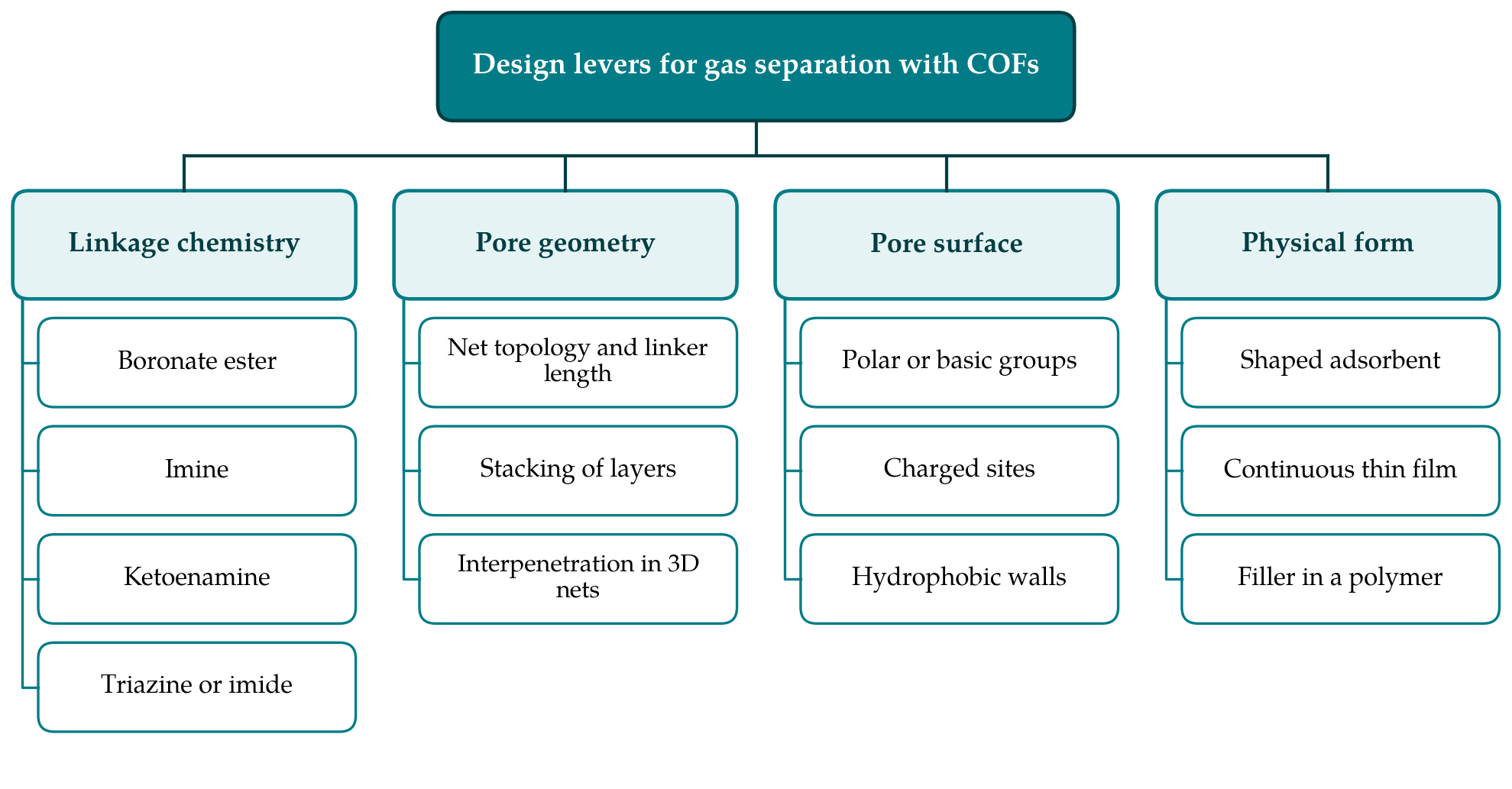
With a stable linkage in hand, the designer can adjust the framework in four broad ways, shown in Figure 1: the linkage itself, the geometry of the pores, the chemistry of the pore surface and the physical form of the product. The last decides whether the material acts as an adsorbent or as a membrane.
4.1. Pore size and stacking
The pores of most COFs are large in relation to gas molecules. Typical two-dimensional frameworks have channels between about one and a few nanometres wide, whereas the kinetic diameters of hydrogen, carbon dioxide, nitrogen and methane all lie between roughly 0.29 and 0.38 nm. A channel that wide cannot sieve such molecules by size. Reticular design can shorten the linkers, and three-dimensional nets can interpenetrate so that one framework partly fills the voids of another, but the smallest building blocks set a floor. For layered frameworks the stacking mode offers another route: when successive sheets are offset instead of eclipsed, the effective aperture narrows. Stacking is hard to control and hard to determine, because most COFs are obtained as microcrystalline powders whose diffraction patterns admit more than one model. The growth of single crystals large enough for X-ray structure determination (Ma et al., 2018) and of single-crystalline two-dimensional colloids by seeded growth (Evans et al., 2018) has begun to remove that uncertainty.
4.2. Pore-wall chemistry
Where sieving is unavailable, selectivity must come from affinity. Carbon dioxide has a large quadrupole moment and is weakly acidic, so walls bearing polar or basic groups bind it in preference to nitrogen or methane. Huang et al. (2015) converted the channel walls of a two-dimensional framework from hydroxyl to carboxylic acid functions and showed that the uptake of carbon dioxide rose with the density of the introduced groups. Amines, triazines, azo groups and ionic sites have been used to similar effect, and the options are surveyed by Zeng et al. (2016). Functionalisation has a cost, since groups that fill the pore reduce the surface area and can slow diffusion, and strong binding raises the energy needed to regenerate the adsorbent.
5. Adsorbents and Membranes
The earliest gas-related work on COFs concerned storage. Furukawa and Yaghi (2009) measured the uptake of hydrogen, methane and carbon dioxide in a series of frameworks and found that the three-dimensional members, with their very high surface areas, held large quantities at elevated pressure. Storage capacity and separation performance are different properties, however. An adsorbent for separation needs a useful working capacity between the adsorption and desorption conditions, selectivity in the mixture, fast kinetics and tolerance of the minor components of the feed.
Selectivity is commonly estimated from single-component isotherms by ideal adsorbed solution theory (Myers and Prausnitz, 1965). The method is sound within its assumptions, but its output is a prediction. Breakthrough experiments with the actual mixture, preferably humid, are the appropriate test, and they are reported less often than calculated selectivities.
Membranes are judged against the trade-off between permeability and selectivity that Robeson (1991) identified for polymers and later updated (Robeson, 2008). Ordered microporous materials are of interest because, in principle, they can lie above that upper bound (Koros and Zhang, 2017). Three membrane forms have been explored with COFs. Continuous polycrystalline films are grown on porous supports or at liquid interfaces, and free-standing films can be cast from a precursor paste (Kandambeth et al., 2017). Because single COF layers have pores too wide for gases, selective membranes have been obtained by stacking two frameworks with different apertures so that the pores interlace (Fan et al., 2018), or by combining a COF layer with a metal-organic framework (Fu et al., 2016). The third form is the mixed-matrix membrane, in which COF particles are dispersed in a polymer. Their wholly organic composition favours adhesion to the matrix, which mitigates the interfacial voids that trouble inorganic fillers (Yuan et al., 2019).
6. Scale-Up Questions
Most COFs have been made on the milligram to gram scale by solvothermal reaction in sealed glass tubes over several days. Each element of that description raises a question for scale-up.
6.1. Monomers and synthesis
The building blocks are speciality aromatic compounds. Multitopic aldehydes and amines with the symmetry required for a given net are produced in small quantities, and the trialdehyde used for β-ketoenamine frameworks is costly to prepare. The solvent mixtures that favour crystallisation, such as mesitylene with dioxane, are neither cheap nor benign. Several alternatives have been demonstrated. Biswal et al. (2013) prepared stable frameworks by grinding the monomers together with little or no solvent. Karak et al. (2017) used p-toluenesulfonic acid to organise the amine before reaction and obtained highly porous frameworks rapidly by simple mixing and heating, a route compatible with extrusion. Peng et al. (2016) showed that an imine framework could be produced at room temperature in continuous flow. What these methods share is the need to reconcile speed with order, since rapid condensation tends to give an amorphous network first, and the conversion of that network into a crystalline framework is the slow step.
6.2. Activation and shaping
A framework is useful only after the solvent has been removed from its pores. Capillary forces during drying can collapse or delaminate layered frameworks, and the measured surface area of a given COF varies widely with the activation procedure. Gentle methods exist, but they add steps. For use in a packed bed the powder must then be formed into pellets or coated on a structured support without crushing the pores or blocking them with binder. Published work on shaping COFs is sparse in comparison with the long experience accumulated for zeolites and activated carbons.
Reproducibility is a related concern. Surface areas reported for nominally the same framework differ between laboratories by large factors, reflecting differences in crystallinity, in residual oligomer trapped in the pores and in activation. For a process designer the relevant figure is the property of material made by the tonne, and no such figure yet exists for any COF. Batch-to-batch consistency at even the kilogram scale is seldom documented, and it would be a useful thing for groups proposing scalable syntheses to report.
6.3. Membrane fabrication
Polycrystalline films contain grain boundaries, and gas takes the easiest path. A membrane separates only as well as its least selective region, so defect density over large areas is the governing parameter. Laboratory membranes are typically a few square centimetres; modules need square metres. Interfacial polymerisation is attractive because the polymer membrane industry already runs it continuously, but whether crystalline order can be maintained at production speed is unresolved. Mixed-matrix membranes fit existing manufacturing most readily, at the price of selectivities limited by the polymer.
6.4. Testing under realistic conditions
Flue gas is wet and contains oxides of sulfur and nitrogen; natural gas carries water, hydrogen sulfide and heavier hydrocarbons. Water competes for polar sites and can swell or hydrolyse the framework over time. Single-gas permeation and dry adsorption isotherms therefore overstate what a material will do in service. Cycling stability over many adsorption and regeneration steps, physical ageing of films, and behaviour under pressure are seldom reported. The comparison that matters is also frequently missing. Zeolite 13X, activated carbons and supported amines are the incumbents for carbon dioxide adsorption, and polyimide and cellulose acetate membranes for gas permeation; a new COF should be measured beside one of them, in the same apparatus and under the same humid conditions, before any claim of advantage is made.
7. Gaps and Future Work
Three kinds of evidence are scarce. The first is cost: there are few published estimates of what a kilogram of a given COF would cost at scale, and without them comparison with zeolites, carbons and amine sorbents is guesswork. The second is durability in mixed, humid feeds over long times. The third is structure: stacking faults, missing linkers and amorphous fractions are known to exist but are difficult to quantify, and they are likely to control transport. Progress on each would benefit from agreed test protocols, including standard gas mixtures and a requirement to report mixed-gas data alongside ideal selectivities. Computational screening has a part to play, since hypothetical frameworks can be enumerated and their adsorption simulated, but such predictions assume perfect crystals and are only as useful as the synthesis that follows. On the materials side, the most promising directions appear to be sub-nanometre pores obtained through controlled stacking or interpenetration, and fabrication routes that borrow directly from established membrane manufacture.
8. Conclusion
COFs give the chemist unusual command over pore geometry and surface chemistry, and the linkage problem that limited the first generation has largely been solved by imine, ketoenamine and related chemistries. For gas separation the central design difficulty is that the natural pore sizes exceed molecular dimensions, so selectivity must be engineered through wall chemistry, stacking or composite architectures. The harder questions now concern manufacture and service: affordable monomers, fast synthesis that preserves order, activation and shaping, defect-free films over large areas, and performance in real mixtures. Until those are answered with data, COFs remain strong candidates and not yet established separation materials. The most useful contributions in the near term are likely to be unglamorous ones: cost estimates, long-duration tests and side-by-side comparisons with incumbent sorbents and membranes.
Conflict of interest
To be declared by the author(s) before publication.
Funding
To be declared by the author(s) before publication.