1. Introduction
Wild legumes are collected for restoration, for forage improvement and as relatives of crops, and their seeds often germinate poorly when first sown. The usual explanation is a hard seed coat, and the usual remedy is scarification. A smaller number of legumes, mostly trees of humid forests such as species of Inga and the Australian Castanospermum australe, produce large, thin-coated seeds that are shed moist and die if dried. For these the hard-seed explanation does not apply, and growers faced with slow or erratic germination sometimes turn to cold moist storage, by analogy with temperate trees.
The phrase "dormancy breaking in recalcitrant seeds through cold stratification" therefore deserves a careful reading before it is taken as the description of a treatment. Each of its three terms has a specific meaning, and the combination is unusual enough that the conditions under which it can hold should be made explicit. This note attempts that. It offers no new observations.
2. Three Terms That Are Easily Run Together
Roberts (1973) divided seeds by their storage behaviour. Orthodox seeds tolerate drying to low water content and live longer the drier and cooler they are kept. Recalcitrant seeds do not survive drying. A third, intermediate category was added later for seeds that tolerate partial drying but are damaged by further drying or by cold storage when dry (Ellis et al., 1990). Recalcitrant seeds are metabolically active when shed and pass from development into germination without the quiescent phase that drying imposes (Berjak and Pammenter, 2008). The classification says nothing directly about dormancy.
Dormancy is a property of a viable seed that fails to germinate under conditions otherwise suitable for germination. The system of Baskin and Baskin (2004) recognises five classes. Two matter here. In physical dormancy a layer of palisade cells in the seed or fruit coat blocks the entry of water; this is the class characteristic of the Fabaceae (Baskin et al., 2000). In physiological dormancy the seed imbibes, but the embryo lacks the growth potential to overcome the restraint of its covering tissues, a state governed largely by the balance of abscisic acid and gibberellins (Finch-Savage and Leubner-Metzger, 2006).
Cold stratification means holding imbibed seeds at low, non-freezing temperatures for weeks or months. It is the classic treatment for physiological dormancy in species of temperate climates. It does not make an impermeable coat permeable, and it cannot act on a seed that has not taken up water (Bewley et al., 2013).
3. What the Classifications Predict for a Recalcitrant Legume
Impermeability of the legume seed coat develops during maturation drying, as the seed approaches low water content on the parent plant. A seed that is shed moist does not complete that step. Physical dormancy and recalcitrance are therefore not expected together, and surveys of desiccation-sensitive species find that the great majority germinate promptly and are not dormant in any sense (Tweddle et al., 2003; Baskin and Baskin, 2014). Desiccation sensitivity is most frequent in large-seeded woody plants of moist, weakly seasonal vegetation, where rapid germination is an advantage, and it can be predicted with fair success from seed mass and the proportion of the seed made up by its coat (Daws et al., 2006). Table 1 summarises the combinations and what each implies for a cold moist treatment.
| Seed type | Response to drying | Usual dormancy | Cold moist treatment |
|---|---|---|---|
| Orthodox legume, hard coat | Tolerant | Physical | No effect until the coat is breached |
| Orthodox, temperate tree or herb | Tolerant | Often physiological | Standard dormancy-breaking treatment |
| Intermediate | Partly tolerant (Ellis et al., 1990) | Variable | Test with care; cold may injure |
| Recalcitrant, tropical | Killed | Usually none | Risk of chilling injury; not advised |
| Recalcitrant, temperate | Killed | None or physiological | May release dormancy and slows deterioration |
The last row is where the title phrase can be true. Some temperate recalcitrant seeds, among them those of several oaks and of horse chestnut, tolerate chilling when moist and have a degree of physiological dormancy that chilling removes (Baskin and Baskin, 2014). A wild legume of a cool, moist habitat with a thin-coated, desiccation-sensitive seed could in principle behave in the same way. Such a case would be of real interest, and for that reason it needs to be established with more than a higher germination percentage after cold storage.
4. How an Apparent Response to Chilling Can Mislead
Several things other than dormancy release can raise germination after a period in a cold, moist medium. A seed that was slow but not dormant will simply have had more time, and some development may have continued in the cold. A seed with a partly permeable coat may have imbibed slowly during the treatment. Fungal softening of the coat in moist medium can have the same effect. In the other direction, seeds of tropical origin may be injured by chilling, so that a poor result reflects damage and not a failure to release dormancy (Berjak and Pammenter, 2008). A further source of confusion is the storage classification itself: a seed described as recalcitrant on the strength of its size or habitat may prove orthodox or intermediate when its tolerance of drying is actually tested, and the survey of African dryland trees by Pritchard et al. (2004) shows how closely storage behaviour follows ecology.
5. A Diagnostic Sequence Before Stratification
Three determinations should come before any chilling trial; Figure 1 sets out the reasoning. The first is storage behaviour, established by drying samples to a series of water contents and testing survival, as in the protocol of Hong and Ellis (1996). The second is whether the fresh seed takes up water, shown by weighing seeds during imbibition with and without a nick in the coat. The third is viability of the embryo, by cutting and by a tetrazolium test. Only a seed that is desiccation-sensitive, imbibes freely, is alive and still fails to germinate within about four weeks under favourable warm conditions has a dormancy that stratification might address.
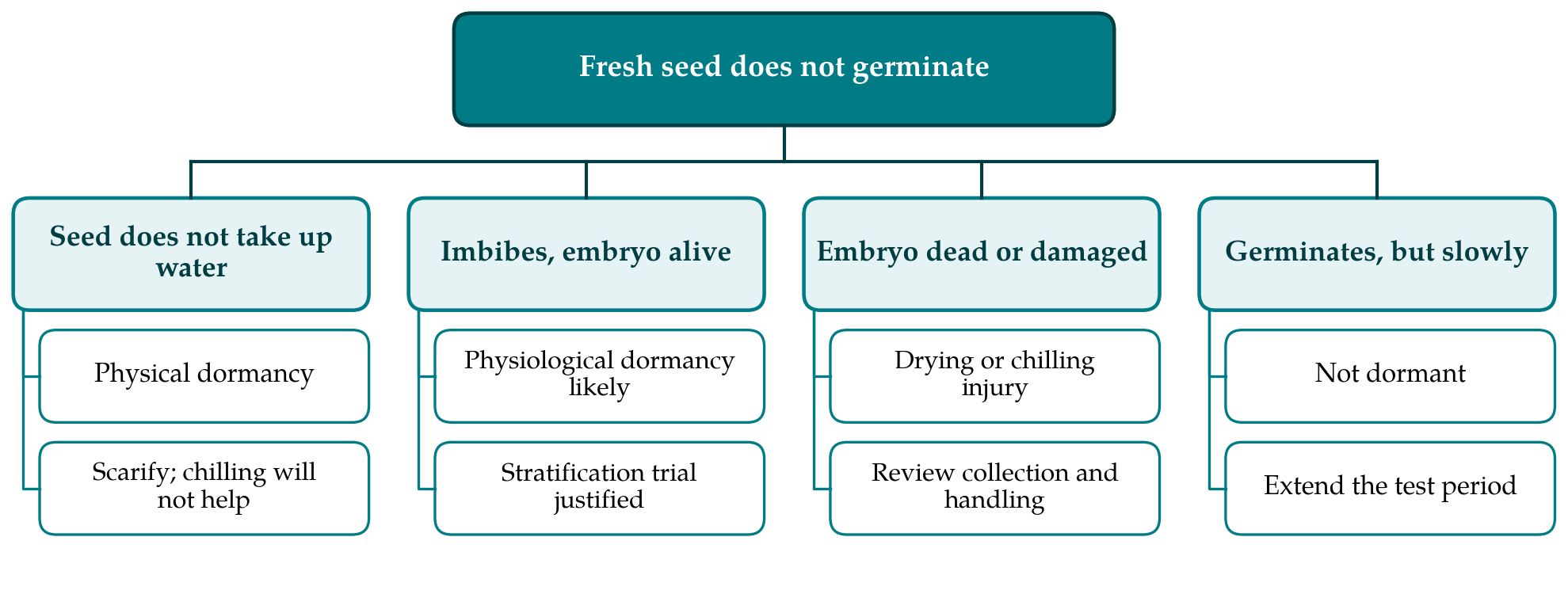
A trial that follows should include a control held moist at warm temperature for the same duration, which separates the effect of cold from that of time and hydration. Several durations of chilling should be compared. Seed water content and viability should be measured at the start and at the end of each treatment, since recalcitrant seeds lose viability in storage at any temperature. Germination should be reported as a proportion of viable seeds, with the time course, and the temperature of chilling should be stated together with the reason for choosing it. With these elements a positive result can be attributed to release of physiological dormancy, and a negative one is informative.
6. Conclusion
Cold stratification of a recalcitrant legume seed is a reasonable thing to investigate in a narrow set of circumstances and a category error in most others. The established frameworks of storage behaviour and dormancy classification indicate which is which, provided that the seed is characterised before it is treated. Reports on wild legumes would be more useful, and more comparable, if they stated the storage class, the imbibition behaviour and the viability of the seed lot alongside any effect of chilling.
Conflict of interest
To be declared by the author(s) before publication.
Funding
To be declared by the author(s) before publication.