1. Introduction
Poisson's ratio is the negative ratio of transverse to axial strain in a body under uniaxial stress. For nearly all common solids it is positive: a stretched rubber band gets thinner. A negative value means the opposite, lateral expansion in tension and lateral contraction in compression. Such behaviour was known in a few crystals and discussed in theory, but it became a subject of engineering interest when Lakes (1987) converted an ordinary polymer foam into one with a negative Poisson's ratio by compressing it triaxially and heat-setting the buckled cell ribs. The adjective auxetic, from a Greek root meaning that which tends to increase, was introduced a few years later by Evans et al. (1991).
Since then the subject has grown along two lines. One concerns naturally occurring or processed auxetic materials: foams, microporous polymers, certain crystals. The other concerns mechanical metamaterials, in which a designed cell, repeated periodically and usually made by additive manufacturing, produces the effect through its kinematics (Bertoldi et al., 2017). Several broad reviews, from the early survey of Evans and Alderson (2000) onward, catalogue the architectures and their reported properties (Saxena et al., 2016; Kolken and Zadpoor, 2017; Ren et al., 2018).
Among the advantages claimed for auxetic structures, energy absorption attracts the most applied interest, with protective padding, crash structures and blast panels as intended uses. The argument is intuitive: under a compressive blow the material draws inward and densifies beneath the load. The present review has a narrower aim than the catalogues cited above. It asks which design rules reliably yield a negative Poisson's ratio together with useful stiffness and strain range, and what bounds the energy an auxetic metamaterial can absorb in comparison with a conventional cellular solid of the same mass.
2. Approach of the Review
The article is a narrative review of the published literature. Sources were chosen for their standing in the field: the papers that introduced each family of architecture, the analytical models in general use, representative experimental and numerical studies of crushing, and earlier reviews. The treatment is restricted to passive, periodic structures in the quasi-static and low-to-moderate velocity impact regimes. Active or programmable metamaterials, auxetic textiles and laminates made auxetic by their stacking sequence are left out. No new data are presented, and comparisons between studies are qualitative, because specimens, base materials and test conditions differ too much for pooled figures to mean anything.
3. What Elasticity Permits
For an isotropic linear elastic solid, positive definiteness of the strain energy requires Poisson's ratio to lie between -1 and 0.5. The upper limit corresponds to incompressibility; the lower limit corresponds to a material that keeps its shape and changes only its size, with a shear modulus far exceeding its bulk modulus (Greaves et al., 2011). Nothing in thermodynamics forbids the negative half of this interval, and Milton (1992) showed that composites of ordinary phases can be constructed with a Poisson's ratio arbitrarily close to -1. For anisotropic materials the ratio between a given pair of directions has no bounds at all (Ting and Chen, 2005), which is why strongly directional cells can show values well beyond the isotropic range.
Two relations from isotropic elasticity explain most of the benefits attributed to auxetic behaviour. The shear modulus equals Young's modulus divided by 2(1 + ν), so it grows without limit relative to Young's modulus as ν approaches -1. The contact stiffness in indentation scales with Young's modulus divided by (1 - ν2), which grows in the same way. Both statements hold at fixed Young's modulus. That qualification is the source of much confusion, because the geometric changes that make a cell auxetic usually lower its Young's modulus as well, and a fair comparison has to be made at equal density or equal mass.
4. Mechanisms and Design Rules
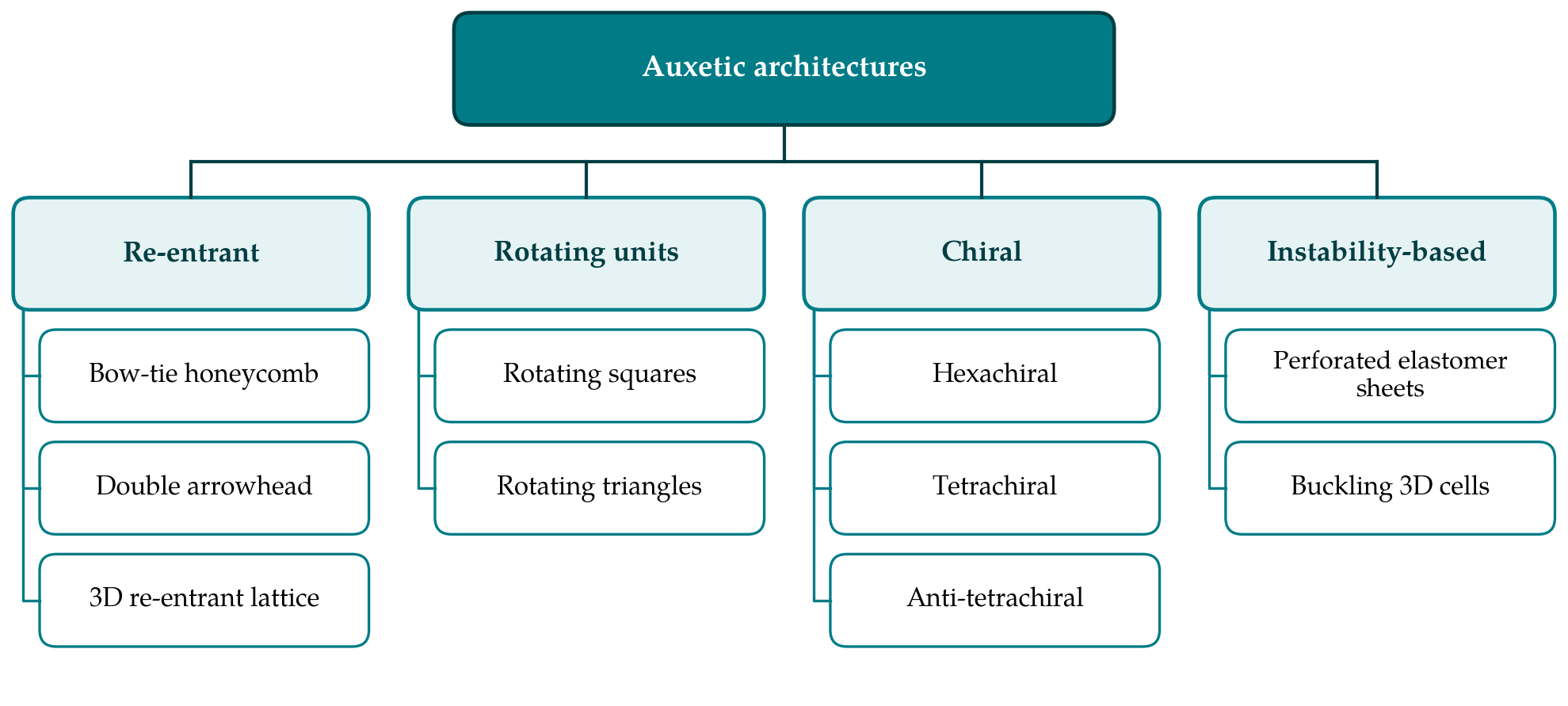
Auxetic architectures can be sorted by the mechanism that produces lateral contraction under compression. Figure 1 shows the four families considered here, with common examples of each.
4.1. Re-entrant cells
The re-entrant or bow-tie honeycomb is the oldest and best understood design. The analysis of two-dimensional cellular materials by Gibson et al. (1982) already showed that a hexagonal honeycomb whose inclined walls point inward has a negative in-plane Poisson's ratio, and the model of Masters and Evans (1996) added wall stretching and hinging to flexure so that the elastic constants can be written in closed form. The design variables are the re-entrant angle, the ratio of inclined to horizontal wall length and the wall thickness. A sharper angle makes Poisson's ratio more negative in one loading direction but leaves less room before opposite vertices touch, and the response is strongly anisotropic. Three-dimensional versions, built from the same motif in orthogonal planes, have been made in titanium alloy by electron beam melting and compared with beam-theory predictions (Yang et al., 2015). Arrowhead-shaped cells obtained by topology optimisation belong to the same family (Larsen et al., 1997).
4.2. Rotating units
Grima and Evans (2000) showed that rigid squares connected at their corners by hinges form a mechanism with a Poisson's ratio of -1 that is isotropic in the plane and independent of the degree of opening. Triangles, rectangles and other polygons give variants. The idealisation assumes perfectly rigid units and free hinges; a manufactured version has ligaments of finite thickness at the corners, and its Poisson's ratio moves towards zero as those ligaments stiffen in proportion to the units. Stress concentrates at the hinges, so strength and fatigue life are set by a small fraction of the material.
4.3. Chiral lattices
In the hexachiral honeycomb of Prall and Lakes (1997), circular nodes are joined by ligaments attached tangentially. Compression makes the nodes rotate and wind the ligaments around themselves, and the in-plane Poisson's ratio stays close to -1 over a wide range of strain. Tetrachiral and anti-tetrachiral arrangements, with four ligaments per node, are easier to fabricate and are anisotropic. Chiral lattices are comparatively compliant in the plane because deformation is carried by ligament bending, and the long, thin ligaments are prone to buckling once crushing begins.
4.4. Instability-based designs
A different route uses buckling. Bertoldi et al. (2010) compressed an elastomer sheet perforated by a square array of circular holes and found that, beyond a critical strain, the ligaments between holes buckle into a pattern of alternating ellipses that pulls the sheet inward: Poisson's ratio becomes negative only after the instability. The effect is reversible in an elastomer, and the same principle has since been taken into three dimensions (Bertoldi et al., 2017). The design rule is porosity: the holes must be large enough for pattern buckling to precede any other mode. Such structures are auxetic in compression only, which happens to be the loading that matters for impact.
Two rules hold across the families, and Table 1 sets them beside the family-specific points. First, the auxetic effect is produced by bending or rotation of slender members, which places these structures in the bending-dominated class of cellular solids (Gibson and Ashby, 1997). Second, Poisson's ratio is a function of strain: it is most negative near the reference configuration, or just after buckling, and drifts towards zero as the cells close. A designer therefore has to specify the strain range over which the property is wanted, and not a single value.
| Family | Controlling geometry | In-plane behaviour | Main weakness |
|---|---|---|---|
| Re-entrant (Masters and Evans, 1996) | Re-entrant angle, wall length ratio, wall thickness | Strongly anisotropic; ratio tunable by angle | Low stiffness; limited stroke before self-contact |
| Rotating units (Grima and Evans, 2000) | Unit shape, hinge ligament thickness | Isotropic, near -1 for ideal hinges | Stress concentration at hinges |
| Chiral (Prall and Lakes, 1997) | Node radius, ligament length and thickness | Near -1 over a wide strain range | Compliant; ligaments buckle during crushing |
| Instability-based (Bertoldi et al., 2010) | Porosity and hole arrangement | Auxetic only after buckling, in compression | Base material must tolerate large elastic strain |
| Optimised cells (Larsen et al., 1997) | Free-form, from topology optimisation | Prescribed by the objective | Thin features; sensitive to manufacturing defects |
5. Energy Absorption: What Auxetic Behaviour Adds
A good energy absorber crushes at a nearly constant stress over a long stroke. The absorbed energy per unit volume is the area under the stress-strain curve up to densification, and the plateau stress must stay below the level that would injure the occupant or damage the protected structure (Lu and Yu, 2003). A conventional honeycomb or foam meets this description well. An auxetic design can alter three things: the plateau stress, the densification strain, and the way the load spreads.
The clearest benefit is in localised loading. When a small indenter or striker presses into an auxetic material, the lateral contraction draws material in from the sides, so the region under the load becomes denser and harder as it is compressed. Lakes and Elms (1993) compared conventional and re-entrant foams under indentation and reported greater resistance to indentation and higher energy absorption for the re-entrant material. These are foams, with their own cell-rib mechanics, but the densification mechanism does not depend on the particular microstructure and carries over to designed lattices.
For uniform crushing between flat platens the picture is less simple. Finite element studies of re-entrant honeycombs under in-plane impact show the cells collapsing inward into a compact band, with a plateau stress that rises with crushing velocity (Liu et al., 2016), as it does for hexagonal honeycombs (Ruan et al., 2003). Qiao and Chen (2015) derived expressions for the plateau stress of double arrowhead honeycombs and examined graded versions, in which wall thickness varies through the depth so that collapse proceeds layer by layer. Numerical work on sandwich panels with auxetic cores under blast loading suggests that the inward flow of core material towards the loaded zone can reduce back-face deflection in comparison with a monolithic plate of equal mass (Imbalzano et al., 2016). Much of this evidence is computational, and it compares auxetic designs with a limited set of conventional ones.
6. Limits on Energy Absorption
Four limits recur in the studies reviewed. They concern the strength available at a given mass, the lateral boundary conditions, the usable strain range and the rate of loading.
6.1. Strength for a given mass
In a bending-dominated cellular solid, stiffness and collapse strength fall steeply as relative density is reduced. For an open-cell foam the modulus scales with the square of relative density and the plastic collapse stress with its three-halves power; for in-plane loading of a honeycomb the corresponding exponents are three and two (Gibson and Ashby, 1997). Auxetic cells obey scalings of this kind, with coefficients that depend on the re-entrant angle or the ligament geometry. A stretching-dominated lattice of the same density is far stronger. Specific energy absorption is, to a first approximation, plateau stress times densification strain divided by density, so an auxetic core starts at a disadvantage that the Poisson effect has to make up. In uniform crushing it generally does not; the gain appears where the loading is local.
6.2. Boundary conditions and finite size
Lateral contraction needs somewhere to come from. In a panel clamped at its edges, or a core bonded between stiff face sheets, the inward movement is restrained and the auxetic mechanism is partly suppressed, while in a narrow specimen with free sides the edge cells deform differently from the interior. Measured Poisson's ratios and plateau stresses therefore depend on the number of cells across the specimen and on how it is held. This sensitivity is seldom reported in a way that allows results from different laboratories to be compared, and it bears directly on design, since real absorbers are always attached to something.
6.3. Strain range
Every mechanism described above has a geometric end stop. Re-entrant walls meet, rotating units close, chiral ligaments are fully wound, buckled holes shut. Poisson's ratio rises towards zero or becomes positive as that point nears, and the structure densifies. Because auxetic cells contract in both directions, they can reach densification at a smaller axial strain than a conventional honeycomb of the same relative density, which shortens the stroke over which energy is absorbed. A sharper re-entrant angle strengthens the auxetic effect and shortens the stroke at once, a design conflict with no general resolution.
6.4. Loading rate
At high crushing speeds, collapse localises at the impact face and travels through the structure as a front. The stress behind the front is then governed by density and velocity, as in the rigid, perfectly plastic, locking shock model that Reid and Peng (1997) developed for wood and that has since been applied widely to cellular materials. In this regime the inertial contribution grows with the square of velocity, and the difference between auxetic and conventional topologies of equal density narrows. Poisson's ratio is a quasi-static property of the cell. Its influence is strongest at low and moderate rates, where the whole specimen can respond before the front arrives.
7. Gaps and Future Work
Three gaps recur in the literature. Comparisons are often made against a single conventional baseline chosen by the authors, and seldom at equal mass, equal base material and equal envelope together. A common protocol, stating relative density, cell count, boundary conditions and strain rate, would make results cumulative. Second, most dynamic studies are numerical, with idealised geometry and elastic, perfectly plastic walls. Printed metal and polymer cells have rough surfaces, residual porosity and limited ductility, and their walls may fracture before the mechanism has run its course. Experiments that follow cell collapse at realistic impact speeds are needed to test the simulations.
Third, the more promising uses seem to lie in combining auxetic behaviour with something else. Graded or hierarchical cores, auxetic layers placed only where loading is local, and hybrid cells that mix stretching-dominated members with a re-entrant mechanism all aim to recover strength without giving up lateral contraction. Fracture and fatigue of hinge and ligament regions under repeated impact have received little attention, although protective equipment is rarely used only once. Recoverable designs based on elastic instability address reuse, at the price of low absorbed energy per unit volume in soft base materials.
8. Conclusion
A negative Poisson's ratio is permitted by elasticity and can be engineered by a small number of well-understood mechanisms: re-entrant walls, rotating units, chiral ligaments and controlled buckling. The design rules linking geometry to Poisson's ratio are mature. The case for energy absorption is narrower than is often stated. Auxetic metamaterials offer a demonstrable advantage under indentation and localised impact, where inward flow of material stiffens the loaded region, and they can be graded to shape the crushing sequence. Against this stand low strength per unit mass, dependence on lateral freedom, a shortened stroke and a diminishing role of topology as impact speed rises. Design should therefore begin from the loading case and ask whether lateral contraction helps it, and should not begin from the auxetic property itself.
Conflict of interest
To be declared by the author(s) before publication.
Funding
To be declared by the author(s) before publication.