1. Introduction
Large gravity irrigation systems deliver water unevenly along their length. Farmers near the head of a distributary or a watercourse take what they need, often more, and what is left travels on through earthen channels that leak. By the time the flow reaches the last village it is smaller, later and less certain than the design assumed. Chambers (1988) called this tail-end deprivation and argued that it was the central failure of canal irrigation in South Asia, rooted in the management of the main system as much as in the behaviour of farmers. Later studies of individual systems documented the same pattern and the political economy that sustains it (Mollinga, 2003).
Rotation is the standard institutional answer to scarcity within an outlet command. Each farmer receives the whole flow of the watercourse for a fixed period in a repeating cycle, so that the share is defined in time and not in volume. Where rotations are imposed from outside, however, they are frequently ignored, and where farmers devise their own, the result can be durable (Wade, 1988; Ostrom, 1992). The practical problem for an irrigation agency, a non-governmental organisation or a water users association is how to arrive at a roster that tail-end farmers regard as theirs.
This article proposes a framework for doing so. It is written for the situation of a single village served by one or a few outlets near the end of a distributary. The framework is a design procedure assembled from published engineering practice and institutional research. It is not a report of a case, and no application of it is described.
2. Background
The design rests on three bodies of knowledge: why tail ends run short, how rotational rosters are constructed, and what makes locally agreed rules last.
2.1. Why tail ends run short
Shortage at the tail has physical and institutional causes that are hard to separate. Conveyance losses accumulate with distance. Upstream outlets are enlarged, tampered with or kept open out of turn. Cropping patterns in head reaches shift to crops that need more water than the system was designed to supply. Main-system operation adds variability that no outlet-level arrangement can remove (Chambers, 1988; Bromley et al., 1980). Many tail-end farmers respond by pumping groundwater, which changes what they want from the canal: a reliable recharge and a pre-sowing irrigation may matter more to them than an equal share through the season (Shah, 2009). A rotation designed without regard to these causes will allocate a flow that does not arrive.
2.2. Rotational delivery and warabandi
The most thoroughly documented rotation is the warabandi of north-west India and Pakistan. In its formal version each farmer on a watercourse has the right to the full flow for a period proportional to the area held, at a fixed time in a weekly cycle of 168 hours. The roster makes allowance for the time the flow takes to fill the empty channel on its way to a field and credits the water that drains from the channel after the supply is cut off (Malhotra, 1982). The system is valued for its transparency, since every farmer knows every other farmer's turn. Bandaragoda (1998) compared the official roster with practice in the Pakistani Punjab and found wide departures, including the exchange and sale of turns and the persistence of informal rosters agreed among farmers alongside the official ones. Division of flow by proportional structures is an alternative to division by time, and each suits different conditions (Horst, 1998).
2.3. Conditions for durable collective rules
Research on common-pool resources identified regularities among irrigation systems that farmers have governed successfully for long periods. They include clear boundaries of the group and the resource, rules matched to local conditions, participation of those affected in changing the rules, monitoring by the users or by people accountable to them, graduated sanctions and accessible means of settling disputes (Ostrom, 1990). Comparative work in Nepal found that farmer-managed systems often outperformed agency-managed ones on delivery to the tail (Lam, 1998), and Wade (1988) observed in South India that villages facing the greatest scarcity and risk were the ones that organised common irrigators and field guards. Experience with organisers placed in farming communities showed that such cooperation can be fostered deliberately (Uphoff, 1986). The same literature cautions against treating any institutional model as a remedy for all settings (Meinzen-Dick, 2007).
3. The Proposed Framework
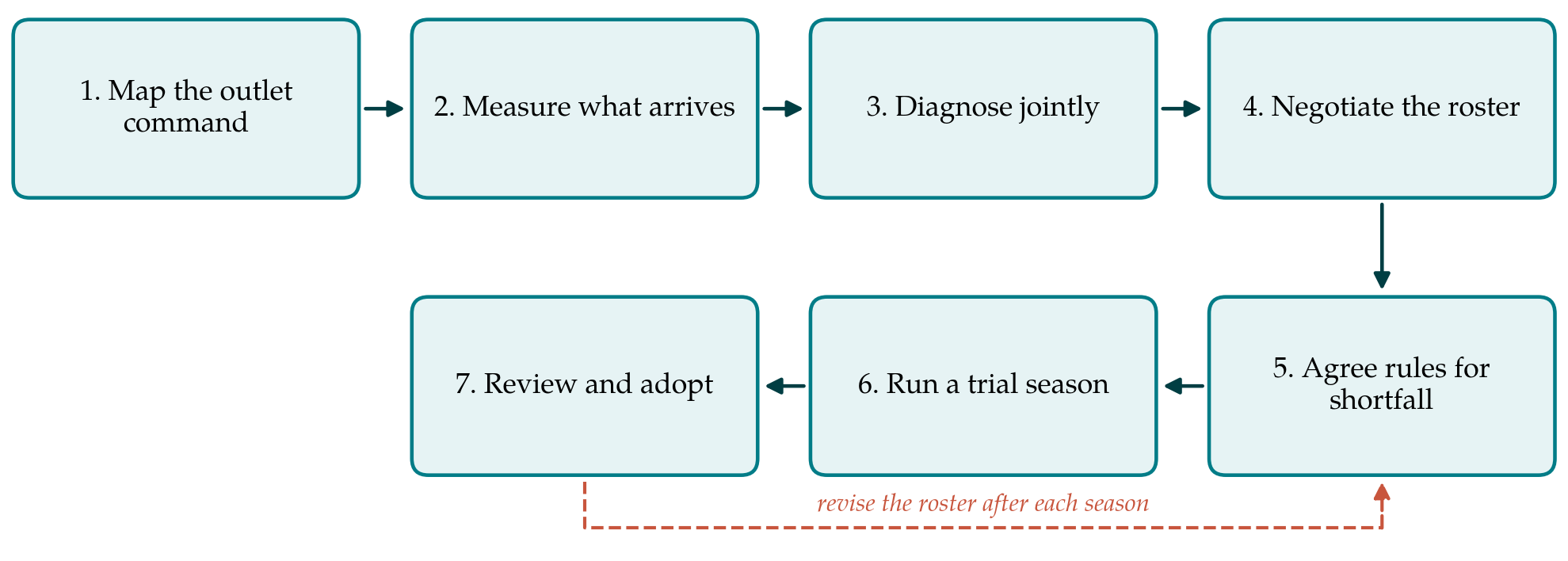
The framework has seven steps, listed in Table 1 with the output of each and drawn as a sequence in Figure 1. It is intended to be led by a facilitator working with the farmers of the outlet over one irrigation season of preparation and one of trial. Decisions on shares, order of turns and sanctions rest with the farmers throughout; the facilitator supplies measurement, arithmetic and record keeping.
| Step | Led by | Output |
|---|---|---|
| 1. Map the outlet command | Farmers with facilitator | Channel map, list of users with areas and field positions |
| 2. Measure what arrives | Facilitator with trained farmers | Record of flow at the outlet and along the watercourse |
| 3. Diagnose jointly | General meeting | Agreed statement of causes, split into internal and external |
| 4. Negotiate the roster | Farmers; arithmetic by facilitator | Time roster with conveyance allowances and order of turns |
| 5. Agree rules for shortfall | General meeting | Written rules on priority, monitoring, sanctions and disputes |
| 6. Run a trial season | Elected committee | Log of turns kept, turns missed and complaints |
| 7. Review and adopt | General meeting | Revised roster and rules; requests to the agency |
3.1. Step 1: Map the outlet command and its users
The first task is to establish who is in the group and what they hold. A walk along the watercourse with farmers from head, middle and tail produces a sketch map of channels, field inlets and problem reaches, in the manner of participatory rural appraisal (Chambers, 1994). The map is reconciled with the official list of the outlet's command. Tenants, sharecroppers and women who farm without title should be recorded as users, since a roster that names only owners leaves the people who irrigate outside the agreement.
3.2. Step 2: Measure what arrives
Negotiation over shares is pointless if nobody knows the size of what is being shared. Flow should be measured at the outlet and at two or three points down the watercourse over several rotations, using a portable flume or a calibrated section (Bos, 1989). Trained farmers can take the readings. The measurements yield the quantities the roster needs: the usual discharge, its variability from turn to turn, the loss between head and tail, and the time the flow takes to reach each field inlet from the previous one.
3.3. Step 3: Diagnose jointly
The measurements are presented at a general meeting, and the causes of shortage are sorted into those the group can act on and those it cannot. Performance assessment offers a vocabulary for this. Molden and Gates (1990) distinguish adequacy, efficiency, dependability and equity of delivery, and practical guidelines show how to compute simple indicators of each (Bos et al., 2005). Poor dependability at the outlet is a matter for the agency. Inequity between head and tail of the watercourse is a matter for the farmers. Keeping the two apart prevents the rotation from being blamed for failures that originate upstream.
3.4. Step 4: Negotiate the turn schedule
The roster follows the logic of warabandi with local choices made explicit. The farmers decide the length of the cycle, the basis of shares, the order of turns and whether turns rotate between day and night from one season to the next. The facilitator then computes the time per unit area as the cycle length, adjusted for total filling time and drainage credit, divided by the total area, and adds to each farmer's turn the filling time for the reach that must be wetted (Malhotra, 1982). The question most likely to divide the meeting is whether tail-end fields should receive extra time to compensate for seepage in transit. The framework does not prescribe an answer. It requires that the measured loss be put before the meeting and that the decision be recorded.
3.5. Step 5: Agree rules for shortfall, monitoring and sanctions
A roster describes the normal week. Tail-end outlets have few normal weeks, so the rules for abnormal ones carry most of the weight. The group should settle in advance what happens when the canal runs at a fraction of its usual flow or closes midway through a cycle: whether the cycle resumes where it stopped, whether priority goes to standing crops at a critical stage, and whether turns may be lent or exchanged. Monitoring should be assigned to a person chosen by the farmers and answerable to them. Sanctions should begin small and rise with repetition, and there should be a named forum for complaints, in keeping with the regularities noted by Ostrom (1990).
3.6. Steps 6 and 7: Trial season and review
The roster is run for one season as a trial. A committee keeps a log of turns taken, turns missed through lack of supply, turns taken out of order and complaints raised. At the end of the season the log and a second round of flow measurements are brought to a general meeting, the roster and rules are revised, and the group decides whether to adopt them. Matters outside its control, such as the timing of distributary rotations or the repair of the outlet, are put to the irrigation agency in writing. Guidance on the transfer of management functions to farmer organisations describes how such requests can be given standing (Vermillion and Sagardoy, 1999).
4. Fitting the Framework to Local Conditions
Three conditions will shape how the framework is used. Where groundwater is widely pumped, the rotation may need to apply only to part of the season or to farmers without wells, and the map of Step 1 should record well ownership. Where the law provides for water users associations, the roster and rules can be adopted as by-laws; where it does not, they rest on local agreement alone and the role of village institutions becomes more important. Where the supply to the outlet is itself rotated among distributaries, the cycle length inside the outlet has to be fitted to the days on which water is expected, and the agency's schedule becomes an input to Step 4.
5. Limitations and What Remains to Be Shown
The framework has not been tested. Its claim is only that each step is supported by established practice or published research, and whether the steps work together in a tail-end village is an empirical matter. A field test should establish at least three things: whether the equity of delivery between head and tail of the watercourse improves, measured by flow and not by reported satisfaction; whether the roster is still followed in the second and third seasons, when the facilitator has left; and whether participation extends to tenants and smallholders or is confined to the larger owners.
Two limits are built in. A rotation redistributes the water that reaches the outlet and cannot create more of it, so where the deficit arises in the main system the framework will at best share scarcity more fairly. It also assumes a degree of common interest. Where a few head-end farmers gain greatly from the present disorder and hold local power, a negotiated roster may not be attainable without outside enforcement, and the framework offers no means of supplying it.
6. Conclusion
Rotational sharing of canal water is an old technique whose arithmetic is well understood. What is less often written down is a procedure by which the farmers of a deprived outlet can arrive at a rotation of their own. The framework proposed here joins measurement of the flow that actually arrives, a diagnosis that separates internal from external causes, a roster negotiated on that basis, and rules for the seasons when supply fails. It is offered as a design to be tried and corrected in the field.
Conflict of interest
To be declared by the author(s) before publication.
Funding
To be declared by the author(s) before publication.