1. Introduction
A garment that protects against rain, chemical splash or infective aerosols is of little use if the wearer cannot work in it. Impermeable films stop liquids completely and also stop the evaporation of sweat, so that heat stress becomes the limiting hazard. The response of the textile industry over the past half century has been the waterproof breathable fabric, in which a microporous or hydrophilic layer blocks liquid water while passing water vapour (Mukhopadhyay and Midha, 2008; Lomax, 2007).
Electrospinning entered this field in the late 1990s, when the technique was revived as a general way of making polymer fibres with diameters well below a micrometre (Reneker and Chun, 1996). Researchers at a United States Army laboratory recognised early that a thin web of such fibres offered high resistance to convective air flow and to aerosol penetration with very little resistance to vapour diffusion, which is the combination a protective garment needs (Gibson et al., 2001; Schreuder-Gibson et al., 2002). A large literature has followed.
This review examines that literature from the point of view of someone who has to turn a membrane into clothing. It asks which materials are suitable, how processing conditions control the structure on which barrier and comfort depend, and what is known about how long the structure lasts in use.
2. Approach of the Review
The article is a narrative review. It relies on the general reviews of electrospinning that have shaped the field, on primary papers that deal specifically with barrier and comfort properties of nanofibre webs, and on the international test standards by which protective and rainwear fabrics are assessed. Sources were chosen for their standing and relevance and not through a formal search protocol. Filtration media, wound dressings and energy applications of electrospun webs are mentioned only where they illuminate the clothing problem.
3. Reconciling Barrier and Breathability
Liquid water and water vapour cross a porous layer by different mechanisms. Liquid enters a pore only when the applied pressure exceeds the capillary pressure, which grows as the pore becomes smaller and as the contact angle of the liquid on the pore wall rises. Vapour moves by diffusion through the air in the pores, at a rate set mainly by porosity and thickness and hardly at all by pore size until pores approach molecular dimensions. A layer with many very small pores, thin and highly porous, can therefore hold back liquid under pressure while offering a short, open path to vapour (Mukhopadhyay and Midha, 2008).
An electrospun web matches this description closely. Its pores are the gaps between randomly laid fibres and scale with fibre diameter, so that thinner fibres give finer pores at the same porosity (Barhate and Ramakrishna, 2007). Gibson et al. (2001) measured the transport properties of such webs and found that they presented little impedance to vapour diffusion while resisting air flow and capturing aerosol particles efficiently. Surface roughness adds to liquid repellency: a rough hydrophobic surface traps air beneath a droplet and raises the apparent contact angle, as the classical analysis of Cassie and Baxter (1944) describes.
Performance is expressed through standard tests. Resistance to water penetration is measured as the hydrostatic head a fabric withstands (ISO, 2018), and breathability either as the water vapour resistance on a sweating guarded hotplate (ISO, 2014) or as a vapour transmission rate by cup methods. Results from different breathability methods are not interchangeable, since each imposes its own humidity gradient and air layers, and comparison between papers that use different methods needs caution (Lomax, 2007).
4. Materials
Almost any soluble polymer of sufficient molecular weight can be electrospun (Huang et al., 2003). The choice for a clothing membrane is narrowed by the need for hydrophobicity, elastic recovery, adhesion to the carrier fabric and resistance to laundering.
4.1. Polyurethanes and other hydrophobic polymers
Thermoplastic polyurethane is the most frequently chosen base polymer. It is tough and elastic, so that a polyurethane web can follow the flexing of a garment without cracking, and it is already the standard material of conventional breathable membranes and coatings (Lomax, 2007). Gorji et al. (2012) prepared electrospun polyurethane membranes specifically for protective clothing and characterised their wind resistance and vapour transport. Polyacrylonitrile, polyamide 6 and poly(vinylidene fluoride) are also common, the last because it combines low surface energy with good chemical resistance. Polyolefins, which would be attractive on cost and inertness, do not dissolve in convenient solvents and have instead been processed by melt electrospinning; Lee and Obendorf (2007) laminated polypropylene webs of this kind to nonwovens and reported improved resistance to liquid penetration with air and vapour permeability retained.
4.2. Fluorinated chemistry and its alternatives
The benchmark microporous membrane, expanded polytetrafluoroethylene, and the most effective water-repellent and oil-repellent finishes are fluorinated, and many of the highest hydrostatic heads reported for electrospun membranes have been obtained with fluorinated polymers or additives. This chemistry is now under regulatory and market pressure because per- and polyfluoroalkyl substances are persistent in the environment (Glüge et al., 2020). Holmquist et al. (2016) compared the available repellent chemistries and concluded that non-fluorinated alternatives based on silicones and hydrocarbons can provide water repellency but not the repellency to oils and low-surface-tension liquids that fluorinated finishes give. For rainwear this may be acceptable. For protection against solvents or body fluids the gap is real, and a nanofibre membrane cannot close it by fine structure alone, since a low-surface-tension liquid wets a hydrocarbon surface whatever its texture.
4.3. Functional additives
The high surface area of a nanofibre web makes it an efficient carrier for active agents. Early work on protective webs explored the incorporation of reactive compounds and sorbents intended to neutralise chemical agents within the barrier layer (Schreuder-Gibson et al., 2002), and later studies have added antimicrobial particles and other functional fillers. Such additions change solution properties and therefore spinning behaviour, and particles held at the fibre surface raise questions of release during wear and washing that are seldom examined.
5. Processing
In electrospinning a charged polymer solution is drawn from a droplet into a jet. The droplet first deforms into a cone; the jet that leaves its tip travels a short straight path and then enters a whipping instability, during which it is stretched by several orders of magnitude while the solvent evaporates (Reneker et al., 2000). The fibres arrive on the collector as a nonwoven web.
5.1. Process variables and web structure
The variables that determine the web have been mapped in many studies and are summarised in the general reviews (Li and Xia, 2004; Bhardwaj and Kundu, 2010; Xue et al., 2019). Table 1 lists the main ones with their commonly reported effects and what those effects mean for a barrier layer. Solution concentration matters most: below the concentration at which chains entangle, the jet breaks up into beads or beaded fibres, and above it fibre diameter rises with viscosity (Fong et al., 1999; Deitzel et al., 2001). Beads are not merely a cosmetic fault in this application, since they open the web locally and lower the pressure at which liquid breaks through.
| Variable | Commonly reported effect | Consequence for barrier and comfort | Source |
|---|---|---|---|
| Solution concentration | Beads at low values; thicker, uniform fibres as it rises | Bead-free fine fibres give the smallest pores | Fong et al., 1999 |
| Applied voltage | Alters jet initiation and stability; effect on diameter is not monotonic | Unstable jets give defects that leak under pressure | Deitzel et al., 2001 |
| Solution conductivity | More charge on the jet favours stretching and thinner fibres | Finer pores at equal basis weight | Bhardwaj and Kundu, 2010 |
| Working distance and humidity | Govern drying; wet fibres fuse at their crossings | Fused junctions add strength but reduce porosity | Li and Xia, 2004 |
| Deposition time | Sets basis weight and thickness | Barrier rises and vapour transport falls with thickness | Gibson et al., 2001 |
| Collector and electrode design | Determines uniformity over the fabric width | Thin spots become the points of first penetration | Teo and Ramakrishna, 2006 |
Thickness, or basis weight, is the main lever a designer has. Hydrostatic resistance and filtration efficiency increase with the amount of web deposited, and air permeability and vapour transmission fall. The published trade-off curves differ in detail between polymers, but their direction is consistent, and it follows that there is no single best membrane: the basis weight has to be chosen for the hazard and the workload.
5.2. From laboratory rig to production
A single needle delivers very little polymer per hour, and a clothing membrane needs uniform coverage over the full width of a fabric roll. Scale-up has gone in two directions: arrays of many needles, which suffer from interference between neighbouring jets and from clogging, and needleless or free-surface systems, in which jets form spontaneously on a wetted wire, cylinder or other electrode (Teo and Ramakrishna, 2006; Persano et al., 2013). Free-surface machines are now the usual industrial form. They produce a broader distribution of fibre diameters than a well-controlled needle, and they require the handling and recovery of considerable volumes of solvent, which carries cost and safety obligations that laboratory reports rarely mention.
5.3. Lamination
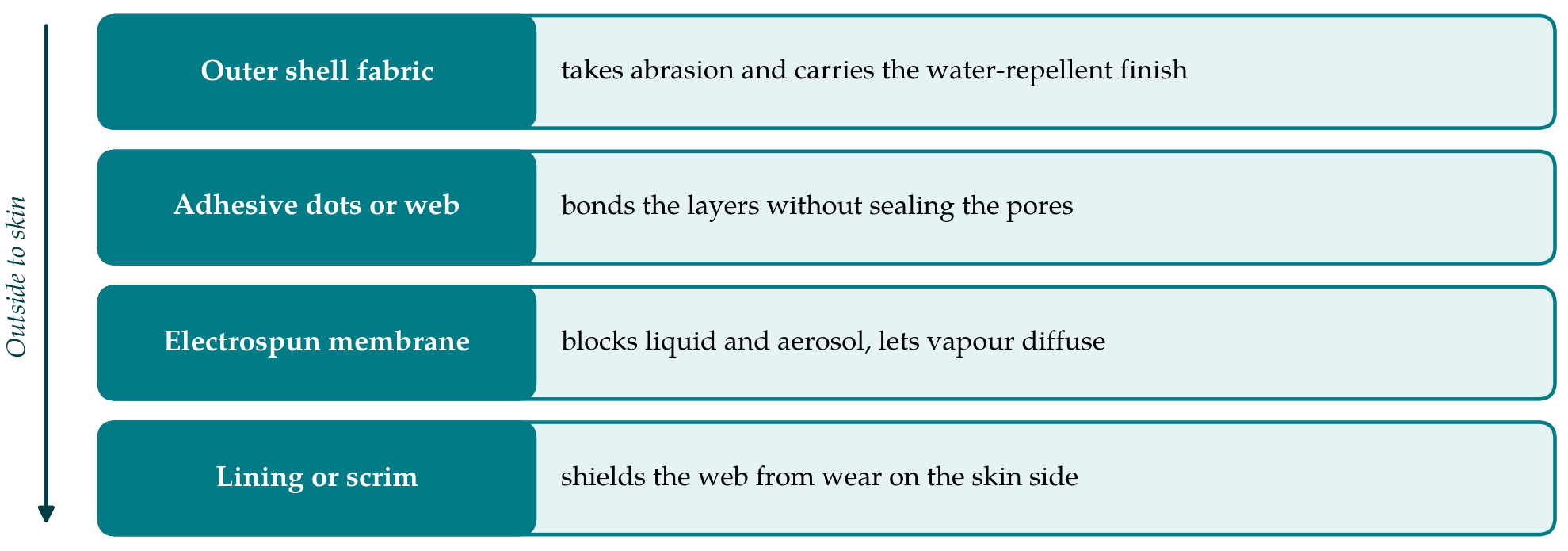
An electrospun web is too weak to be used alone and is built into a laminate. Figure 1 shows the usual construction. The web is either spun directly onto a carrier and covered, or transferred and bonded between a face fabric and a lining with a discontinuous adhesive, typically printed hot-melt dots or a fusible web. The adhesive is a compromise in itself: more of it improves peel strength and wash durability and blocks a larger share of the pores. Bonding pressure and temperature can also compact the web and reduce its porosity, so that the properties of the finished laminate cannot be read off from those of the free-standing membrane.
6. Durability
Durability is where the gap between demonstration and product is widest. A nonwoven of fibres a few hundred nanometres across, held together mainly by friction and occasional fused contacts, has low tensile strength and very low abrasion resistance. Rubbing removes or rolls up the fibres, flexing opens cracks along fold lines, and peeling forces at seams can separate the web from its carrier. These failure modes are well known to practitioners, yet a large share of papers on protective nanofibre membranes report hydrostatic head and vapour transmission only for the material as made.
Established textile methods are available for the purpose. Abrasion can be applied with the Martindale apparatus (ISO, 2016) and laundering with standard domestic washing procedures (ISO, 2021), with the barrier tests repeated afterwards, and garments intended for protection against infective agents are assessed against a performance standard that sets requirements for resistance to penetration by contaminated liquids and aerosols (CEN, 2003). Laundering challenges a laminate in several ways at once: mechanical action, swelling of hydrophilic components, deposition of surfactant residues that lower the contact angle of the pore walls, and loss of the repellent finish on the face fabric, after which the outer layer wets out and the vapour path is obstructed (Holmquist et al., 2016).
Approaches to strengthening the web include thermal or solvent-vapour treatment to weld fibre junctions, crosslinking, spinning from blends that include a lower-melting component, and deliberate control of residual solvent so that fibres bond as they land (Xue et al., 2019). Each trades some porosity for integrity. The wider literature on filtration media supports the view that a nanofibre layer performs best when it is thin and is protected by coarser layers on both sides (Barhate and Ramakrishna, 2007), which is the logic of the laminate in Figure 1.
7. Gaps and Future Work
Several needs follow from this account. Reporting should move from the bare membrane to the laminate, and from the as-made state to the state after defined cycles of abrasion, flexing and washing; without such data, claims of suitability for protective clothing cannot be assessed. Breathability should be reported by a named standard method, with enough detail for comparison. Work on fluorine-free membranes needs to state plainly which liquids they repel and which they do not. Release of nanofibre fragments and additives during laundering deserves study both as a durability question and as an environmental one. Finally, the field would benefit from process studies carried out on free-surface machines at realistic widths, since conclusions drawn from single-needle rigs do not transfer automatically (Persano et al., 2013).
8. Conclusion
Electrospun nanofibre membranes offer a sound physical answer to the conflict between barrier and comfort: fine pores to hold back liquid and particles, high porosity and small thickness to let vapour through. The polymers and the process variables that deliver this structure are well understood, and production machinery exists. The open issues are practical ones. The membrane must be laminated without losing the properties that justified it, it must survive wear and washing, and it increasingly has to do so without fluorinated chemistry. Progress on those points, reported against recognised test standards, will decide how far these materials move into protective clothing in everyday use.
Conflict of interest
To be declared by the author(s) before publication.
Funding
To be declared by the author(s) before publication.