1. Introduction
Anyone who reads through an Ayurvedic formulary notices how often the peppers recur. Black pepper (Piper nigrum, maricha) and long pepper (Piper longum, pippali), frequently with dry ginger as the triad called trikatu, are ingredients of powders, pills, confections and fermented preparations prescribed for conditions that have little else in common (Government of India, 2003). The classical authors gave their own reasons. The pungent drugs kindle the digestive fire, clear the channels, and in the case of pippali serve as yogavahi, a substance that carries and augments the action of whatever it accompanies (Sharma, 1981).
A pharmacological reading of that idea was offered when Atal et al. (1981) reported that long pepper raised blood levels of co-administered compounds in rats and proposed that the peppers were included in traditional recipes to improve the bioavailability of the other ingredients. Piperine, the pungent amide present in both species, was soon identified as the constituent responsible, and a large literature on piperine as a "bioenhancer" has grown since (Johri and Zutshi, 1992; Kesarwani and Gupta, 2013).
The proposition has two parts that are often run together. One is that piperine, given as a pure compound at a suitable dose, can increase the systemic exposure of another substance. The other is that this is what pepper does within a classical polyherbal formulation as actually prepared and taken. The first is a question about a molecule. The second concerns a complex product in which piperine is one minor component among hundreds. This review considers each in turn and asks how far the evidence for the first can be carried over to the second.
2. Approach of This Review
This is a narrative review of the published literature on piperine and the pepper-containing formulations of Ayurveda. It draws on the primary pharmacokinetic and mechanistic papers that are most often cited in this field, on earlier reviews, and on the classical and official sources that describe the formulations. No claim is made to have identified every relevant study. Studies were chosen because they are the ones on which the argument for bioenhancement usually rests, and they are described in qualitative terms. Readers who need effect sizes should consult the original reports.
3. Piperine and the Pepper Drugs of the Classical Pharmacy
Piperine is the piperidine amide of piperic acid and the main pungent principle of black pepper fruit. It is also present in long pepper, generally at a lower concentration, along with related amides such as piperlongumine. The physiological effects attributed to it are broad and include stimulation of digestive secretions, antioxidant activity and effects on drug metabolism (Srinivasan, 2007). Its pungency arises from activation of the vanilloid receptor TRPV1, the same receptor that responds to capsaicin (McNamara et al., 2005).
In the formulary the peppers play different roles from one recipe to the next. In trikatu itself they are the principal drugs. In Sitopaladi and Talisadi churna, given for respiratory complaints, pippali is a major active ingredient alongside aromatic spices and sugar. In large compound preparations a pepper may be one of several dozen components and contribute a small fraction of the mass. The amount of piperine delivered by a dose therefore varies over a wide range, and it depends further on the species used, the quality of the fruit, and whether the preparation involves prolonged boiling, roasting or fermentation. This variation matters for everything that follows, because the experimental literature concerns defined doses of the pure compound.
4. Proposed Mechanisms
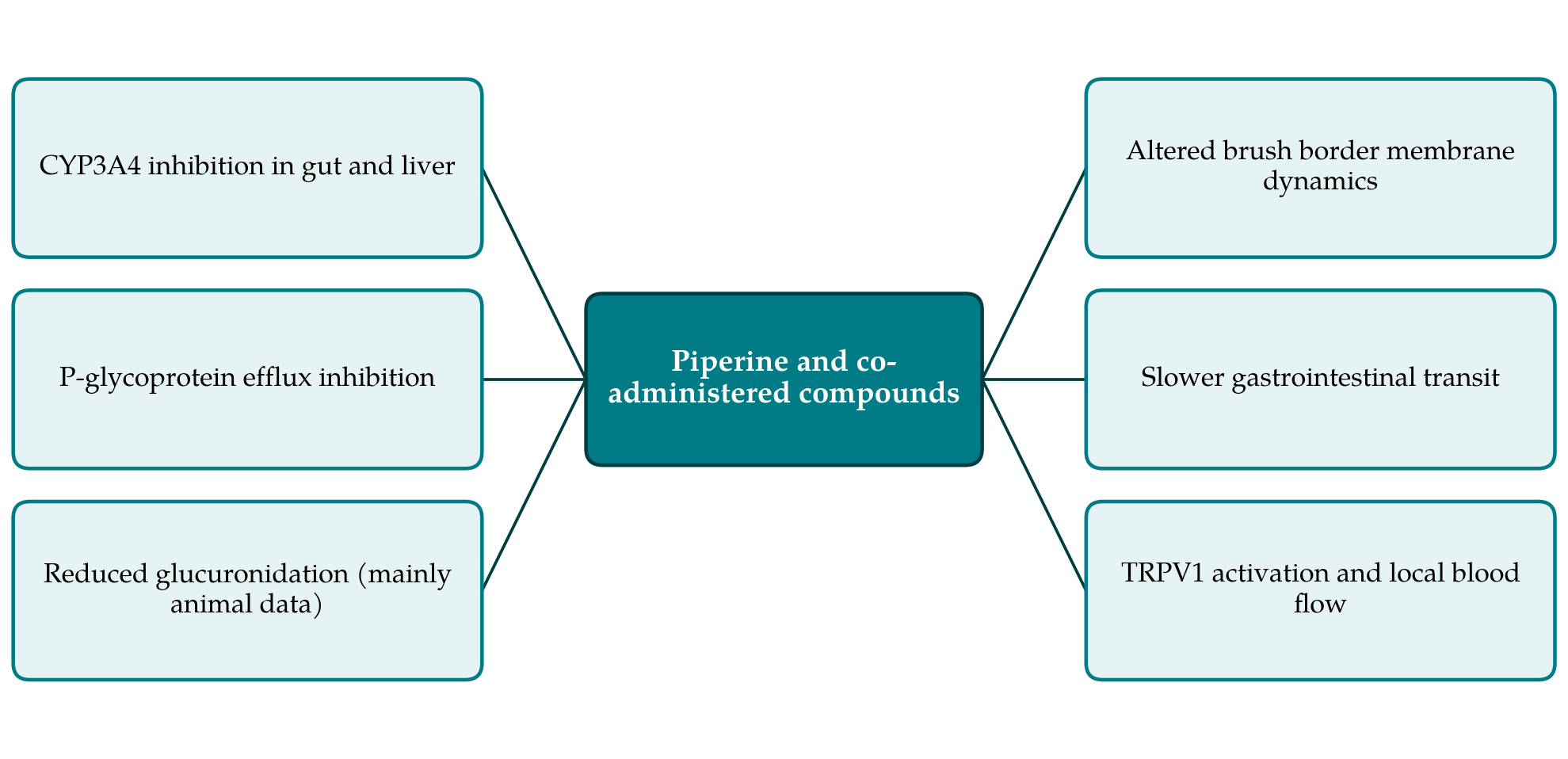
Several mechanisms have been put forward to explain how piperine could raise the exposure of another compound, and they are not mutually exclusive. Figure 1 groups them. Some act on presystemic metabolism, some on transport across the intestinal epithelium, and some on the physiology of the gut as a whole.
4.1. Inhibition of drug-metabolising enzymes
The earliest mechanistic work showed that piperine inhibited hepatic mixed-function oxidases and glucuronidation in rodents and prolonged the action of drugs cleared by those routes (Atal et al., 1985). Later studies traced part of the effect on conjugation to a fall in the cofactor UDP-glucuronic acid in intestinal epithelial cells (Singh et al., 1986). With human enzyme systems, Bhardwaj et al. (2002) found that piperine inhibited CYP3A4-mediated metabolism in liver microsomes, and Volak et al. (2008) described it as a relatively selective CYP3A4 inhibitor with weak activity against the human glucuronosyltransferases and sulfotransferases they tested. The implication is that inhibition of glucuronidation, prominent in the animal work, may count for less in humans than inhibition of CYP3A4.
4.2. Inhibition of efflux transport
P-glycoprotein pumps many lipophilic substrates from the enterocyte back into the gut lumen and works in concert with intestinal CYP3A4 to limit oral absorption. In the same study that examined CYP3A4, Bhardwaj et al. (2002) showed that piperine reduced P-glycoprotein-mediated transport of probe substrates across Caco-2 cell monolayers. A compound that inhibits both barriers would be expected to affect the many drugs that are substrates of both, which gives the bioenhancer hypothesis a plausible molecular basis and, by the same token, a basis for concern about interactions (Han, 2011).
4.3. Effects on the intestinal membrane and gut physiology
Other proposals concern absorption itself. Khajuria et al. (2002) reported that piperine altered the fluidity of the brush border membrane, the kinetics of membrane-bound enzymes and the ultrastructure of the microvilli in rat intestine, changes that could increase the absorptive surface or the permeability of the membrane. Piperine has also been reported to slow gastrointestinal transit in mice, which would lengthen the time a compound spends at its site of absorption (Lambert et al., 2004). Thermogenic and vascular effects linked to TRPV1 activation have been suggested as well, though they are the least well characterised. Piperine itself is absorbed and extensively metabolised in the rat (Bhat and Chandrasekhara, 1986), so any local action on the gut wall occurs during a limited window after ingestion.
5. Evidence From Pharmacokinetic Studies
The mechanistic work would matter little if exposure did not change in vivo. A series of studies has examined that question with pharmaceutical drugs and with plant compounds and nutrients. Table 1 lists representative examples and the direction of the effect each reported.
| Co-administered compound | Model | Reported effect on exposure | Source |
|---|---|---|---|
| Vasicine, sparteine | Rats, with long pepper or piperine | Higher blood levels | Atal et al., 1981 |
| Rifampicin | Patients with pulmonary tuberculosis | Higher blood levels | Zutshi et al., 1985 |
| Phenytoin | Healthy volunteers; patients with epilepsy | Increased | Bano et al., 1987; Pattanaik et al., 2006 |
| Propranolol, theophylline | Healthy volunteers | Increased | Bano et al., 1991 |
| Nevirapine | Healthy volunteers | Increased | Kasibhatta and Naidu, 2007 |
| Curcumin | Rats and healthy volunteers | Increased, markedly in humans | Shoba et al., 1998 |
| Coenzyme Q10, beta-carotene | Healthy volunteers | Higher plasma or serum levels | Badmaev et al., 1999; Badmaev et al., 2000 |
| Rifampicin, with whole trikatu | Rabbits | Enhancement not reproduced | Karan et al., 1999 |
5.1. Pharmaceutical drugs
Human studies began in India in the 1980s. Zutshi et al. (1985) reported higher blood levels of rifampicin when piperine was added in patients with pulmonary tuberculosis. Phenytoin exposure was increased by piperine in healthy volunteers (Bano et al., 1987) and later in patients with epilepsy at steady state (Pattanaik et al., 2006). Pretreatment with piperine raised the exposure of propranolol and theophylline in volunteers (Bano et al., 1991), and a randomised crossover study found the same for the antiretroviral nevirapine (Kasibhatta and Naidu, 2007). The drugs concerned are chemically diverse, but most are cleared in part by oxidative metabolism, which fits the enzyme inhibition described above.
5.2. Phytochemicals and nutrients
The best known result concerns curcumin, whose oral bioavailability is poor because of limited absorption and rapid conjugation (Anand et al., 2007). Shoba et al. (1998) gave curcumin with and without piperine to rats and to healthy volunteers and reported a large increase in serum curcumin in the human arm, of the order of twenty-fold, over a short period after dosing. This single study is the origin of the many commercial curcumin products that include a pepper extract, and it is cited throughout the later literature on curcumin. In mice, piperine increased plasma levels of the tea catechin epigallocatechin gallate, an effect the authors attributed to reduced intestinal glucuronidation and slower transit (Lambert et al., 2004). Supplementation studies in volunteers reported higher serum beta-carotene and plasma coenzyme Q10 when a small daily amount of piperine was added (Badmaev et al., 1999; Badmaev et al., 2000).
These studies agree in direction, and that is their strength. Their weaknesses are equally plain. Most involved small groups, single or short-term dosing, and plasma concentration as the only outcome. Higher exposure was seldom linked to a clinical benefit, and for a compound such as curcumin, in which the circulating forms are largely conjugates, a rise in the parent compound over an hour or two says little about effect at the tissue level. The findings establish that piperine can alter pharmacokinetics. They do not show by how much it does so under conditions of ordinary use.
6. From Isolated Piperine to Polyherbal Formulations
To carry these findings over to classical formulations, three further things would have to hold. The formulation must deliver enough piperine. The other ingredients must contain compounds whose absorption or metabolism is limited by the processes piperine affects. And the matrix must not cancel the effect. None of the three can be taken for granted.
On the first point, the volunteer studies typically used piperine in amounts of some milligrams to a few tens of milligrams as a single defined dose. A classical powder in which pepper is a main ingredient may well supply that much. A large compound preparation in which pepper is a minor component, taken in gram quantities, probably supplies much less, and the piperine content of market samples is seldom declared. On the second, the argument works best for formulations whose active principles are known to be poorly bioavailable, and for most classical recipes the active principles have not been defined at all. The yogavahi concept is general; the pharmacology is specific to particular substrates and enzymes.
The third point is where direct evidence is most needed and least available. Few studies have tested a whole traditional pepper preparation in place of pure piperine. In one that did, Karan et al. (1999) gave trikatu with rifampicin to rabbits and did not observe the enhancement that had been reported for piperine alone. A single animal study cannot settle the matter, but it is a reminder that ginger, the other pepper amides and the remaining constituents may influence gastric emptying, solubility or metabolism in their own ways. It also bears on the reverse case, in which a formulation is credited with enhanced bioavailability simply because pepper appears in its list of ingredients.
The classical rationale also deserves to be read on its own terms. The texts explain the pungent drugs chiefly through their action on digestion, and many of the mechanisms now grouped under bioenhancement, such as increased secretions, altered motility and changes at the mucosal surface, are digestive effects described in another vocabulary (Johri and Zutshi, 1992). The two accounts are compatible. What the modern account adds is a set of testable predictions about specific compounds, and it is those predictions that remain largely untested in formulations.
7. Safety and Herb-Drug Interaction
A substance that raises the exposure of other substances is an interaction risk as much as a formulation aid. The drugs for which piperine has been shown to increase blood levels include phenytoin and theophylline, both with narrow therapeutic margins, and the antiretroviral nevirapine. Pepper eaten as a spice has a long record of safe use, and there is no good evidence that culinary amounts cause clinically significant interactions. Concentrated piperine supplements and high-pepper formulations taken daily are a different exposure, and patients on drugs that are CYP3A4 or P-glycoprotein substrates should tell their physicians about them (Han, 2011). Reviews of herbal bioenhancers tend to present dose reduction of the partner drug as an advantage (Kesarwani and Gupta, 2013). That holds only where the combination is fixed, standardised and clinically tested. It does not justify informal co-administration.
8. Gaps and Future Work
The most useful next studies would be simple in concept. Piperine should be quantified in authenticated batches of the major pepper-containing formulations, prepared by the classical method, so that the delivered dose is known. For a few formulations with defined marker compounds, crossover pharmacokinetic studies could compare the complete recipe with the same recipe made without the peppers, which is the comparison the classical claim actually implies. Human enzyme and transporter data should be preferred to rodent data when mechanisms are discussed, given the species difference in the effect on glucuronidation. And outcome measures should extend beyond the plasma level of a parent compound to metabolites and, where possible, to a pharmacodynamic or clinical endpoint.
9. Conclusion
Piperine as a pure compound can raise the systemic exposure of a range of drugs and phytochemicals, and the inhibition of CYP3A4 and P-glycoprotein gives that observation a credible mechanism in humans. The statement that the peppers therefore enhance the bioavailability of classical polyherbal formulations is a reasonable hypothesis and an attractive bridge between traditional and modern accounts, but it has rarely been tested in the formulations themselves. Until it is, the presence of pepper in a recipe is better described as consistent with a bioenhancing role than as proof of one, and the interaction potential of concentrated piperine deserves the same attention as its promise.
Conflict of interest
To be declared by the author(s) before publication.
Funding
To be declared by the author(s) before publication.