1. Introduction
Cryptosporidium oocysts are around four to six micrometres across, are shed in enormous numbers by an infected host, and remain infective in cool water for weeks. They are also highly resistant to chlorine at the concentrations and contact times used in routine drinking water disinfection, a property demonstrated in classical laboratory work comparing disinfectants (Korich et al., 1990). A supply that depends on chlorination alone, without effective filtration or protection of the source, therefore has no reliable barrier against this organism. The outbreak in Milwaukee, in which a very large number of people were affected after oocysts passed through a treatment plant, remains the reference demonstration of what follows from that gap (Mac Kenzie et al., 1994).
Reviews of waterborne protozoan outbreaks worldwide show that Cryptosporidium and Giardia together account for most reported events, and that the proportion attributed to Cryptosporidium has risen as diagnostic capacity has improved (Karanis et al., 2007; Efstratiou et al., 2017). The burden falls most heavily on young children in low and middle income settings, where cryptosporidiosis is a leading attributable cause of moderate to severe diarrhoea and is associated with lasting effects on growth (Kotloff et al., 2013; Checkley et al., 2015).
Rural piped supplies in monsoon climates present a recognisable combination of hazards: shallow intakes or boreholes close to grazing land, intermittent supply with recurrent loss of pressure, distribution pipes laid in shallow trenches that flood, and minimal treatment. Heavy rainfall mobilises faecal material from both human and livestock sources and can carry it into a source or into a network. Investigations of such clusters are often delayed because the first cases present to scattered rural facilities and because the laboratory work needed to confirm a water source is unavailable locally. This article proposes a protocol intended to be workable under those conditions. It is a proposal: it has not been applied to an outbreak in the course of preparing this article, and no results of its use are reported.
2. Background to the Design
Three bodies of work shaped the protocol. The first is the outbreak investigation literature for waterborne protozoa, which has repeatedly shown that the epidemic curve and the spatial distribution of cases identify the implicated supply earlier than any laboratory result, and that control measures should be decided on that basis (Karanis et al., 2007). The second is the laboratory literature on detection and typing. Oocysts are recovered from large volumes of water by filtration, immunomagnetic separation and immunofluorescence microscopy, a sequence standardised in national regulatory methods (US EPA, 2012), while clinical diagnosis has moved from microscopy of stained smears towards antigen detection and nucleic acid amplification (Chalmers and Katzer, 2013). The third is the water safety planning framework, which treats an outbreak as evidence of a failure in a system of barriers rather than as an isolated event (Bartram et al., 2009; WHO, 2022).
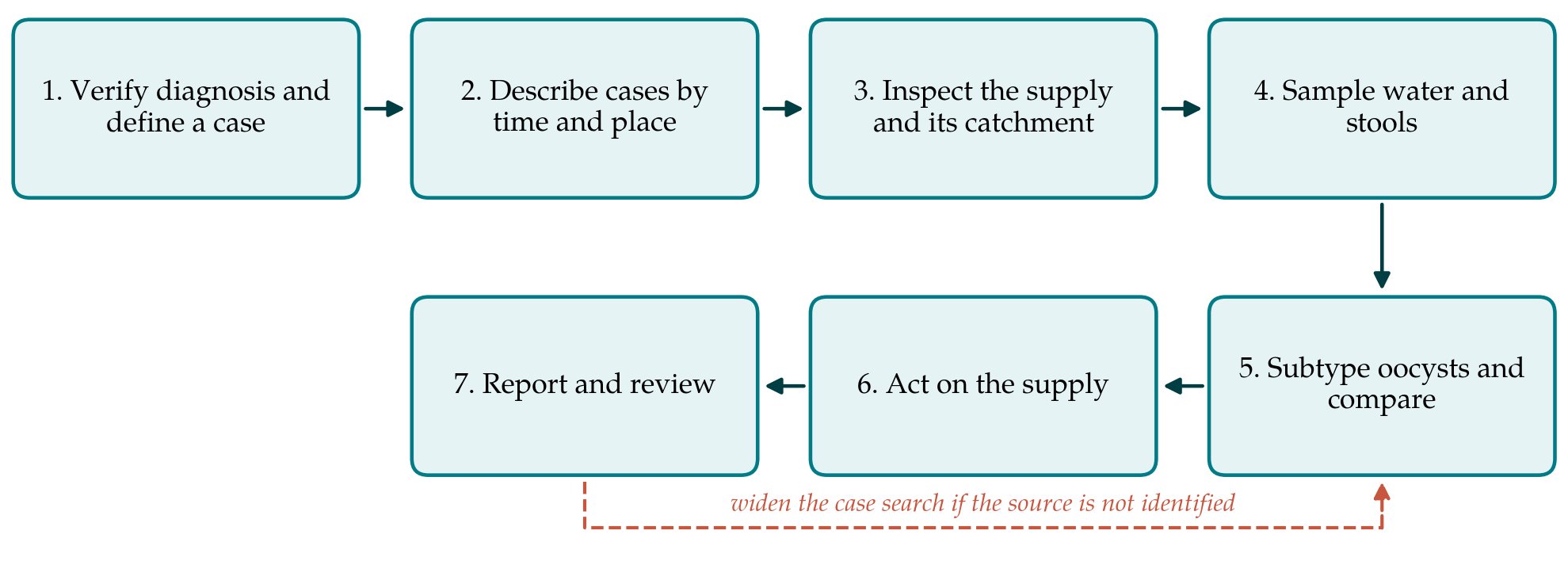
Species and subtype identification deserves particular emphasis because it is what distinguishes a plausible waterborne attribution from a demonstrated one. Cryptosporidium hominis is essentially restricted to human transmission, whereas C. parvum circulates in ruminants as well as people, so the species alone narrows the likely source (Hunter and Thompson, 2005). Within a species, sequencing of the gp60 gene resolves subtypes at a level fine enough to link human cases to one another and to an environmental isolate (Alves et al., 2003; Xiao, 2010). Table 1 groups the seven steps of the protocol and gives the record each is intended to generate.
| Stage | What is done | Output |
|---|---|---|
| Steps 1 and 2 | Confirm diagnoses, define cases, plot and map them | Line list, curve and map |
| Steps 3 and 4 | Sanitary survey, then water and stool sampling | Record and specimens |
| Step 5 | Species identification and gp60 subtyping | Genotypes and subtypes |
| Steps 6 and 7 | Control measures, write up, revise the plan | Report and revised plan |
3. The Protocol Step by Step
The seven steps are described below in the order in which they would normally begin, although several run concurrently. Figure 1 shows the sequence and the point at which the investigation may need to widen.
3.1. Step 1: Verify the diagnosis and define a case
An investigation that begins from unverified reports wastes effort. The first task is to confirm that the initial diagnoses rest on a recognised test, whether modified acid-fast staining, immunochromatographic antigen detection or a molecular assay, and to record which was used, since the sensitivity differs and a negative result on a single stool does not exclude infection. A case definition then fixes the clinical features, the place and the time window. Watery diarrhoea lasting more than three days, in a resident of the affected service area, with onset after a stated date, is a workable clinical definition; confirmed cases are those with laboratory evidence of Cryptosporidium. The incubation period of roughly one to two weeks, and the fact that shedding continues after symptoms resolve, should both be reflected in the window chosen.
3.2. Step 2: Describe the cluster in time and place
A line list with date of onset, age, household location, water source and any travel is enough to produce the two displays that matter: the epidemic curve and a map of cases against the distribution network. A sharp single peak is consistent with a short contamination event, whereas a prolonged curve suggests continuing ingress or secondary person to person spread, which is common in households and in settings where young children are cared for together. Mapping cases onto the network, rather than onto administrative boundaries, is what reveals whether illness follows one branch of the system. Standard epidemiological reasoning about comparison groups and bias applies here as in any other outbreak (Rothman et al., 2008), and an analytical comparison between households using the implicated supply and those using other sources is often feasible even in small clusters.
3.3. Step 3: Inspect the supply and its catchment
The sanitary survey is walked rather than desk based. It covers the source and its surroundings, including livestock access, latrines and the path taken by runoff during the recent rainfall; the treatment arrangements, with chlorine residual measured at several points; the storage tanks and their covers; and the distribution pipes, with attention to the places where they cross drains or flooded ground and to the periods when the system is depressurised. Guidance on service level and on the relationship between supply continuity and health informs how these observations are weighed (Howard and Bartram, 2003). Photographs and a dated written record are part of the output, because the breach may be repaired before the report is written.
3.4. Step 4: Sample water and stools concurrently
Water sampling for Cryptosporidium requires large volumes, typically tens to hundreds of litres passed through a filter, followed by elution, immunomagnetic separation and microscopy (US EPA, 2012). Samples are best taken at the source, after any treatment, and at a point in the network near the affected households, with turbidity and chlorine residual recorded alongside. Negative water samples are common and do not refute a waterborne origin, since oocysts are shed intermittently into a supply and the contamination may have passed before sampling began. Stool specimens should be collected from as many cases as will provide them, with an aliquot preserved unfixed or in a medium compatible with the molecular work in step five; the timing matters because shedding declines as symptoms resolve.
3.5. Step 5: Identify species and subtype
Species identification, usually by sequencing a fragment of the small subunit ribosomal RNA gene, separates C. hominis from C. parvum and from the less common species, and therefore separates a human sewage source from one involving livestock (Xiao, 2010). Subtyping by sequencing the gp60 gene gives the resolution needed to say whether the human cases share a subtype and whether that subtype is also present in the water or in animal faeces from the catchment (Alves et al., 2003). Where a laboratory cannot perform this work, specimens should be preserved and referred rather than discarded, because retrospective typing has resolved the source of many outbreaks after the event (Chalmers and Katzer, 2013).
3.6. Steps 6 and 7: Act, report and revise
Control measures are decided on the descriptive evidence and do not wait for typing. Advice to boil drinking water, provision of an alternative supply, repair of the identified breach, cleaning and disinfection of storage, and exclusion of symptomatic food handlers and childcare workers are the usual components. Clinical management is supportive, with attention to rehydration; the evidence on specific antiparasitic treatment in children is summarised in the trial literature and in the burden review cited above (Amadi et al., 2002; Checkley et al., 2015), and prescribing decisions remain a matter for clinicians following national guidance. The final step closes the loop: a written report, feedback to the community and the supply operator, and revision of the water safety plan so that the hazard identified is managed before the next monsoon (Bartram et al., 2009).
4. Limitations and What Remains to Be Shown
The protocol is a proposal and has not been evaluated. Three questions would need answering before it could be recommended as routine. The first is feasibility: whether a district team without a specialist laboratory can complete steps one to four within the period during which evidence is still recoverable, and what the realistic turnaround is for referred specimens. The second is yield: how often the typing step changes the conclusion reached from the descriptive work alone, since a step that rarely changes a decision is hard to justify where resources are scarce. The third is retention, because the value of the final step depends on whether the revised water safety plan is still being followed at the next flood.
Two cautions apply to any use of the protocol. Negative findings in water carry very little evidential weight, and an investigation that treats them as exculpatory will reach the wrong conclusion. And a cluster detected in a rural supply is likely to be a fraction of the true number of infections, because mild cases do not present and many facilities do not test for protozoa unless asked. The protocol is designed to identify and interrupt a source, not to measure the size of an outbreak.
5. Conclusion
A suspected waterborne cryptosporidiosis cluster can be investigated with modest means if the work is sequenced sensibly: verify, describe, inspect, sample, type, act and report, with control measures taken on descriptive evidence rather than held back for laboratory confirmation. The protocol set out here collects that sequence into a form that a district team can follow and states the output expected at each step. Its practical value is an open question, and testing it during real investigations, with attention to timing and to the yield of the typing step, is the natural next piece of work.
Conflict of interest
To be declared by the author(s) before publication.
Funding
To be declared by the author(s) before publication.