1. Introduction
Most people who lose their sense of smell during a cold or influenza-like illness recover it within days or weeks, as nasal congestion settles. A minority do not. In them the loss, partial or complete, continues long after the infection has cleared and the nasal airway looks normal on endoscopy. This condition, called postviral or postinfectious olfactory dysfunction, was a familiar diagnosis in specialist clinics well before 2020 and typically affected middle-aged and older adults, women more often than men (Seiden, 2004). The arrival of SARS-CoV-2 changed its scale. Sudden smell loss proved to be a characteristic symptom of COVID-19, and although most of those affected improved quickly, the number left with persistent impairment was large enough to make the problem a matter for primary care and general otolaryngology alike (Whitcroft and Hummel, 2020).
The consequences are easy to underestimate. Smell warns of smoke, gas and spoiled food, and it supplies most of what is experienced as flavour. People with long-standing olfactory loss describe reduced enjoyment of eating, anxiety about personal hygiene and household hazards, and lowered mood, and these effects are documented across many studies of quality of life (Croy et al., 2014). Against that background the absence of an established drug treatment is striking. Olfactory training has filled the gap. It is recommended in an international position paper (Hummel et al., 2017) and in consensus guidance written during the pandemic (Addison et al., 2021; Hopkins et al., 2021). This review asks how well the evidence supports that recommendation for adults whose smell loss has persisted after a viral illness.
2. Scope and Approach
This is a narrative review of the published literature. It draws on the original clinical studies of olfactory training, the meta-analyses that have pooled them, and the position and consensus papers that have turned them into recommendations. It is selective and does not claim to be exhaustive. Studies were chosen because they introduced a protocol, tested it against a control, or shaped current guidance. The review concerns adults with postinfectious loss. Training has also been studied after head injury, in idiopathic loss and in neurodegenerative disease, and those groups are mentioned only where a study enrolled mixed populations. Systemic and topical drug treatments are outside its scope.
3. Why Training Might Work
The olfactory epithelium is unusual among neural tissues in that its receptor neurons are replaced throughout life from basal stem cells, and the new neurons extend axons to the olfactory bulb and re-form synapses there (Schwob, 2002). Recovery after a viral injury is therefore biologically plausible, and the common observation that function returns gradually over many months fits a process of regrowth. In COVID-19 the primary target appears to be the supporting cells of the epithelium and not the neurons themselves, since it is the sustentacular and stem cells that express the receptor the virus uses to enter (Brann et al., 2020). That finding helps explain why most cases resolve quickly and suggests that persistent cases involve more extensive damage to the epithelium.
The idea behind training is that repeated, attentive exposure to odours encourages this recovery, much as practice aids rehabilitation of other sensory and motor functions. Where the effect arises is not settled. Changes at the periphery, in the bulb and in cortical networks have each been proposed. Imaging studies report an increase in olfactory bulb volume after a period of training (Negoias et al., 2017) and altered functional connectivity in olfactory networks in patients whose smell improved (Kollndorfer et al., 2014). These observations are consistent with a central contribution, but they come from small groups and cannot separate the effect of training from that of recovery itself.
4. The Protocols
The procedure now called classical olfactory training was introduced by Hummel et al. (2009). Patients sniffed four odours twice a day for twelve weeks: phenyl ethyl alcohol (rose), eucalyptol (eucalyptus), citronellal (lemon) and eugenol (cloves). The four were chosen to represent the flowery, resinous, fruity and spicy categories of the odour prism that Henning proposed early in the twentieth century (Henning, 1916). Each was sniffed for roughly ten seconds. Function was measured before and after with the Sniffin' Sticks battery, which gives separate scores for odour threshold, discrimination and identification and a composite of the three (Hummel et al., 1997). Figure 1 places this study among the later steps in the development of the method.
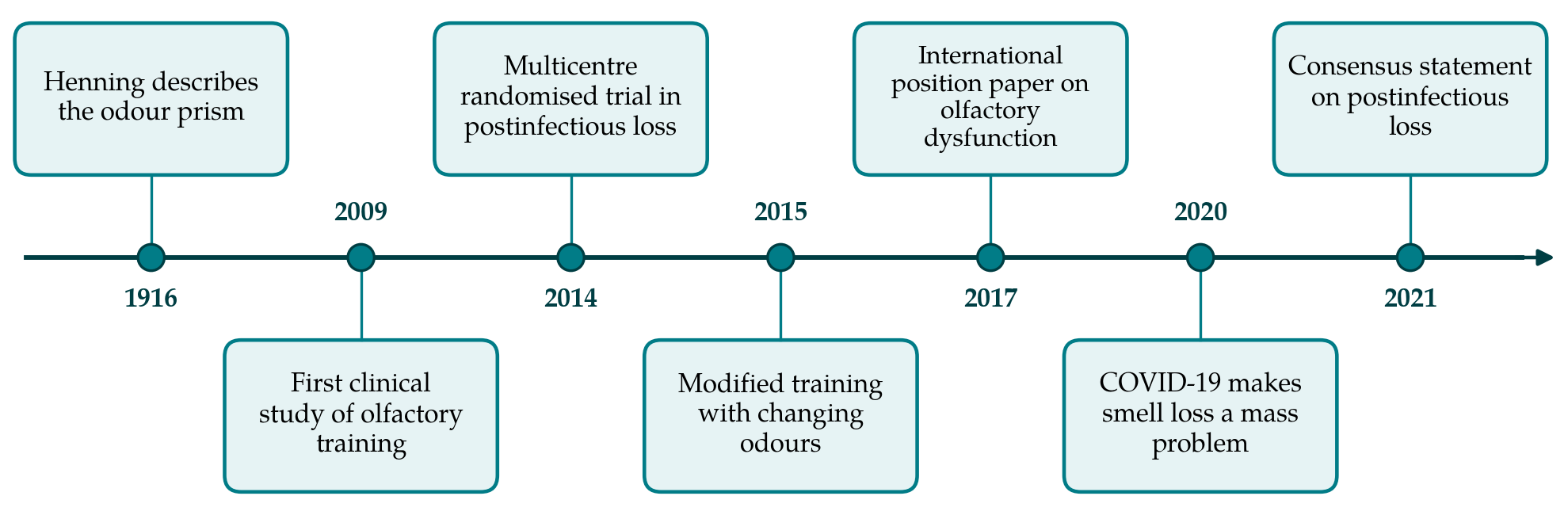
Later work varied almost every element of the protocol. Damm et al. (2014) compared odours at high concentration with the same odours at concentrations close to threshold. Altundag et al. (2015) exchanged the four odours for a new set every twelve weeks over thirty-six weeks, an approach they called modified training. Konstantinidis et al. (2013) extended the classical regimen to sixteen weeks, and the same group later followed patients who continued for about a year (Konstantinidis et al., 2016). The main variants and the reasoning behind each are summarised in Table 1.
| Protocol | What is done | Question addressed | Source |
|---|---|---|---|
| Classical | Four fixed odours sniffed twice daily for twelve weeks | Does training improve test scores at all | Hummel et al., 2009 |
| High versus low concentration | Same odours at strong or near-threshold strength, crossover design | Is the effect specific to odour stimulation | Damm et al., 2014 |
| Extended classical | Four odours for sixteen weeks in two causes of loss | Does the cause of loss alter response | Konstantinidis et al., 2013 |
| Modified | Odour set changed every twelve weeks over thirty-six weeks | Do duration and variety add benefit | Altundag et al., 2015 |
| Long-term | Classical training continued for about one year | Is longer training better and is the gain kept | Konstantinidis et al., 2016 |
5. What the Trials Show
The original study was not randomised. Patients chose whether to train, and those who did improved more on the composite Sniffin' Sticks score than those who did not (Hummel et al., 2009). The result established that the idea deserved testing but could not exclude the possibility that more motivated patients, or those already recovering, selected themselves into the training group.
The trial by Damm et al. (2014) remains the strongest single piece of evidence. It was randomised, single-blind and multicentre, enrolled only patients with postinfectious loss, and used low-concentration odours as a control that patients could not readily distinguish from active treatment. Improvement was more frequent with high-concentration training, and the difference was clearest in patients whose loss had lasted less than a year. The design answers the main objection to the earlier study, since both groups sniffed bottles twice a day and differed mainly in the strength of the stimulus.
Studies of protocol variants point in the same direction. Patients with postinfectious loss responded better than those with post-traumatic loss (Konstantinidis et al., 2013), changing the odours periodically produced better identification and discrimination than keeping them fixed (Altundag et al., 2015), and longer training was associated with further gain that was maintained at follow-up (Konstantinidis et al., 2016). None of these comparisons was blinded, and each was carried out at a single centre.
Three meta-analyses have pooled the available studies. Pekala et al. (2016) concluded that training improves olfactory test scores in patients with loss from several causes. Sorokowska et al. (2017) found sizeable effects on odour discrimination and identification and a smaller effect on threshold, a pattern that is often read as pointing to a central or cognitive component. Kattar et al. (2021) restricted the analysis to postviral loss and reported that trained patients were considerably more likely than controls to achieve a clinically important improvement. For the Sniffin' Sticks composite that threshold is conventionally taken as a gain of 5.5 points, the value derived by Gudziol et al. (2006) from patients' own ratings of change.
6. Limits of the Evidence
Several features of this literature call for caution. The first is spontaneous recovery. Follow-up of untreated patients with postinfectious loss shows that a substantial proportion improve measurably within a year or so (Reden et al., 2006). Any uncontrolled series will therefore show improvement, and any controlled comparison needs enough patients to distinguish a treatment effect from a favourable natural course. Most training studies are small.
The second is the difficulty of blinding. A patient knows whether a jar smells of anything, and a patient with severe loss may be unable to tell, which makes the adequacy of a placebo depend on baseline function. Low-concentration odours are the best control yet devised, but they may themselves have some effect, in which case trials that use them underestimate the benefit. Trials that compare training with no intervention have the opposite problem: expectation and the extra attention paid to smelling may influence performance on tests that depend on effort and familiarity, particularly identification tasks. Identification tests are also culturally bound, a point recognised since the development of the University of Pennsylvania Smell Identification Test (Doty et al., 1984).
The third is adherence. Training asks for a few minutes twice a day for months, with no immediate reward, and few studies have recorded how faithfully patients complied. Regimens also differ in the odours used, their concentration, the number of sessions and the total duration, so that pooled estimates combine interventions that are not identical. Finally, the usual outcome is a psychophysical score. Whether a gain on testing translates into restored enjoyment of food or confidence in daily life has been examined far less often, although those are the outcomes patients care about (Croy et al., 2014).
7. Smell Loss After COVID-19
When persistent loss after COVID-19 became common, clinicians reached for the one intervention with some evidence behind it. Guidance issued by the British Rhinological Society advised olfactory training for loss lasting more than two weeks (Hopkins et al., 2021), and the Clinical Olfactory Working Group reached consensus in favour of training for postinfectious dysfunction generally, while declining to recommend most drug treatments (Addison et al., 2021). Both groups were explicit that their advice rested largely on studies carried out before the pandemic, in patients whose loss followed other viruses.
Whether that extrapolation holds is still uncertain. Patients with COVID-19 are on average younger than the earlier postviral cohorts, their loss often began abruptly without nasal obstruction, and qualitative disturbances such as parosmia, in which familiar odours are distorted and often unpleasant, are prominent during recovery. A Cochrane review of treatments for persistent post-COVID-19 olfactory dysfunction found the randomised evidence to be sparse and of low certainty for every intervention it examined (O'Byrne et al., 2022). The reasonable position is that training is likely to help in this group as it does in others, that it carries no meaningful risk, and that direct confirmation from adequately controlled trials is still needed.
8. Implications for Practice and Research
For the clinician, the first task is still diagnosis. Persistent loss after an infection should be confirmed with a validated test and other causes considered, since chronic rhinosinusitis, head injury, medication and neurological disease all produce olfactory impairment and some are treatable in their own right (Whitcroft and Hummel, 2019). Once postinfectious loss is established, patients can be told honestly that many people improve with time, that training is supported by controlled studies though not by large blinded trials, that it is safe and inexpensive, and that persistence over months appears to matter. Advice on smoke and gas detectors and on food safety belongs in the same consultation.
For researchers the priorities follow from the gaps described above. Trials need a credible control, stratification by duration and severity of loss, an objective or at least recorded measure of adherence, and patient-reported outcomes alongside psychophysical scores. The questions of which odours, how many, at what concentration and for how long remain open, as does the timing of treatment: starting early may catch a period of active regeneration, but it also enrols many patients who would have recovered unaided. Parosmia deserves study as an outcome in its own right, and cohorts recruited since 2020 offer the numbers that earlier single-centre studies lacked.
9. Conclusion
Olfactory training is a simple intervention with a coherent rationale and a body of evidence that, taken as a whole, favours it. Controlled studies and meta-analyses agree that adults with postinfectious smell loss who train are more likely to improve on standard tests than those who do not. The same literature is modest in size, largely unblinded and uneven in its protocols, and it says little about the outcomes that matter most in daily life. Training is justified as first-line advice because it is harmless and probably effective. The certainty with which it is sometimes presented to patients runs ahead of what has been shown, and the large population affected since 2020 gives both the reason and the means to close that gap.
Conflict of interest
To be declared by the author(s) before publication.
Funding
To be declared by the author(s) before publication.