1. Introduction
Artemisinin-based combination therapy has been the backbone of falciparum malaria treatment for around two decades. Its effectiveness rests on an unusual property of the artemisinins: they kill parasites across a wide range of asexual stages, reduce the biomass rapidly over the first two days, and leave a smaller residual population for a longer-acting partner drug to clear. Resistance to the artemisinin component therefore does not usually present as treatment failure. It presents as slower clearance, which transfers a larger surviving population to the partner drug and in time selects for resistance against it.
That phenotype was first reported from western Cambodia, where parasite clearance after artesunate was slower than expected (Noedl et al., 2008) and was then characterised in detail in a study that compared clearance kinetics across sites and established the central features of the phenotype (Dondorp et al., 2009). The term now preferred is partial resistance, because the drugs retain substantial activity and cure rates remain high where the partner drug is effective. Over the following decade the phenotype spread across the Greater Mekong subregion (Ashley et al., 2014), and the long-anticipated question became whether the same would occur in Africa, which carries most of the global burden (WHO, 2023).
It has now occurred, by independent emergence rather than importation. This article reviews the evidence in three parts: how the phenotype is defined and measured, what the molecular markers do and do not tell us, and where current surveillance falls short. The treatment is a narrative review of the published literature rather than a systematic one, and it concentrates on the sources that have shaped how the field reasons about the problem.
2. Defining and Measuring the Phenotype
Partial resistance is defined operationally. In vivo it is expressed as the proportion of patients still parasitaemic by microscopy on day three after the start of treatment, or more precisely as the parasite clearance half-life estimated from serial counts. In vitro the conventional susceptibility assay proved unsuitable, because the drug acts over a few hours on a narrow window of the life cycle and a standard forty-eight hour exposure does not capture it. The ring-stage survival assay, which exposes tightly synchronised early rings to a short pulse of dihydroartemisinin and counts viable parasites afterwards, was developed to fill that gap and correlates with clearance in patients (Witkowski et al., 2013).
Both measures have limitations that bear on surveillance. Day three positivity depends on the starting parasitaemia, on host immunity and on the quality of microscopy, so it performs poorly as a comparator across sites with different transmission intensity. The ring-stage survival assay requires fresh isolates, synchronisation and skilled staff, which restricts it to a small number of laboratories. Table 1 sets out the principal approaches, what each measures and the constraint that limits its routine use.
| Approach | What it measures | Main constraint |
|---|---|---|
| Day three parasitaemia | Proportion still positive by microscopy after three days | Sensitive to immunity and initial parasite density |
| Clearance half-life | Rate of decline from serial counts | Requires frequent sampling over several days |
| Ring-stage survival assay | Survival of early rings after a short drug pulse | Fresh isolates and specialist laboratory capacity Witkowski et al., 2013 |
| kelch13 genotyping | Presence of validated or candidate propeller mutations | Many alleles have no established clinical meaning Menard et al., 2016 |
| Therapeutic efficacy study | Cure rate at day 28 or 42 with genotyping of recurrences | Resource intensive and slow to repeat WHO, 2020 |
| Partner drug markers | Copy number and polymorphisms linked to partner drug response | Markers differ by drug and are incompletely validated |
3. The Molecular Marker and Its Mechanism
The genetic basis was identified through long-term in vitro selection combined with sequencing of resistant and sensitive lines, which pointed to mutations in the propeller domain of a kelch protein encoded on chromosome 13 (Ariey et al., 2014). Causality was established by gene editing: introducing single propeller mutations into sensitive parasites raised ring-stage survival, and reverting them in resistant clinical isolates lowered it (Straimer et al., 2015). Population genomic work showed that the resistant populations in Southeast Asia arose on particular genetic backgrounds, which suggested that additional loci modulate the phenotype (Miotto et al., 2015).
Mechanistically the picture that has gained most support links kelch13 to the endocytosis of host haemoglobin by the parasite. Artemisinins are activated by the iron released during haemoglobin digestion, so a parasite that takes up less haemoglobin during the ring stage activates less drug and survives the pulse. Proteomic and genetic work placed kelch13 at the cytostomal structures responsible for that uptake and showed that reduced kelch13 function diminishes it (Birnbaum et al., 2020). An alternative line of work implicated increased phosphatidylinositol-3-phosphate and an unfolded protein response in tolerance to the drug (Mbengue et al., 2015). The two accounts are not mutually exclusive, and both are consistent with the stage specificity of the phenotype.
The practical value of the marker depends on validation. A worldwide survey of propeller polymorphisms found considerable diversity, much of it without any demonstrated association with clearance (Menard et al., 2016). An individual patient data meta-analysis established which alleles are reliably associated with slow clearance and provided the evidence base for the distinction between validated and candidate markers that surveillance now uses (WWARN K13 Genotype-Phenotype Study Group, 2019). Reporting a kelch13 mutation without stating which category it falls into is a recurring weakness in the literature.
Two further properties of the marker shape how it should be used. Propeller mutations carry a fitness cost in the absence of drug pressure, which is part of the reason resistant genotypes have sometimes receded when drug policy changed, and it means that frequency estimates are sensitive to recent treatment practice as well as to transmission. The marker is also imperfectly sensitive: slow clearance has been observed in parasites with wild-type propeller sequences, and genotyping alone will therefore underestimate the phenotype where an unrecognised mechanism is operating. Genotype data are most informative when collected alongside clinical clearance data from the same patients, which is the design the therapeutic efficacy study protocol already supports.
4. Emergence in Africa
Two sets of findings established that partial resistance is present in East Africa. In Rwanda, parasites carrying the R561H propeller mutation were found at appreciable frequency and showed raised ring-stage survival (Uwimana et al., 2020); a subsequent therapeutic efficacy study linked the genotype to delayed clearance in treated patients (Uwimana et al., 2021). In northern Uganda, delayed clearance was documented together with the A675V and C469Y mutations (Balikagala et al., 2021), and longitudinal genotyping across Ugandan sites showed these alleles rising in frequency over successive years (Conrad et al., 2023).
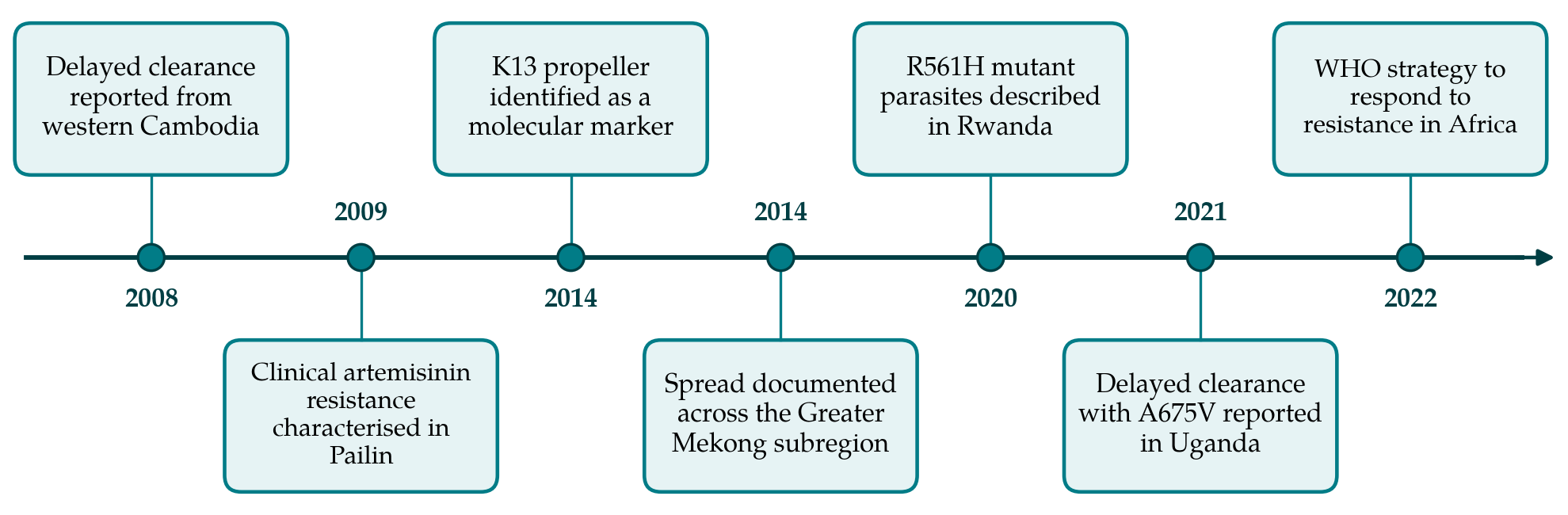
Two features of this evidence matter for policy. The first is that the African alleles differ from those that dominate in Southeast Asia and sit on local genetic backgrounds, indicating independent emergence rather than spread along a trade route. Containment strategies modelled on the Mekong experience, which assumed a geographically advancing front, do not transfer directly. The second is that cure rates in the reported studies largely remained high, because the partner drug, in most cases lumefantrine, was still effective. Figure 1 places these reports in sequence with the earlier Asian findings. The sequence shows how long the interval was between the first Asian report and the first African confirmation, and how short the interval has been between successive African reports.
The epidemiological setting also differs in ways that may alter the trajectory. Transmission in most of sub-Saharan Africa is far more intense than in the Mekong region, so a treated infection is frequently one of several and the parasite population within a host is genetically mixed. Higher recombination rates break up the multi-locus combinations on which the Asian resistant lineages depended, which could slow the assembly of parasites resistant to both components of a combination. Acquired immunity works in the same direction, since partially immune hosts clear residual parasites that would survive in a non-immune patient. These arguments cut both ways: the same intensity of transmission produces an enormous number of infections, and therefore of opportunities for a resistant parasite to arise and be transmitted onwards.
5. Surveillance Gaps
Therapeutic efficacy studies remain the reference activity, and the decade-long synthesis published by the World Health Organization shows both their value and their unevenness (WHO, 2020). Coverage is concentrated where research capacity already exists. Large areas of Central and West Africa are sampled infrequently, and a study conducted once every few years at a sentinel site cannot detect an allele rising in frequency between rounds. Molecular surveillance is cheaper and can use samples already collected for other purposes, but it inherits the validation problem described above and says nothing about the partner drug.
Partner drug resistance is the more immediate threat to treatment outcome, and the Asian experience illustrates why. Where piperaquine resistance emerged alongside artemisinin partial resistance, dihydroartemisinin-piperaquine failed outright, with cure rates falling to levels that forced a change of policy (Amaratunga et al., 2016). African surveillance is at present better equipped to detect kelch13 mutations than to detect the amplifications and polymorphisms associated with partner drug response. The mechanistic and clinical background to the whole problem is reviewed by Fairhurst and Dondorp (2016).
A third gap is analytical rather than logistical. Genotyping is often performed on samples collected through routine surveys, with little information on recent treatment history, on which drug was taken, or on whether the infection was polyclonal. Minority resistant clones within a mixed infection are readily missed by conventional sequencing, and deep sequencing methods that detect them are not yet standard outside research laboratories. Nor is there agreement on the frequency threshold at which a candidate allele should prompt a programmatic response. These are solvable problems, but they require protocols agreed across national programmes rather than decisions taken study by study.
The response options under discussion are set out in the strategy published for the African region (WHO, 2022). They include deploying multiple first-line therapies simultaneously so that drug pressure is diversified, improving the quality of diagnosis so that treatment is not given unnecessarily, and triple artemisinin-based combinations, which add a second partner drug. A multicentre randomised trial found triple combinations to be efficacious and acceptably tolerated where the underlying two-drug combination was failing (van der Pluijm et al., 2020). Each option carries costs in procurement, regulation and adherence that fall on programmes already stretched.
6. Conclusion
Artemisinin partial resistance is established in East Africa, it arose there independently, and the alleles involved are being tracked. What is not in place is surveillance dense enough to see those alleles move, validation of the many propeller mutations that fall outside the confirmed list, and equivalent attention to the partner drugs on which cure actually depends. The Asian experience suggests that the interval between a slow-clearance phenotype and frank treatment failure is measured in years rather than decades, and that the interval is the window in which policy can still act. Using it well will require sustained investment in therapeutic efficacy studies outside the current sentinel sites and in laboratory capacity for ex vivo phenotyping within the region.
Conflict of interest
To be declared by the author(s) before publication.
Funding
To be declared by the author(s) before publication.