1. Introduction
The compound formulations of Unani medicine were designed long before chemical analysis existed. A majoon or an itrifal may contain anything from three to several dozen ingredients, powdered and stirred into a qiwam, a syrup of sugar or honey boiled to a set consistency. The physician or pharmacist who made it judged the raw drugs by eye and the finished product by its texture and taste. That system depended on personal skill and on short supply chains, and neither can be assumed when formulations are manufactured in bulk from traded raw material.
Official standards have partly filled the gap. The Unani Pharmacopoeia of India sets out formulae, methods of preparation and physicochemical limits for compound preparations (Government of India, 2009), and the World Health Organization describes general test methods for herbal materials (WHO, 2011). Tests such as total ash, acid-insoluble ash, loss on drying and alcohol-soluble extractive are useful for detecting gross adulteration or poor processing. They are weak tests of identity, because very different mixtures can return similar values, and a sugar base dominates most of them.
Chromatographic fingerprinting addresses that weakness. Instead of measuring one constituent, it records the pattern of many and asks whether a sample has the pattern expected of the genuine article (Liang et al., 2004; Xie et al., 2006). This article sets out a procedure for developing such a fingerprint for a classical Unani compound formulation. It is a proposed method. It reports no analyses, and where it refers to particular constituents it relies on chemistry that is already established in the literature.
2. Background
Two ideas shape the design: the difference between a marker assay and a fingerprint, and the particular difficulties that a sweet semi-solid presents to the analyst.
2.1. Markers and fingerprints
A marker assay quantifies one or a few named compounds. It is precise and easy to specify, but a marker can be met by adding the pure compound or a cheaper plant that happens to contain it, and for many Unani drugs the constituents responsible for the claimed action are not known (Li et al., 2008). A fingerprint is a chromatogram, or a set of chromatograms, obtained under fixed conditions and treated as a characteristic profile of the product. The comparison is made on the presence, position and relative size of many peaks or bands. European guidance accepts fingerprint chromatograms as part of the specification of herbal medicinal products, particularly combinations in which individual assay of every component is impracticable (EMA, 2011). The two approaches are complementary, and the procedure below uses both.
2.2. Why compound semi-solids are difficult
Three properties of a majoon or itrifal complicate the work. Sugars make up most of the mass, so the analytes are dilute and the matrix can foul columns and distort bands on a plate. The ingredients are chemically diverse: tannins, volatile oils, alkaloids, flavonoids and resins may all be present, and no single solvent or detection mode shows them all. And processing changes the chemistry, since roasting in oil or ghee and prolonged heating in syrup hydrolyse some constituents and form others. A fingerprint must therefore be built on the finished product made in the classical way, and not assumed from the chromatograms of the raw drugs.
3. The Proposed Procedure
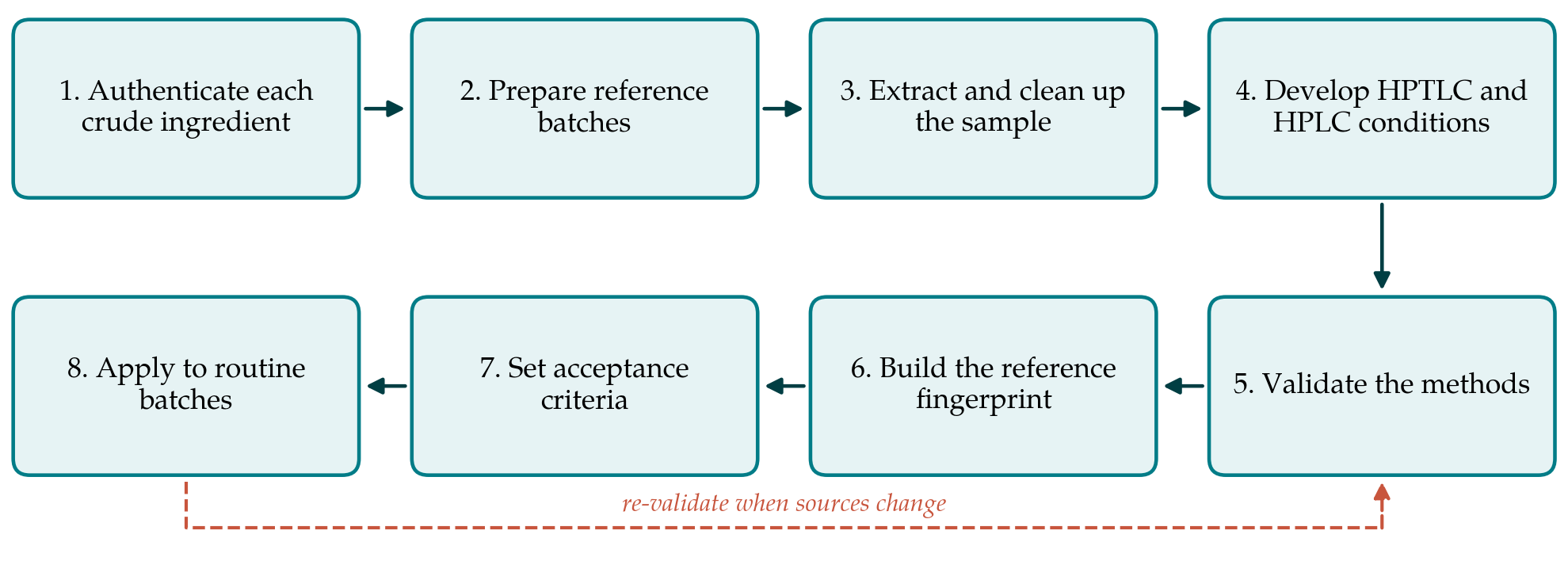
The procedure has eight steps, shown in sequence in Figure 1. Table 1 lists what each step is for and what it should produce. An itrifal of the simplest kind, built on the dried fruits of Terminalia chebula, Terminalia bellirica and Emblica officinalis, serves as the running illustration. Gallic acid, ellagic acid and the hydrolysable tannins of these fruits are well characterised and are widely used as reference substances for them.
| Step | Purpose | Output |
|---|---|---|
| 1. Authenticate ingredients | Confirm botanical identity and purity of every crude drug | Vouchers and single-drug chromatograms |
| 2. Reference batches | Capture genuine variation; trace each ingredient | Complete and minus-one laboratory batches |
| 3. Extraction and clean-up | Remove the sugar base and recover analytes reproducibly | Fixed sample preparation protocol |
| 4. Method development | Resolve as many characteristic constituents as possible | HPTLC and HPLC conditions |
| 5. Validation | Show that the methods are specific, precise and robust | Validation report |
| 6. Reference fingerprint | Define the common pattern of genuine batches | Characteristic peaks and mean profile |
| 7. Acceptance criteria | Turn the pattern into a pass or fail rule | Written specification |
| 8. Routine use | Test production batches and monitor drift | Batch records and trend charts |
3.1. Step 1: Authenticate each ingredient
A fingerprint of the product is only as sound as the identity of what went into it. Each crude drug is authenticated by a qualified botanist or pharmacognosist against pharmacopoeial descriptions, using macroscopic and microscopic characters, and a voucher sample is retained. A thin-layer chromatogram of each single drug is run at this stage, following standard practice for plant drug analysis (Wagner and Bladt, 1996). Contaminants are tested separately: heavy metals, pesticide residues, aflatoxins and microbial load fall under their own limits and are not addressed by a fingerprint (WHO, 2007).
3.2. Step 2: Prepare reference batches
The reference against which later batches will be judged cannot be a single preparation. Several batches are made in the laboratory strictly by the pharmacopoeial method, each from authenticated drugs of a different geographical or commercial origin, so that the natural variation of genuine material is represented. For each, a set of "minus-one" batches is also prepared, in which one ingredient at a time is left out. Comparing these with the complete product shows which peaks or bands each ingredient contributes and so allows every component of the formula to be traced in the finished mixture.
3.3. Step 3: Extraction and clean-up
The sample preparation has to separate the analytes from the sugar base without losing them. A common approach is to disperse a weighed portion in water and partition it against solvents of increasing polarity, or to extract directly with aqueous methanol and pass the extract through a solid-phase cartridge that retains the phenolic and less polar constituents while the sugars wash through. Whatever route is chosen, it is fixed in writing, including the sample mass, solvent volumes, times and temperatures, because small changes here alter the fingerprint more than any instrumental setting. Volatile constituents, where they matter, need a separate preparation and gas chromatography.
3.4. Step 4: Develop the chromatographic methods
Two techniques are developed side by side. High-performance thin-layer chromatography is inexpensive, runs many samples on one plate under identical conditions and gives an image that can be read at several wavelengths and after derivatisation; it suits the routine laboratory of a Unani manufacturer (Reich and Schibli, 2007). Reversed-phase high-performance liquid chromatography with diode-array detection gives better resolution and quantitative data. Because no single run shows every class of compound, the use of more than one fingerprint for the same product has been recommended (Fan et al., 2006). For the myrobalan itrifal, an acidified mobile phase is needed to keep the phenolic acids in a single ionisation state and so obtain sharp peaks. Conditions are optimised for the number and separation of characteristic peaks and not for the speed of one marker (Tistaert et al., 2011).
3.5. Step 5: Validate
The marker assays within the method are validated in the ordinary way for specificity, linearity, range, accuracy, precision, limits of detection and quantitation, and robustness (ICH, 2005). The fingerprint itself is validated on the parameters that apply to a pattern: repeatability of relative retention times or RF values and of relative peak areas, intermediate precision across days and analysts, stability of the sample solution, and robustness to small changes in mobile phase, temperature and plate or column lot. The minus-one batches from Step 2 provide the test of specificity, since the method should detect the absence of each ingredient.
3.6. Step 6: Build the reference fingerprint
The chromatograms of the reference batches are aligned, since retention times drift slightly between runs. Correlation optimised warping is the most widely used alignment method (Nielsen et al., 1998; Tomasi et al., 2004). Peaks present in every genuine batch are designated characteristic peaks, and those identified against reference substances are labelled. A mean or median chromatogram then serves as the reference fingerprint. Principal component analysis of the aligned data is a helpful check at this point: genuine batches should cluster, and minus-one batches should fall outside the cluster (Wold et al., 1987).
3.7. Step 7: Set acceptance criteria
A fingerprint becomes a quality standard only when it yields a decision. Three kinds of criterion are combined. The first is qualitative: every characteristic peak or band must be present at the expected position. The second is a similarity measure, usually the correlation coefficient or the cosine of the angle between the sample chromatogram and the reference, with a threshold derived from the spread among the reference batches themselves (Gong et al., 2003). The third is quantitative: content limits for one or two markers. The threshold must come from the data on genuine batches and should not be borrowed from another product.
3.8. Step 8: Apply to routine batches
In routine use each production batch is run alongside a retained reference batch on the same plate or in the same sequence. Results are charted over time so that a slow drift, such as a change of raw material supplier, is noticed before a batch fails. The reference fingerprint is reviewed when the source of an ingredient changes.
4. Fitting the Procedure to a Unani Manufacturing Unit
Most Unani pharmacies are small, and the procedure is meant to be divisible. Steps 1 to 3 and the thin-layer part of Step 4 need only equipment that a modest quality control laboratory already holds, and they deliver the main benefit, which is evidence that each ingredient is present. Liquid chromatography and chemometric comparison can be done once, in collaboration with a university or a government drug testing laboratory, to establish the reference fingerprint, after which routine control returns to the plate. General accounts of herbal standardisation make the same point about matching the method to the means of the laboratory (Mukherjee, 2002; Kunle et al., 2012). Written procedures and retained samples cost little and matter as much as the instruments.
5. Limitations and What Remains to Be Shown
The procedure has not been applied to any batch in this article, and several questions can be settled only by doing so. One is whether ingredients present in small proportion can be detected against the dominant ones; in formulations with many components some will leave no visible trace in any practical chromatogram, and the specification should say so openly. Another is how much genuine batches vary, since a wide natural spread forces a loose threshold and weakens the test. A third is transferability: a fingerprint developed in one laboratory has to be reproduced in another before it can enter a monograph.
A chemical fingerprint is also silent on matters that classical authors cared about. It confirms composition and consistency. It does not show that a preparation is effective or safe, and it does not capture the classical processing steps except through their chemical consequences. Chemical standardisation is one part of quality assurance, alongside good agricultural, collection and manufacturing practice and tests for contaminants.
6. Conclusion
Chromatographic fingerprinting gives classical Unani compound formulations something their pharmacopoeial limits lack: a test of whether the product is, chemically, the mixture the formula describes. The eight-step procedure proposed here begins with authenticated ingredients and minus-one batches, uses thin-layer and liquid chromatography together, and ends with acceptance criteria derived from genuine material. Its worth for any particular formulation has to be established by applying it, and that work is best shared between manufacturers and reference laboratories.
Conflict of interest
To be declared by the author(s) before publication.
Funding
To be declared by the author(s) before publication.