1. Introduction
Guggulu is the resinous exudate tapped from the bark of Commiphora wightii, a thorny shrub of the arid tracts of western India and neighbouring regions. It is the base of a whole class of Ayurvedic pills that carry its name, among them Yogaraja guggulu, Kaishora guggulu and Triphala guggulu, and it is among the Ayurvedic drugs most studied in the laboratory and the clinic (Satyavati, 1988; Shishodia et al., 2008). The crude material is official in the Ayurvedic Pharmacopoeia of India (Government of India, 1990).
Before it enters any formulation, guggulu undergoes shodhana. The word is usually translated as purification, though the classical concept is wider: the process is meant to remove physical impurities, reduce properties regarded as harmful, and make the drug fit for compounding. The official formulary gives the method in a few lines (Government of India, 2003). It names the apparatus and the permitted liquids and tells the operator to boil, strain and concentrate. It does not say how much liquid, how hot, or for how long.
For a physician preparing medicines by hand that brevity was sufficient, since skill supplied what the text left out. For a licensed manufacturer working under good manufacturing practice it is a gap. This article proposes a way to close it by defining the parameters of each stage of guggulu shodhana and the records each should generate. The framework is offered for discussion and trial. It has not been validated here and no data are presented.
2. Background
The proposal rests on three bodies of knowledge: the classical procedure itself, the chemistry of the resin, and the reasons why loosely specified processing has practical consequences.
2.1. The classical procedure
In the method given in the formulary, raw guggulu is freed from visible foreign matter such as bark, sand and stones, broken into small pieces, tied in a cloth bundle and suspended in a dola yantra, a vessel in which the bundle hangs immersed in boiling liquid without touching the bottom. The liquids named include cow's urine, decoction of triphala, decoction or juice of vasa leaf, juice of nirgundi leaf with turmeric, and milk (Government of India, 2003); decoctions of guduchi or dashamula and plain water are also used in practice. Heating continues until the soluble and dispersible part of the resin has passed through the cloth into the liquid. The residue in the bundle is discarded, the liquid is strained and then boiled down to a thick mass, which is dried and may be worked with a little ghee.
2.2. Chemistry of the resin
Guggulu is a mixture of water-soluble gum, a lipophilic resin and a small fraction of volatile oil. The resin holds the constituents of greatest pharmacological interest: the pregnane steroids E- and Z-guggulsterone, related guggulsterols, diterpenoids of the cembrene type and lignans (Sarup et al., 2015). The guggulsterones were shown to act as antagonists of the farnesoid X receptor, which gave a molecular rationale for the lipid-lowering use of the drug (Urizar et al., 2002; Deng, 2007). Clinical findings have been less uniform. Early Indian trials of a standardised ethyl acetate extract reported reductions in serum lipids (Nityanand et al., 1989), whereas a later randomised trial in the United States did not confirm a fall in low-density lipoprotein cholesterol and recorded hypersensitivity rashes in some participants (Szapary et al., 2003).
During shodhana the gum acts as a natural emulsifier, so that resin and oil pass into the hot aqueous medium as a fine dispersion while coarse debris stays in the cloth. The operation is therefore an extraction, a filtration and a concentration carried out in sequence, with prolonged heating throughout. Each of these can alter composition. Volatile constituents are lost with the steam, heat-sensitive compounds may degrade or isomerise, and soluble matter from the medium, such as tannins from triphala, is carried into the product. Liquid chromatographic methods that separate and quantify the two guggulsterone isomers are available (Mesrob et al., 1998) and provide a way to follow at least one class of constituents through the process.
2.3. Why undefined parameters matter
Three concerns make the question more than academic. The first is consistency. If the ratio of medium to resin or the length of heating differs from batch to batch, so will the proportion of resin recovered and the amount of medium solids in the finished mass. The second is the raw material. C. wightii is assessed as Critically Endangered on the IUCN Red List (Ved et al., 2015), supply is short, and scarce commodities attract substitution, so a process that begins without identity testing may purify the wrong resin. The third is regulatory. Schedule T of the Indian drug rules requires manufacturers of Ayurvedic medicines to work to written procedures and keep batch records (Government of India, 1945), and World Health Organization guidance on herbal medicines asks the same (World Health Organization, 2007). A procedure cannot be followed or audited until it has been written in measurable terms.
3. A Proposed Parameter Framework
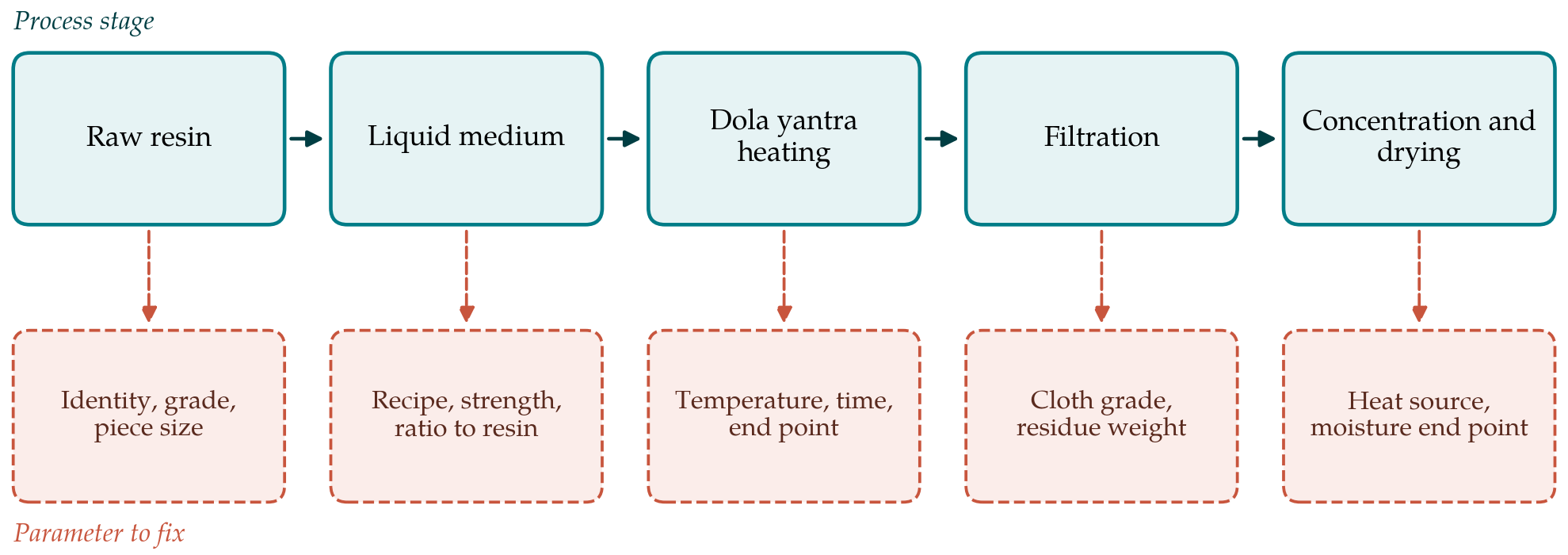
The framework divides shodhana into five stages and assigns to each the parameters that should be fixed in the master procedure and entered in the batch record. Figure 1 shows the stages with the principal parameters of each, and Table 1 sets them out with a suggested means of control. The classical method is kept intact. Nothing is added to or removed from the sequence of operations; the proposal concerns only how they are specified and documented.
| Stage | Parameters to define | Suggested control or record |
|---|---|---|
| 1. Raw resin | Identity, foreign matter, piece size | Pharmacopoeial tests; sieve range; weight rejected |
| 2. Liquid medium | Recipe, strength, ratio of medium to resin | Herb weights, reduction, specific gravity |
| 3. Dola yantra heating | Temperature, immersion, topping up, end point | Thermometer log; total time; residue check |
| 4. Filtration | Cloth or mesh grade | Dried residue as a proportion of starting resin |
| 5. Concentration and drying | Heat source, stirring, moisture end point, ghee added | Loss on drying; yield; drying temperature and time |
| Finished material | Identity, purity, marker content | Ash and extractive values; guggulsterones (Mesrob et al., 1998); microbial limits |
3.1. Stage 1: Qualify the raw resin
Control begins before the cloth is tied. Each lot of raw guggulu should be identified against the pharmacopoeial monograph, which provides a macroscopic description and tests including foreign matter, ash values, extractive values and volatile oil content (Government of India, 1990). A chromatographic fingerprint against an authenticated reference adds assurance where substitution is suspected. After manual cleaning, the weight of rejected foreign matter is recorded, and the resin is broken to a stated size range. Piece size deserves a number because it governs the surface exposed to the medium and hence the rate at which the resin disperses.
3.2. Stage 2: Prepare the liquid medium
The medium is an ingredient and should be specified like one. For a decoction, the master procedure states the identity and quality of each herb, the weight of herb per volume of water, the degree of reduction and the time between preparation and use. Total dissolved solids, or simply specific gravity, gives a quick measure of strength that can be compared between batches. For milk or cow's urine, source and freshness are stated. The ratio of medium to resin is then fixed by weight and volume. Classical practice varies on this point, and that variability is the reason a pharmacy should choose one ratio, justify it, and keep to it.
3.3. Stage 3: Heat in the dola yantra
This stage is the heart of the process and the one least specified in the texts. Four things should be defined: the temperature of the liquid, measured with a thermometer instead of judged by the vigour of boiling; the height of the bundle in the liquid; the method and frequency of topping up to replace evaporated medium; and the end point. The classical end point is that no more material passes from the bundle. This can be made more objective by a time limit established during development together with a check on the weight of residue remaining in the cloth. Total heating time is recorded for every batch.
3.4. Stage 4: Filter
The hot liquid is strained to remove fine insoluble matter that escaped the bundle. The grade of cloth or the mesh size of the sieve should be specified, since a coarser filter passes more grit and raises the ash value of the product. The combined weight of the dried residue from bundle and filter, expressed against the starting weight of resin, is a useful in-process figure. It reflects both the quality of the raw lot and the completeness of the extraction, and an unusual value in either direction is a reason to investigate.
3.5. Stage 5: Concentrate and dry
The filtrate is evaporated to a soft mass. Scorching is the main risk, because the mixture thickens and the temperature at the vessel wall climbs as water is lost. The procedure should state the heat source, whether direct flame, steam jacket or water bath, the stirring regime, and an end point more exact than "thick enough". Loss on drying of a sample taken at the end of concentration serves well, with a target range set during development. The mass is then dried at a stated temperature for a stated time. If ghee is incorporated, its quantity per unit weight of purified guggulu is fixed. Final yield against the starting resin is calculated for every batch and compared with an expected range.
3.6. Controls on the purified material
Purified guggulu should have its own specification, distinct from that of the raw drug. A reasonable minimum comprises description, loss on drying, total and acid-insoluble ash, extractive values, a chromatographic fingerprint, content of E- and Z-guggulsterone, and the tests for microbial load and contaminants that apply to herbal materials generally (World Health Organization, 2011). Limits should be derived from the pharmacy's own batches made under the defined procedure. Because the medium contributes solids, a batch purified in triphala decoction and one purified in milk are different materials, and each medium needs its own specification.
4. Establishing the Parameter Ranges
Naming the parameters does not settle what their values should be. The framework proposes that ranges be established by the quality-by-design approach set out in the ICH guideline on pharmaceutical development (ICH, 2009) and explained for practitioners by Yu et al. (2014). The first step is to state the quality attributes that matter in the purified resin, for example guggulsterone content, residual moisture and ash. The second is a risk assessment, following the principles of quality risk management (ICH, 2005), to judge which process parameters are most likely to affect those attributes. Medium-to-resin ratio, heating temperature, heating time and concentration temperature are the obvious candidates.
The third step is experimental. A factorial design, in which the candidate parameters are varied together at two or three levels on portions of a single homogenised raw lot, shows their main effects and interactions with far fewer runs than changing one factor at a time (Montgomery, 2013). The region in which all quality attributes stay within their limits becomes the operating range written into the master procedure. Using one raw lot for the whole design matters, because lot-to-lot variation in a natural resin could otherwise mask the effect of the process.
5. Limitations and What Remains to Be Shown
This framework is a proposal and has not been tested. Whether the parameters named here are the ones that govern product quality, and how wide their acceptable ranges are, can only be learned from the experiments outlined above. It is possible that some parameters prove unimportant across any realistic range and can be left loosely controlled, and that others not listed here turn out to matter.
There are also limits of principle. Guggulsterone content is a convenient analytical marker, but the classical aims of shodhana are stated in terms of tolerability and therapeutic fitness, and no chemical measure has been shown to capture them. A process optimised for marker retention could, in principle, depart from what the tradition intends. Process control cannot compensate for a poor or substituted raw material, and the conservation status of the species means that raw material will remain the weakest link. The framework also treats each medium separately and offers no basis for saying which medium is preferable. That is a clinical question.
6. Conclusion
Shodhana of guggulu is a sequence of extraction, filtration and concentration that the classical texts describe in qualitative terms. Writing it as a defined process requires only that the quantities, temperatures, times and end points already implicit in skilled practice be measured, fixed and recorded, stage by stage. The five-stage framework proposed here identifies those parameters and a route to setting their ranges. Its usefulness depends on experimental work that has yet to be done, preferably by several pharmacies working with a shared protocol and comparing their results.
Conflict of interest
To be declared by the author(s) before publication.
Funding
To be declared by the author(s) before publication.