1. Introduction
The identity of the starting material is the first quality attribute of any herbal medicine. If the wrong species, or the wrong part of the right species, enters production, no later control can restore what is missing. Pharmacopoeial monographs have traditionally secured identity through macroscopic and microscopic description supported by a thin-layer chromatographic test, and the guidance issued by the World Health Organization on quality control of herbal materials follows the same pattern (WHO, 2011). These methods work well for whole or coarsely cut drugs examined by a trained pharmacognosist. They are less secure for fine powders, for drugs from genera with many similar species, and in laboratories where that training is no longer available.
DNA barcoding entered this field with considerable publicity. A survey of herbal products sold in North America, which reported that many contained DNA of unlabelled species or lacked DNA of the labelled one (Newmaster et al., 2013), was followed by wide publicity and then by sustained criticism of the method as applied to processed products. The debate clarified what sequencing can and cannot establish, and subsequent appraisals have converged on the view that DNA methods are powerful for raw botanical material and should be used with chemical methods, not instead of them (Parveen et al., 2016; Raclariu et al., 2018).
That recommendation is easier to state than to follow, because the literature gives little practical direction on how the two kinds of result should be combined when they disagree. This article proposes a procedure that does so for raw materials at the point of receipt. It is a design, set out with its reasoning, and not a report of its application.
2. Background
The procedure rests on a division of labour between the two techniques, and the case for that division should be made before the steps are described.
2.1. What a barcode can establish
The barcoding concept, proposed for animals by Hebert et al. (2003), is that a short, standard stretch of DNA differs enough between species and little enough within them to serve as an identifier. No single region does this for plants. An international working group recommended the plastid genes rbcL and matK as a core two-locus barcode (CBOL Plant Working Group, 2009), earlier work had shown the value of the non-coding plastid spacer trnH-psbA (Kress et al., 2005), and large comparative studies argued that the nuclear ribosomal internal transcribed spacer should be added because it discriminates better among closely related species (China Plant BOL Group, 2011). For medicinal plants specifically, the second spacer, ITS2, was validated on several thousand samples and is short enough to amplify from partly degraded material (Chen et al., 2010).
A barcode identifies the organism from which DNA was recovered. It does not reveal which organ was harvested, whether the plant was mature, how the material was dried or stored, or whether the constituents responsible for the therapeutic use are present. It can fail to amplify from material that has been heated or stored for years, and it can amplify a minor contaminant in preference to a degraded main component (Parveen et al., 2016). Its reliability also depends on the reference library: an identification is only as good as the vouchered sequences against which the query is matched (Techen et al., 2014).
2.2. What a chemical fingerprint can establish
A chromatographic fingerprint is the pattern of constituents obtained from an extract under fixed conditions. In the form used for identification, high-performance thin-layer chromatography, the pattern is a sequence of coloured or fluorescent zones compared by eye and by image against a reference track (Reich and Schibli, 2007). In liquid chromatography it is a profile of peaks that can be compared numerically through similarity indices and multivariate analysis (Liang et al., 2004). The fingerprint reflects plant part, growth stage, processing and storage as well as species, which is its strength for quality assessment. Its weakness for identity is the converse: related species may share a chemistry, a genuine sample grown or handled unusually may look atypical, and an inferior material spiked with a marker compound or an extract may look acceptable.
3. The Proposed Procedure
The procedure has seven steps. They are listed with their controls and records in Table 1, and the sequence is drawn in Figure 1. Steps 3 and 4 form the DNA arm and step 5 the chemical arm; in practice the two arms are run side by side on portions of the same homogenised laboratory sample, and neither result is read until both are complete.
| Step | Main control | Record kept |
|---|---|---|
| 1. Sample and record the lot | Sampling plan covering all containers; retained sample | Lot details, sampling scheme, photographs |
| 2. Pharmacognostic check | Comparison with monograph description | Observations and foreign matter found |
| 3. DNA extraction and assessment | Extraction blank; check of yield and purity | Method, quantities, gel or spectrophotometer reading |
| 4. Amplification and sequencing | Negative and positive PCR controls; both strands read | Primers, conditions, trace files, edited sequence |
| 5. Chromatographic fingerprint | System suitability; reference material on the same plate or run | Images or chromatograms with conditions |
| 6. Comparison with references | Vouchered sequences; authenticated reference drug | Match statistics, similarity assessment |
| 7. Decision and report | Predefined rule; second-person review | Signed conclusion and any follow-up |
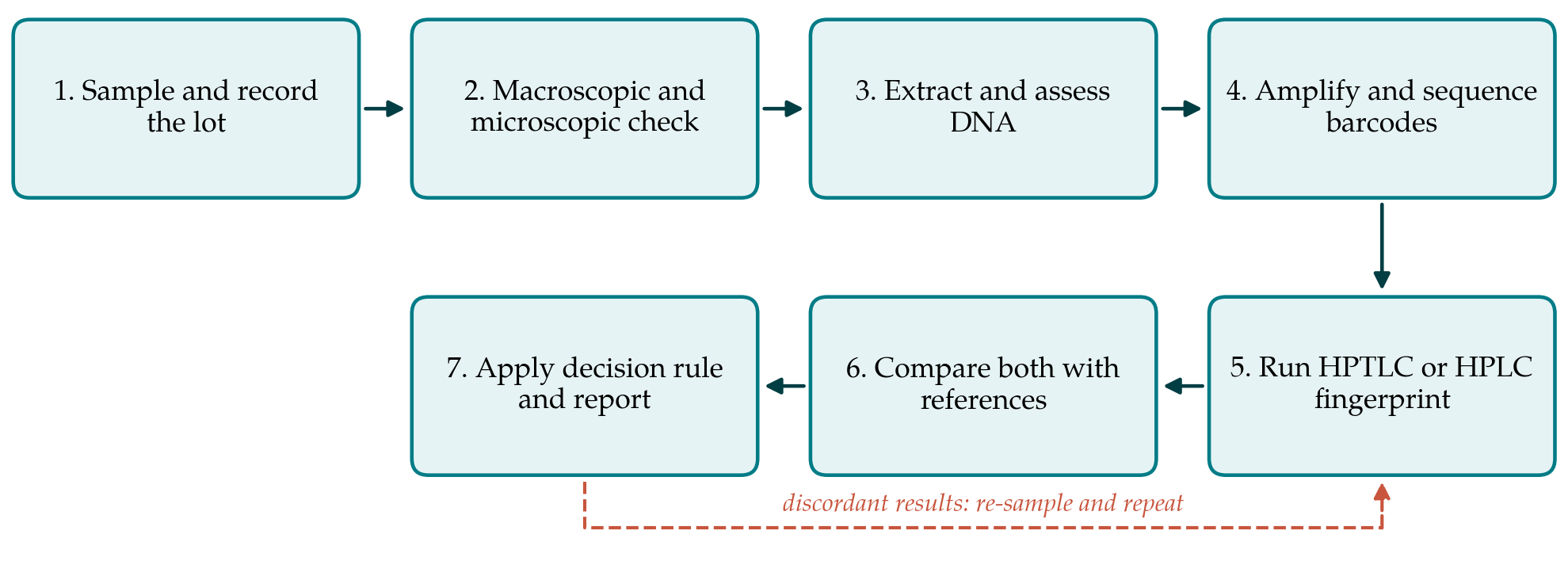
3.1. Step 1: Sample and record the lot
Adulteration is often partial and unevenly distributed, so the sample must represent the lot. Increments are drawn from the number of containers specified in the applicable pharmacopoeia or in the WHO guidance (WHO, 2011), pooled, reduced by quartering, and divided into a laboratory sample and a retained sample. Whole or cut material is photographed before milling. The laboratory sample is then ground to a uniform powder from which the portions for both arms are taken, so that the two results refer to the same material.
3.2. Step 2: Preliminary pharmacognostic check
A short examination against the monograph description comes first because it is inexpensive and because it guides everything that follows. Visible foreign matter, an unexpected odour, or powder characters that do not fit the declared organ indicate what kind of substitution to look for and may justify rejecting the lot without further work.
3.3. Step 3: Extract DNA and assess its quality
DNA is extracted in duplicate from the powder together with an extraction blank. Protocols based on cetyltrimethylammonium bromide, derived from the method of Doyle and Doyle (1987), remain the usual choice for tissues rich in polysaccharides and phenolics, with commercial silica-column kits as an alternative. Yield and purity are checked by spectrophotometry and fragment size by gel electrophoresis. Roots, barks and resins commonly give little and fragmented DNA. That outcome is recorded as a finding in its own right, since it determines whether a full-length barcode or only a shorter region can be attempted.
3.4. Step 4: Amplify and sequence the barcode regions
Two regions are amplified: ITS2 as the primary marker and a plastid region, rbcL or trnH-psbA, as the second. Using a nuclear and a plastid locus guards against the failure of either and against the occasional misleading result caused by fungal ITS sequences or by plastid sharing between hybridising species. Each run includes a no-template control and a positive control from an authenticated specimen. Products are sequenced by the Sanger method in both directions, and the traces are inspected for mixed signals, which indicate more than one template. Where a mixture is suspected and the question justifies the cost, amplicon sequencing on a high-throughput platform can resolve the components (Ivanova et al., 2016).
3.5. Step 5: Acquire the chromatographic fingerprint
The fingerprint is obtained by the monograph method where one exists. High-performance thin-layer chromatography is proposed as the default for identity, because sample, reference drug and marker substances run side by side on one plate and several derivatisation and detection modes can be applied to it (Reich and Schibli, 2007). A liquid chromatographic profile is added when the monograph requires an assay or when the thin-layer pattern is ambiguous. System suitability is confirmed before the sample tracks are evaluated.
3.6. Step 6: Compare with authenticated references
Edited sequences are queried against a curated library such as the Barcode of Life Data System (Ratnasingham and Hebert, 2007) and, by similarity search, against the public nucleotide databases (Altschul et al., 1990). A species-level identification is accepted only when the best match is to a vouchered record of the declared species and is clearly separated from the best match to any other species; otherwise the result is reported at genus level. The fingerprint is compared with that of a botanical reference material of documented origin, noting the presence, position and relative intensity of the characteristic zones or peaks and any additional ones.
3.7. Step 7: Apply the decision rule and report
Four outcomes are possible. If both arms agree with the declared identity, the lot is accepted as authentic. If the barcode matches and the fingerprint does not, the species is probably right and the material is suspect on other grounds: wrong plant part, exhausted or deteriorated drug, or admixture with inert matter. If the fingerprint matches and the barcode does not, the possibilities are a related species with similar chemistry, contaminating DNA, or a fortified substitute, and the lot is held while a fresh sample is taken through both arms. If neither matches, the lot is rejected. A barcode that fails to amplify is treated as no information and never as evidence against the lot; the decision then rests on the pharmacognostic and chromatographic evidence, and the report says so.
4. Fitting the Procedure to a Working Laboratory
Few quality control laboratories in the herbal sector have both a molecular biology bench and chromatographic equipment. The procedure does not require them under one roof. The chemical arm can be run in-house and the sequencing contracted out, provided that the homogenised sample is split by the originating laboratory and that controls travel with it. Separation of pre- and post-amplification areas is essential wherever amplification is done, because carry-over of amplified product is the commonest cause of false species assignments.
The largest practical investment is the reference collection. Each drug in routine use needs authenticated material, tied to a herbarium voucher determined by a taxonomist, from which both a reference sequence and a reference fingerprint are generated in the laboratory's own hands. Public sequence databases contain misidentified entries, and reliance on them alone has been identified as a weakness of barcoding for pharmacovigilance and quality assurance (de Boer et al., 2015; Mishra et al., 2016). The procedure can also be applied selectively. A risk-based scheme would reserve the DNA arm for drugs with known confusable species, for new suppliers and for lots that give an unusual fingerprint.
5. Limitations and What Remains to Be Shown
The procedure is proposed and has not been validated here. Its performance should be established on a panel of authentic drugs, known adulterants and prepared mixtures at stated proportions, analysed blind, so that the rate of correct acceptance and rejection of the combined rule can be compared with that of each arm alone. The proportion of admixture at which Sanger sequencing still returns the major component, and at which the fingerprint first shows a visible change, needs to be determined drug by drug. Agreement between laboratories should be tested before the decision rule is written into a specification.
Some limits are inherent. The procedure is intended for crude drugs and powders. Extracts, in which DNA is absent or badly degraded, fall outside it, as do finished products with many ingredients. Sanger sequencing reads the dominant template and will miss a minor adulterant that a fingerprint may also fail to show. Neither arm addresses pesticide residues, heavy metals, microbial load or aflatoxins, which remain separate tests.
6. Conclusion
A DNA barcode and a chromatographic fingerprint give independent evidence about a herbal raw material, one on the species and one on the composition. Run in parallel on a single sample and read together through a stated rule, they can distinguish kinds of nonconformity that neither reveals alone. The seven-step procedure described here is a workable way of doing this with established techniques. Whether it improves decisions enough to justify its cost is a question for validation studies, which this article is intended to prompt.
Conflict of interest
To be declared by the author(s) before publication.
Funding
To be declared by the author(s) before publication.