1. Introduction
A legged robot is an awkward subject for trial-and-error learning. It falls, and falls damage it. Its dynamics are hybrid, switching at every footfall, and the forces that matter most pass through contacts that are difficult to measure. Reinforcement learning needs a volume of experience that no physical machine can supply in reasonable time. Simulation supplies it cheaply, and the price is the mismatch between the simulated and the physical robot. The term for that mismatch, the reality gap, comes from evolutionary robotics, where Jakobi et al. (1995) observed that controllers evolved in simulation transferred only when the simulation contained appropriate noise.
For many years the strongest legged controllers were model based. Whole-body and model predictive control gave quadrupeds such as the MIT Mini Cheetah fast and dynamic gaits (Kim et al., 2019), and learned policies were a laboratory curiosity by comparison. That changed quickly. Within a few years policies trained entirely in simulation were shown trotting and galloping on a small quadruped (Tan et al., 2018), recovering a larger one from falls (Hwangbo et al., 2019) and carrying it over rough natural ground (Lee et al., 2020).
This review asks two questions of that literature. Which ideas account for the progress, and which parts of the gap remain open once the demonstrations are set aside? The second question receives the more attention, because the successes are well publicised and the failures are seldom written up.
2. Scope and Approach
The article is a narrative review of the published literature on transferring learned locomotion controllers from simulation to legged hardware. It concentrates on reinforcement learning for quadrupeds and bipeds, and it draws on peer-reviewed articles, conference papers and widely cited preprints known to the field. It does not attempt an exhaustive or systematic search, and it does not rank methods numerically, since the reported experiments differ in robot, terrain and measure. General surveys of sim-to-real methods in robotics are available elsewhere (Zhao et al., 2020; Muratore et al., 2022); the present review is narrower and limited to legs.
3. Where the Reality Gap Comes From
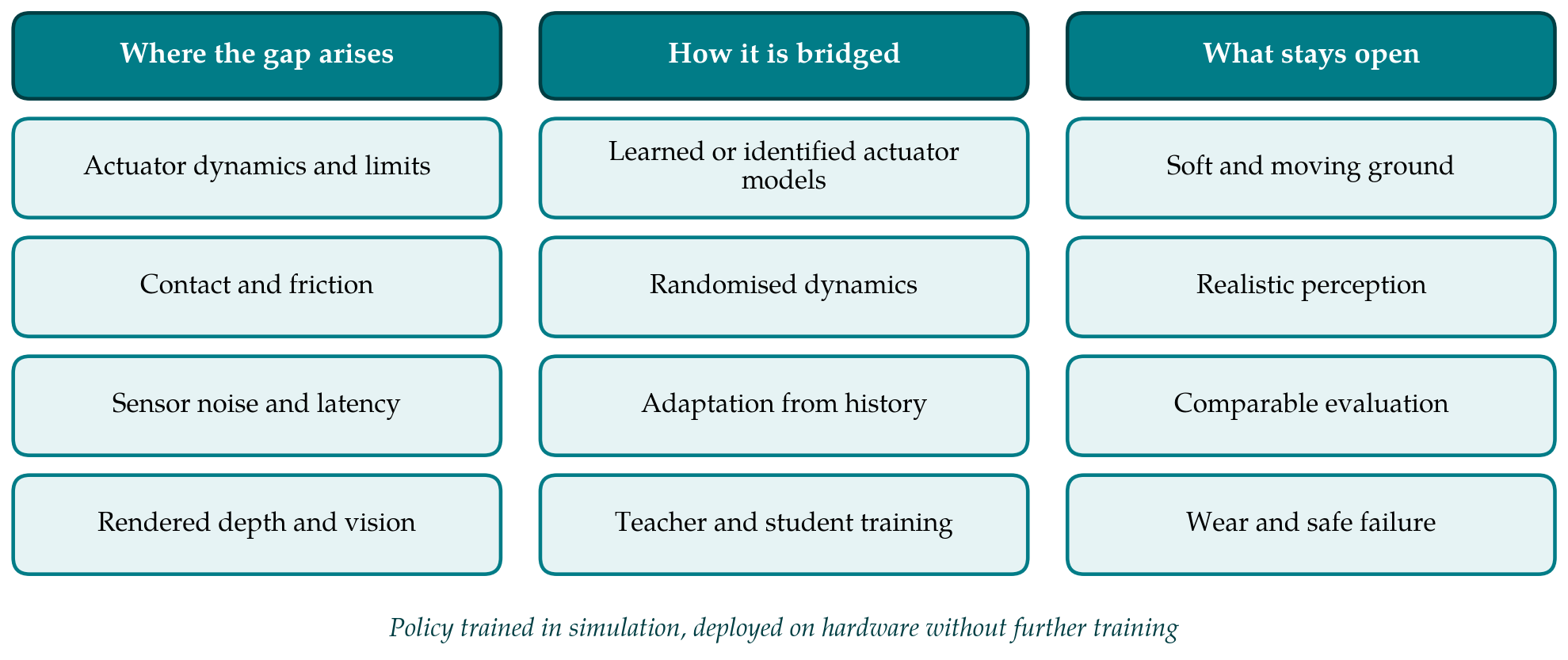
Figure 1 groups the sources of mismatch, the remedies and the open problems that organise the rest of this review. Four sources recur in the literature.
3.1. Actuators
Rigid-body simulators treat a joint as an ideal torque source. Real actuators are nothing of the kind. Gear trains add friction and backlash, motor drivers saturate, series elastic elements store energy, and the low-level control loop introduces delay. Hwangbo et al. (2019) identified the actuator as the dominant error for the ANYmal quadruped, whose joints are series elastic (Hutter et al., 2016), and Tan et al. (2018) reached the same conclusion for the direct-drive Minitaur, where an accurate motor model and a model of latency were both needed before policies transferred.
3.2. Contact
Simulators resolve contact with simplified models: rigid or lightly compliant bodies, Coulomb friction with a single coefficient, and solvers that soften constraints for numerical stability, as in MuJoCo (Todorov et al., 2012). Real feet slip, sink, roll on their edges and strike surfaces whose properties change from step to step. A policy can learn to rely on a contact artefact, such as a small penetration that the solver permits, and that reliance is invisible until the hardware trial.
3.3. Sensing and perception
Joint encoders are accurate, but base velocity is estimated, inertial measurements drift and are noisy, and every signal arrives late. Exteroception is worse. Depth cameras and lidar return missing data on reflective or dark surfaces, treat tall grass as an obstacle and lose their pose estimate when the robot slips, none of which appears in a cleanly rendered height map. Miki et al. (2022) made this unreliability the centre of their design, training a policy to decide for itself when the perceived terrain should be distrusted.
4. Methods for Crossing the Gap
The remedies fall into five families, which are usually combined. Table 1 summarises them with representative sources.
| Family | Idea | Representative sources | Limit |
|---|---|---|---|
| Actuator modelling | Identify or learn the map from command to joint torque | Tan et al., 2018; Hwangbo et al., 2019 | Specific to one robot and its wear state |
| Dynamics randomisation | Vary mass, friction, delays and gains during training | Peng et al., 2018; Tobin et al., 2017 | Ranges are hand-set; wide ranges cost performance |
| Randomisation tuned from data | Fit the simulation parameter distribution to real rollouts | Chebotar et al., 2019 | Needs repeated hardware trials |
| Online adaptation | Infer hidden properties from recent proprioceptive history | Yu et al., 2017; Kumar et al., 2021 | Adapts only within the trained range |
| Privileged teacher and student | Teacher sees true state; student imitates it from sensors | Lee et al., 2020; Miki et al., 2022 | Two-stage training; student may lag the teacher |
| Massively parallel simulation | Thousands of robots simulated at once on a graphics processor | Makoviychuk et al., 2021; Rudin et al., 2022 | Speed gained by simplifying contact |
4.1. Better models of the robot
The most direct remedy is to improve the simulator where it is worst. Tan et al. (2018) did so analytically, with a motor model identified on the bench. Hwangbo et al. (2019) took a different course and trained a neural network on logged data to predict joint torque from a short history of position errors and velocities, then placed that network inside the rigid-body simulation. The approach captures effects that are tedious to model by hand, and it ties the trained policy to a particular actuator in a particular condition.
4.2. Randomisation
If the true parameters cannot be known, a policy can be trained across a distribution of them. Tobin et al. (2017) introduced domain randomisation for visual inputs, and Peng et al. (2018) applied the same idea to dynamics, randomising masses, friction and delays so that the real system would appear as one more sample. The idea has an antecedent in the noise-based argument of Jakobi et al. (1995). Randomisation is now universal in legged work. Its weakness is that the ranges are chosen by the engineer: too narrow and the policy overfits, too wide and it becomes conservative. Chebotar et al. (2019) addressed this by adjusting the randomisation distribution from real trajectories.
4.3. Adaptation and privileged learning
A policy that is merely robust treats every surface alike. An adaptive one infers what it is standing on. Yu et al. (2017) paired a universal policy with an online estimator of physical parameters. Lee et al. (2020) trained a teacher with access to privileged simulator state, such as contact forces and terrain profile, and then a student that reproduced the teacher's actions from a history of joint measurements alone. Rapid motor adaptation, proposed by Kumar et al. (2021), follows similar reasoning with a module that estimates a compact description of the environment from recent states and actions. Peng et al. (2020) adapted policies that imitate recorded animal motion by searching a learned latent space of dynamics on the real robot.
4.4. Faster simulation
The last ingredient is throughput. Simulators that run thousands of environments in parallel on a graphics processor (Makoviychuk et al., 2021) reduced the training of a rough-terrain walking policy from days to minutes (Rudin et al., 2022), using a standard on-policy learning algorithm. Speed changes practice: with short iterations, engineers tune rewards and randomisation ranges against hardware behaviour, so that the designer becomes part of the transfer loop.
5. What Has Been Demonstrated
The evidence for these methods consists of hardware demonstrations. On quadrupeds the sequence runs from flat-ground gaits (Tan et al., 2018) through fall recovery and fast running (Hwangbo et al., 2019) to blind traversal of mud, snow and rubble (Lee et al., 2020), perceptive hiking on an alpine trail (Miki et al., 2022) and parkour-style climbing and jumping (Hoeller et al., 2024). Bipeds, with a smaller support polygon and less margin, followed. Policies for the Cassie biped were transferred after iterative refinement of the training design (Xie et al., 2020) and later climbed stairs without vision (Siekmann et al., 2021). Radosavovic et al. (2024) reported a full-size humanoid walking outdoors under a policy trained only in simulation.
These results are persuasive, and they should be read for what they are. Each is a demonstration on one robot, selected by its authors, in conditions they chose. Success rates are reported by some groups and not by others, and negative results are rare. The literature shows that transfer can work. It says much less about how often it does, or by what margin.
6. Persistent Gaps
Terrain that deforms or moves. Training terrains are rigid height fields. Sand, deep snow, vegetation, loose scree and floating or swaying platforms violate that assumption. Blind policies cope with some of these through adaptation, but they do so by extrapolation, and no widely used simulator models granular or yielding ground at the speed that learning requires.
Perception. Policies that use cameras or lidar are trained on rendered depth or sampled height maps with synthetic noise. The failure modes of real sensors are structured, not random, and correlated with the very situations in which the robot most needs to see. The belief-state design of Miki et al. (2022) mitigates the problem by falling back on proprioception; it does not make the simulated sensor realistic.
Evaluation. There is no accepted test course, no standard perturbation set and no common reporting format for sim-to-real locomotion. Papers report different robots on different ground with different measures. Whether one method transfers better than another is in most cases impossible to establish from the published record, a weakness that surveys of the wider field also note (Muratore et al., 2022).
Reward and curriculum engineering. Policies that transfer well are trained with long lists of shaped reward terms that penalise foot slip, joint acceleration, torque and action rate. These terms are partly a disguised remedy for the gap, since they discourage behaviour the hardware cannot reproduce, and they are tuned by hand against the real robot. The knowledge involved is rarely documented in full.
Hardware condition and safe failure. A learned actuator model describes a robot on the day the data were logged. Gearboxes wear, batteries sag and feet are replaced. Little published work examines how transferred policies degrade as hardware ages, or how a policy should behave when the situation lies outside anything it met in training.
Learning on the robot itself is one response. Haarnoja et al. (2019) trained a small quadruped to walk in the real world in about two hours, Smith et al. (2022) reduced this to around twenty minutes with a carefully tuned off-policy method, and Wu et al. (2023) used a learned world model for the same purpose. Such methods avoid the gap by never entering simulation, but so far for simple gaits on benign ground. The likelier role for real-world learning is to refine a policy pre-trained in simulation.
7. Directions for Future Work
Three lines of work would address the gaps identified above. The first is measurement. A shared set of physical test conditions, with agreed perturbations and reporting of failures as well as successes, would let the field compare methods and would expose which sources of mismatch still matter. The second is simulation of what is currently omitted: compliant and granular ground, sensor models built from recorded failure cases, and actuator models that include temperature and wear. The third is a principled account of the residual gap at run time, so that a policy can recognise when its training no longer applies and hand over to a conservative fallback.
A further question concerns the division of labour between learning and models. Model-based controllers come with constraints that can be checked, and learned policies with robustness that cannot yet be certified. Hybrid schemes, in which a learned policy proposes and a model-based layer verifies, are an obvious meeting point and are likely to matter most where legged robots work near people.
8. Conclusion
Sim-to-real transfer for legged locomotion has moved from doubtful to routine through a small number of ideas applied together: honest actuator models, randomised dynamics, adaptation from proprioceptive history, privileged training and very fast simulation. The demonstrations that followed are real achievements. They are also selected ones, and the published record does not yet support quantitative claims about reliability. Deformable terrain, realistic perception, comparable evaluation, undocumented reward engineering and ageing hardware are where the gap persists. Progress on those fronts depends less on new learning algorithms than on better measurement and on simulators that include what has so far been left out.
Conflict of interest
To be declared by the author(s) before publication.
Funding
To be declared by the author(s) before publication.