1. Introduction
Broiler production rests on two ingredients, a cereal for energy and soybean meal for protein. The arrangement works because soybean meal is rich in lysine, consistent from one consignment to the next and well characterised in every feed formulation database. Its weaknesses lie outside nutrition. Soybeans are grown in a few exporting regions, the price moves with currency and trade policy, and expansion of the crop has been linked to land-use change. Producers in importing countries, and especially small feed mills in Africa and Asia, therefore have a standing interest in protein sources that can be produced locally.
Insects entered this discussion in earnest after the Food and Agriculture Organization published its assessment of edible insects for food and feed (van Huis et al., 2013). Among the candidate species, the black soldier fly, Hermetia illucens, has attracted the most work. Its larvae grow on a wide range of organic residues, the adult does not feed and is not regarded as a pest or a disease vector, and the prepupae leave the substrate of their own accord, which simplifies harvesting (Sheppard et al., 1994). The idea is not new. Dried larvae were being fed to chicks as early as the 1970s (Hale, 1973). What has changed is the scale of production and the number of controlled feeding trials.
This review asks a narrow question: what does the published evidence say about using larvae meal to replace part, not all, of the soybean meal in broiler diets? Partial replacement is the realistic case. Supplies of insect meal are small beside the tonnage of soybean meal that the poultry industry consumes, and nutritionists introduce an unfamiliar ingredient at low inclusion before they trust it at high.
2. Scope and Approach
The article is a narrative review of the published literature. It draws on the general reviews of insects as feed (Makkar et al., 2014; Veldkamp and Bosch, 2015; Gasco et al., 2019), on the review of black soldier fly composition by Barragan-Fonseca et al. (2017), and on primary studies of digestibility and performance in broilers and closely related poultry. No formal search protocol was applied and no pooled estimate is offered. Studies on laying hens and quail are mentioned where they help to interpret the broiler work, and larval fat is treated only briefly because the question here concerns protein.
3. Composition of Larvae Meal and Why It Varies
A formulator replacing soybean meal needs to know what is being put in its place, and for larvae meal the answer depends on how the larvae were reared and processed. Table 1 summarises the features that matter most and sets them against soybean meal.
| Feature | Larvae meal compared with soybean meal | Consequence for formulation | Source |
|---|---|---|---|
| Crude protein | Similar or lower in full-fat meal; higher after defatting | State the degree of defatting; formulate on analysed values | Makkar et al., 2014 |
| Nitrogen factor | Chitin nitrogen inflates protein calculated with 6.25 | True protein is lower than the label suggests | Janssen et al., 2017 |
| Amino acids | Lysine adequate; methionine and cystine limiting, as in soybean | Synthetic methionine is still required | Barragan-Fonseca et al., 2017 |
| Fat | Far higher and very variable; rich in lauric acid | Raises dietary energy and saturated fat | Spranghers et al., 2017 |
| Minerals | High calcium and a wide calcium to phosphorus ratio | Reduce limestone; check available phosphorus | Makkar et al., 2014 |
| Consistency | Varies with substrate and processing | Analyse each source before use | Spranghers et al., 2017 |
3.1. Protein and amino acids
Full-fat larvae meal carries rather less crude protein than soybean meal on a dry matter basis, and partially or highly defatted meals carry more (Makkar et al., 2014). The figure on the label needs care, however. Part of the nitrogen in an insect is bound in chitin and other non-protein compounds, so the conventional factor of 6.25 overstates true protein. Janssen et al. (2017) proposed a factor of about 4.76 for whole larvae of the species they examined, Hermetia illucens among them. A meal that appears to match soybean meal on crude protein may therefore deliver appreciably fewer amino acids.
The amino acid pattern itself is favourable in most respects and fairly stable. When Spranghers et al. (2017) reared prepupae on four different organic substrates, the amino acid profile changed little, while fat and ash changed a great deal. Lysine, valine and the other branched chain amino acids are well supplied. The sulphur amino acids are not, which means that larvae meal shares the main limitation of soybean meal instead of correcting it (Barragan-Fonseca et al., 2017). A diet in which one replaces the other still depends on supplemental methionine to meet the requirements set out for broilers (NRC, 1994).
3.2. Fat, chitin and minerals
Fat is the most variable fraction. Its amount depends on the substrate and the stage of harvest, and its fatty acid profile is dominated by lauric acid, a saturated medium-chain fatty acid that the larva synthesises itself. The remaining fatty acids reflect the diet of the larvae: feeding fish offal, for example, enriched them in long-chain omega-3 fatty acids (St-Hilaire et al., 2007). Chitin is the structural polysaccharide of the cuticle. Estimates based on acid detergent fibre overstate it, because that fraction also contains bound amino acids (Finke, 2007), but some chitin is always present and broilers digest it poorly. The cuticle of this species is also mineralised, so the meal is rich in calcium and has a wide ratio of calcium to phosphorus.
4. Digestibility and Energy Value in Broilers
Formulating on digestible amino acids requires measured coefficients, and several groups have supplied them. De Marco et al. (2015) determined apparent nutrient digestibility, ileal amino acid digestibility and apparent metabolisable energy for a full-fat Hermetia illucens meal and a Tenebrio molitor meal in broilers, and concluded that both were useful sources of energy and digestible amino acids. Schiavone et al. (2017a) repeated the exercise for a partially defatted and a highly defatted meal and found that the two differed in energy value and in the digestibility of individual amino acids, a difference they related to processing as well as to fat content.
Two points follow for practice. One is that there is no single matrix value for larvae meal in the way there is for a soybean meal of stated protein content; each product needs its own. The other is that heat applied during drying and fat extraction can depress amino acid digestibility, as it does in any animal protein meal, so two meals with identical proximate analysis may not feed alike.
5. Growth Performance at Partial Replacement
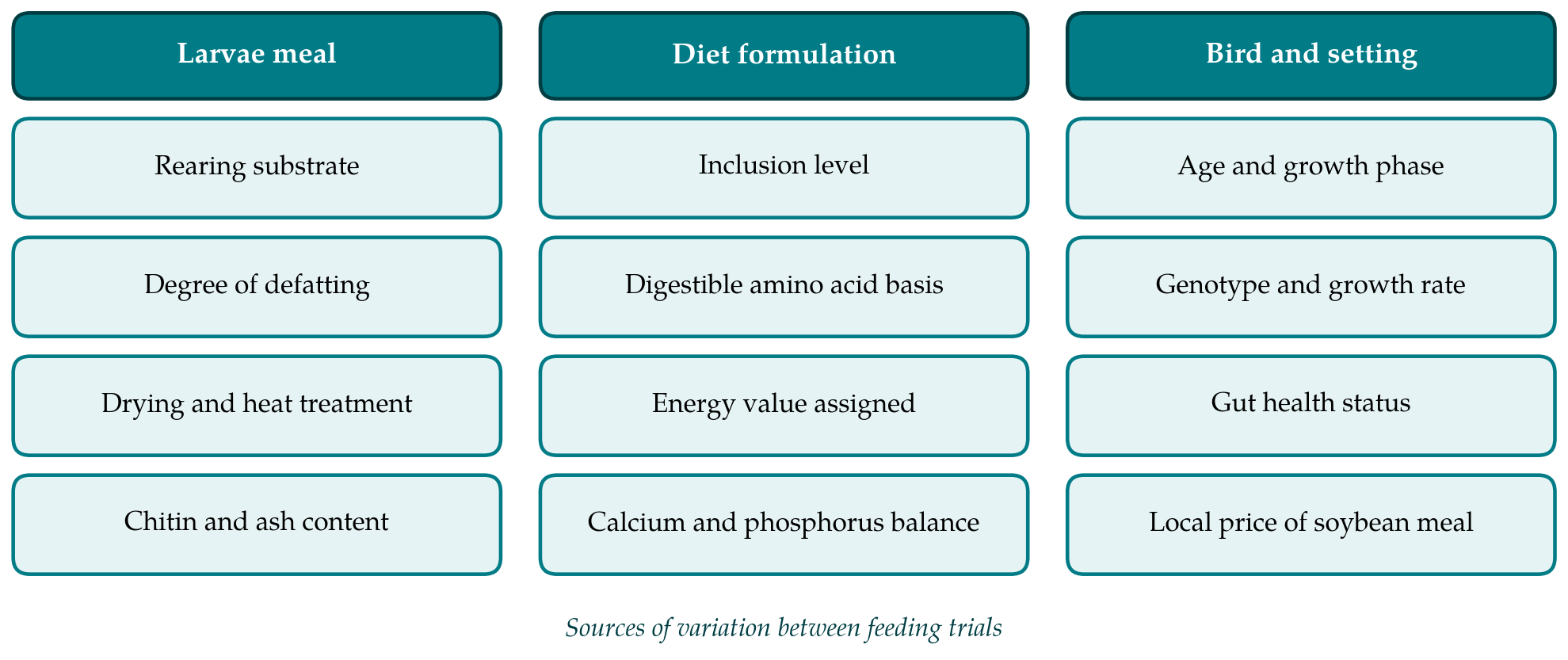
The feeding trials are easier to read once the sources of variation between them are set out. Figure 1 groups them under the meal, the formulation and the bird. Trials differ in all three at once, which is why apparently contradictory results are common and why a single recommended inclusion level cannot be read off the literature.
The broad pattern is nonetheless consistent with the reviews of Gasco et al. (2019) and Veldkamp and Bosch (2015). At low to moderate inclusion, with diets balanced for digestible amino acids and energy, growth and feed conversion have usually matched those of the soybean control. Onsongo et al. (2018), working in Kenya with meal that replaced part of both the soybean meal and the fish meal, reported no penalty in growth or carcass traits and a better economic return under local prices. In growing quail, Cullere et al. (2016) found that defatted meal could replace a share of the soybean meal and oil without harming performance or carcass yield, and Maurer et al. (2016) reached a similar conclusion for soybean cake in layer diets.
The limits appear at higher inclusion. Dabbou et al. (2018) fed graded levels of defatted meal to broilers and observed that the highest level they tested was accompanied by poorer feed efficiency and less favourable gut morphology, while the lower levels were tolerated. Explanations offered in the literature include the dilution of digestible amino acids by chitin, the effect of chitin on protein digestion, and imbalance of minerals when the limestone allowance is not corrected. These explanations are plausible and not mutually exclusive, but trials have seldom been designed to separate them.
6. Gut Health, Carcass and Meat Quality
Two components of the larva have been credited with benefits beyond nutrient supply. Lauric acid and its monoglyceride inhibit some Gram-positive bacteria in vitro, and chitin and its derivatives have been proposed as substrates for the caecal microbiota. Both ideas are reasonable, and both rest largely on laboratory findings and short trials. Whether they translate into fewer enteric problems in commercial flocks has not been established, and the same chitin that may act as a prebiotic at low inclusion is a candidate cause of impaired digestion at high inclusion (Gasco et al., 2019).
Effects on the carcass are small where diets are properly balanced. The clearest change is in the fat. When larval fat replaced soybean oil in finisher diets, performance and carcass traits were unaffected but the fatty acid profile of the meat shifted towards saturated fatty acids (Schiavone et al., 2017b). Full-fat meal can be expected to move the profile in the same direction, in proportion to the amount of larval fat it contributes. Sensory consequences have received little systematic study.
7. Safety, Regulation and the Substrate Question
The appeal of the black soldier fly lies in its ability to convert manure and food waste (Sheppard et al., 1994). Feed law in many places forbids exactly that. The European Food Safety Authority concluded that the hazards of insect products depend chiefly on the substrate and the processing (EFSA Scientific Committee, 2015), and European rules treat farmed insects as farmed animals, which may be fed only materials already permitted as feed. Processed insect protein was first admitted for aquaculture and was authorised for poultry and pigs in 2021 (European Commission, 2021). Rules elsewhere vary widely.
The chemical evidence justifies some of this caution. Larvae reared on contaminated substrate accumulated cadmium, whereas mycotoxins and the pesticides examined were not accumulated (Purschke et al., 2017). Microbial hazards, allergens and veterinary drug residues are reviewed by van der Fels-Klerx et al. (2018). For a feed mill, the implication is that the origin of the substrate belongs in the specification of the ingredient alongside protein and fat.
8. Economic and Environmental Arguments
Larvae meal is often presented as a low-impact protein. Life cycle assessments give a more conditional picture. Smetana et al. (2016) found that the environmental standing of insect products depended heavily on what the insects were fed, with clear advantages only where low-value side streams were used, and Salomone et al. (2017) identified energy use in rearing and drying as a main burden of a food-waste conversion system. The economic case is similarly local. Where soybean meal is imported and costly and labour and residues are cheap, substitution can pay, as the Kenyan study suggested (Onsongo et al., 2018). Where soybean meal is cheap, larvae meal at present prices competes with fish meal more readily than with soybean meal.
9. Gaps and Future Work
Four gaps stand out. First, products are poorly described. Many papers give crude protein and fat but not the substrate, the nitrogen factor, the chitin content or the drying conditions, so results cannot be compared or reproduced. Second, few trials isolate the cause of the decline at high inclusion; designs that hold digestible amino acids, energy and minerals equal while varying chitin would help. Third, most evidence comes from small pens over a single cycle, and the behaviour of the ingredient in commercial houses, with their litter and disease pressure, is largely unreported. Fourth, safety work has concentrated on a handful of contaminants, while the substrates of most interest to low-income producers are the ones least studied.
10. Conclusion
The literature supports the use of black soldier fly larvae meal as a partial replacement for soybean meal in broiler diets, on three conditions: that the particular meal has been analysed, that the diet is formulated on digestible amino acids with the nitrogen and mineral peculiarities of the ingredient taken into account, and that inclusion stays moderate. It does not support treating larvae meal as a like-for-like substitute, and it does not show that the health benefits attributed to lauric acid and chitin are realised in the field. Whether substitution is worthwhile is, in the end, a question of local prices and local law as much as of nutrition.
Conflict of interest
To be declared by the author(s) before publication.
Funding
To be declared by the author(s) before publication.