1. Introduction
Serum testosterone falls gradually across adult life. Longitudinal data from the Baltimore Longitudinal Study of Aging and the Massachusetts Male Aging Study established this decades ago (Harman et al., 2001; Feldman et al., 2002). Whether the fall is a disease to be treated or a feature of ageing and accumulated illness has been argued over ever since. Prescribing did not wait for the answer: androgen use in the United States rose steeply in the first decade of this century, much of it in men without a clear diagnosis (Baillargeon et al., 2013).
The reaction came from cardiovascular safety signals. A trial in frail older men was stopped early because of an excess of cardiovascular events in the testosterone arm (Basaria et al., 2010), and two widely publicised observational studies reported higher rates of infarction and death among treated men (Vigen et al., 2013; Finkle et al., 2014). The United States Food and Drug Administration responded by cautioning against use for what it called age-related hypogonadism and by requiring a safety trial (Nguyen et al., 2015).
That trial has reported, and its headline finding was reassuring. The argument of this Perspective is that the reassurance is narrower than it appears, and that the proper response is not a return to liberal prescribing or continued blanket caution, but a consultation built around the individual man's risks and aims.
2. What the Trials Established
Three bodies of randomised evidence now frame the subject. The Testosterone Trials enrolled men aged 65 years or older with low testosterone and symptoms, and found that a year of treatment produced a moderate improvement in sexual function and small improvements in mood, with no clear benefit for vitality (Snyder et al., 2016). A substudy using coronary computed tomographic angiography found a greater increase in non-calcified plaque volume in treated men (Budoff et al., 2017), a finding of uncertain clinical meaning that kept concern alive.
The TRAVERSE trial addressed that concern directly. It randomised men aged 45 to 80 years with symptoms, confirmed low testosterone and either established cardiovascular disease or high risk of it to testosterone gel or placebo, and found testosterone non-inferior for a composite of major adverse cardiac events (Lincoff et al., 2023). The same report noted a higher incidence of atrial fibrillation, acute kidney injury and pulmonary embolism in the testosterone group. A prespecified substudy found more clinical fractures with testosterone than with placebo (Snyder et al., 2024), contrary to what improved bone density had led many to expect. A further analysis found a low incidence of high-grade prostate cancer that did not differ between groups, in men who had been screened carefully before entry (Bhasin et al., 2023).
The third body of evidence concerns metabolic disease. In men with impaired glucose tolerance or newly diagnosed type 2 diabetes enrolled in a lifestyle programme, two years of injectable testosterone lowered the proportion with diabetes, at the cost of more frequent rises in haematocrit (Wittert et al., 2021). Read side by side, these trials describe a treatment with modest benefits in defined domains and a set of harms that are uncommon but not trivial.
3. Why an Average Result Is Not an Individual Answer
Non-inferiority for major cardiac events in a trial population is a statement about an average. It does not say that every man in that population, still less every man outside it, carries the same risk. The TRAVERSE participants were selected by entry criteria that excluded, among others, men with a raised prostate-specific antigen or a raised haematocrit. Many stopped the study drug before the end, and treatment lasted a few years, not the decades over which a man in his fifties might take it. Table 1 sets out the principal domains of risk, what the trials show and where individual circumstances change the calculation.
| Domain | What controlled evidence shows | Factors that change individual risk |
|---|---|---|
| Major cardiac events | Non-inferior to placebo in a high-risk trial population Lincoff et al., 2023 | Frailty, recent events, duration beyond trial follow-up |
| Arrhythmia and thrombosis | More atrial fibrillation and pulmonary embolism with testosterone | Previous arrhythmia, thrombophilia, prior venous thrombosis |
| Erythrocytosis | Haematocrit rises predictably; monitoring is required Bhasin et al., 2018 | Baseline haematocrit, sleep apnoea, smoking, formulation |
| Prostate | No excess of high-grade cancer in screened men Bhasin et al., 2023 | Unscreened status, raised PSA, family history |
| Bone | More clinical fractures despite higher bone density Snyder et al., 2024 | Osteoporosis, falls risk, physical activity |
| Fertility | Exogenous testosterone suppresses spermatogenesis | Wish for future fatherhood, partner age |
The benefits are just as unevenly spread. The European Male Ageing Study showed that only a small minority of older men combine consistently low testosterone with the sexual symptoms that track it most closely (Wu et al., 2010). The same cohort showed that testosterone falls with weight gain and rises with weight loss (Camacho et al., 2013), which means that in many men a low value is a marker of obesity and illness as much as a cause of symptoms. A man with unequivocally low levels and loss of libido stands to gain more than a man with borderline levels and fatigue. Both currently tend to receive the same leaflet.
4. What an Individualised Conversation Would Contain
The proposal here is simple to state. Before a prescription is written, the clinician and the man should place him, explicitly, on two axes: how likely he is to obtain a benefit he values, and how high his baseline risk is in the domains that matter. Figure 1 shows the four positions that result. The scheme is a device for structuring discussion and is not a validated decision rule.
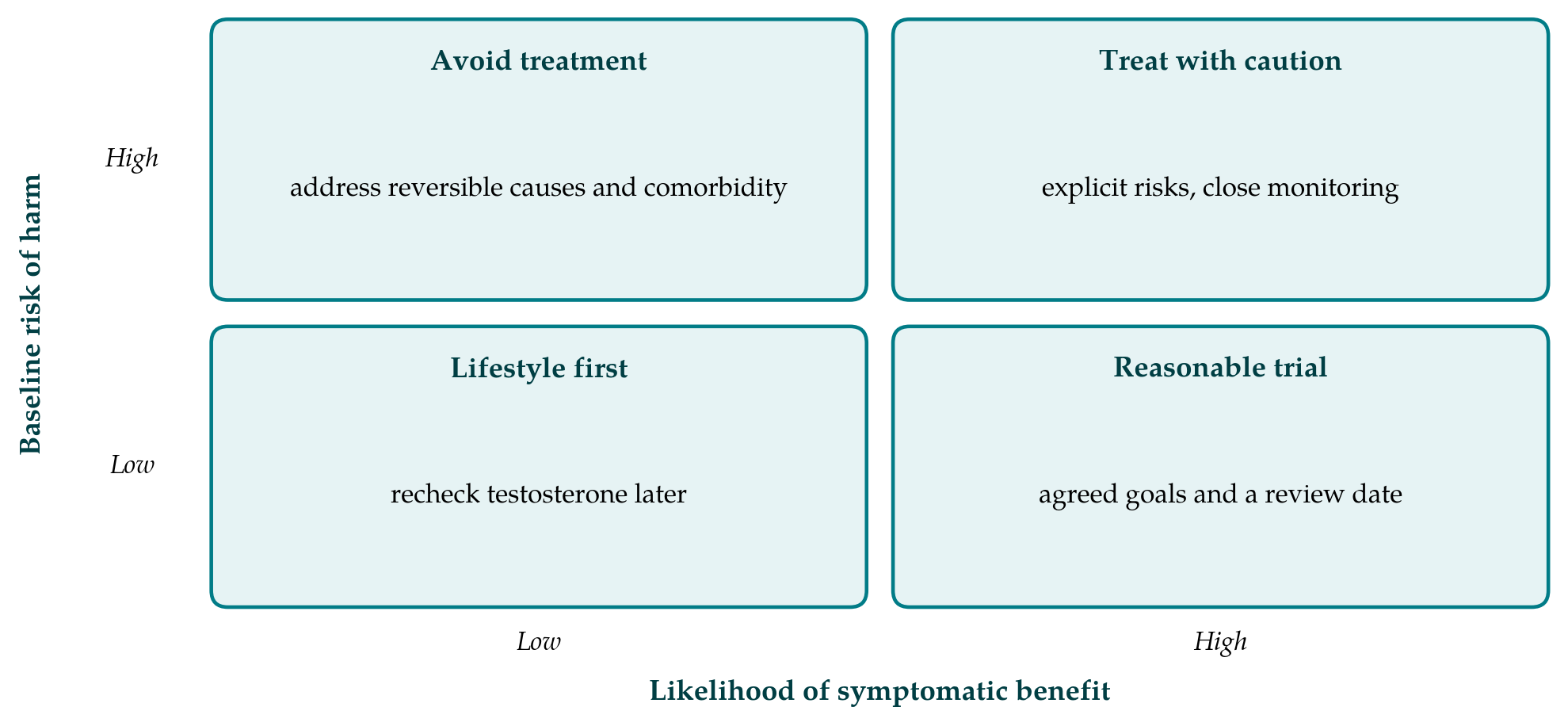
Likelihood of benefit depends first on diagnosis. The Endocrine Society and the American Urological Association both require symptoms together with consistently low morning testosterone on repeat testing (Bhasin et al., 2018; Mulhall et al., 2018). It depends next on which symptom the man hopes to change, since the evidence is strongest for sexual function and weak for energy and cognition, and on whether a reversible cause such as obesity, opioid use or untreated sleep apnoea is present.
Baseline risk is assessed domain by domain, as Table 1 implies. A man with paroxysmal atrial fibrillation should hear that the largest trial recorded more of it on treatment. A man with osteoporosis should hear the fracture finding and should not assume testosterone will protect his skeleton. A man who hopes to have children should be told that treatment is likely to suppress sperm production. None of these facts forbids treatment. Each alters the balance for the person concerned, and the model of shared decision making, in which options are laid out and the person's preferences are actively sought, provides the method (Elwyn et al., 2012).
The conversation should also fix what success would look like and when it will be judged. If the target symptom has not improved after an agreed interval at adequate serum levels, guidelines support stopping (Mulhall et al., 2018). Agreeing this in advance turns an open-ended prescription into a time-limited trial of therapy.
Nor is the assessment made once and filed. Risk shifts during treatment: haematocrit climbs in some men and not in others, a new arrhythmia or a fall changes the picture, and plans for fatherhood are revised. The monitoring that guidelines already require, of testosterone level, haematocrit and prostate status at set intervals (Bhasin et al., 2018), supplies the occasions on which the man's position in the frame can be reviewed. Used in that way, monitoring becomes a continuation of the original conversation instead of a laboratory routine whose results are noted and set aside.
5. Objections
One objection is that this is already what guidelines say. In outline it is: the Endocrine Society recommends against routine treatment of all older men with low testosterone and advises an individualised decision (Bhasin et al., 2018). The difficulty lies in the absence of tools. Guidelines list contraindications and monitoring schedules, but they do not supply a way to weigh an increased chance of atrial fibrillation against an improvement in libido for a particular man, and patterns of prescribing suggest that the nuance is frequently lost in practice.
A second objection is that individualisation invites exactly the loose prescribing that prompted regulatory concern, because almost any man can be argued into the favourable corner. The risk is real. The answer is that the frame begins with a strict diagnosis and makes the grounds for treatment explicit and reviewable, which is the opposite of prescribing on request.
A third objection is that the excess harms seen in the trials were secondary or exploratory findings and may be chance. They may be. But a clinician is not entitled to mention only the reassuring result of a trial and omit the less comfortable ones from the same report. Uncertainty is itself information that a man can use, provided it is described honestly as uncertainty.
Finally, it may be said that consultations are too short for this. A structured frame should make the discussion quicker, not longer, because it directs attention to the few facts that bear on the individual and away from a recitation of every possible effect.
6. Implications
For clinicians, the implication is to replace the question of whether testosterone is safe with the question of whether it is worthwhile for this man, and to record the reasoning. For guideline bodies, it is to translate trial findings into plain statements of absolute risk for recognisable groups, and to develop and test decision aids. For researchers, the need is for analyses that examine how effects vary between participants, for longer follow-up, and for trials in the men who were excluded from the large studies. Comparisons between formulations also matter, since rises in haematocrit differ between injectable and transdermal preparations and the safety trial tested only a gel.
There is a further implication for how low testosterone is discussed with men who are overweight or unwell. Weight loss and treatment of underlying illness raise testosterone and bring other benefits, and for many men they are the first intervention to offer. Presenting them as an alternative within the same conversation, not as a preliminary hurdle, respects the man's aims while keeping treatment in proportion.
7. Conclusion
The cardiovascular question that overshadowed testosterone therapy has been answered as well as one trial can answer it, and the answer is reassuring within its limits. It does not license indifference to the other findings from the same programme, and it does not tell any individual man what he should do. Benefit is modest and depends on diagnosis and symptom; harm is uncommon and depends on who is treated. A consultation that locates each man on both dimensions, states the uncertainties and agrees a point of review would serve ageing men better than either reassurance or alarm.
Conflict of interest
To be declared by the author(s) before publication.
Funding
To be declared by the author(s) before publication.