1. Introduction
Reactive distillation places a reaction zone inside a distillation column so that products are removed from the reacting mixture as they form. For equilibrium-limited reactions this pulls conversion beyond what a separate reactor would reach, and the heat of reaction contributes to vapour generation. The technology is established for fuel ethers such as MTBE, ETBE and TAME and for esterifications, of which the methyl acetate process is the best known example, and it is widely regarded as a leading case of process intensification (Harmsen, 2007; Taylor and Krishna, 2000). The price of the integration is a loss of operating freedom. A conventional plant can correct a reactor upset in the separation train. A reactive column has to absorb the upset where it occurs.
Feedstock is the usual source of such upsets. The C4 cut fed to an etherification column changes in isobutene content with the upstream cracker or dehydrogenation unit, alcohols arrive with varying water content, and renewable acids and oils differ from batch to batch. Each change moves the economically best operating point, and the conventional control hierarchy follows it slowly. Economic model predictive control (EMPC) is the proposal to remove that delay by letting the dynamic controller optimise an economic objective directly, without the intermediate step of a setpoint (Rawlings et al., 2012; Ellis et al., 2014).
This article reviews what the published literature says about applying that idea to reactive distillation columns whose feed varies. It considers the features of the process that shape the control problem, the theory that underpins economic formulations, the available treatments of feed disturbances, the small number of reported applications, and the practical questions of computation and implementation. It reports no new simulations or plant results.
2. Scope and Approach
The review is narrative. It draws on journal articles, conference papers and textbooks in process control and chemical engineering that are well known in the field, selected for their bearing on the question and not through a formal search protocol. No claim of completeness is made. Preference was given to sources that state general results, such as stability conditions or structural properties of reactive columns, over those that report the tuning of a single example. Where the literature consists of simulation studies only, that is said, because the distinction between a result shown on a model and one shown on a plant matters a great deal for the conclusions that can be drawn.
3. Reactive Distillation as a Control Problem
Three properties of reactive columns recur in the control literature: the need to keep reactants in stoichiometric balance, the strong nonlinearity that follows from coupling reaction with phase equilibrium, and the uncertainty of the models used to describe both.
3.1. Stoichiometric balance and control structure
In a column fed with two reactants and designed to produce two products with no excess of either reactant, any imbalance between the feeds has nowhere to go. The surplus reactant accumulates, dilutes the reaction zone and eventually appears in a product. Al-Arfaj and Luyben (2000) showed for an ideal two-product column that flow ratio control alone cannot hold this balance, because flow measurements are never exact, and that some measurement from inside the column, a composition or a suitably placed temperature, is needed to trim one feed. The monograph by Luyben and Yu (2008) extends the argument to a range of real systems and to designs that run with an excess of one reactant, where the constraint is relaxed at the cost of a recovery step. A change in feed composition is, in effect, an unmeasured change in the feed ratio, which is why it is so damaging to these columns.
3.2. Multiplicity and gain sign changes
Steady-state multiplicity was reported for MTBE synthesis in the early 1990s, when simulations with identical specifications converged to solutions with very different conversions (Jacobs and Krishna, 1993). Later work distinguished output multiplicity, in which one set of inputs gives several steady states, from input multiplicity, in which several input sets give the same output and the process gain changes sign across the operating range. Both are a consequence of the interaction between reaction rate, which rises with temperature, and chemical equilibrium and volatility, which may move the other way. Kumar and Daoutidis (1999) derived a detailed dynamic model of an ethylene glycol column, analysed its nonlinear behaviour and designed a nonlinear controller for it, arguing that linear controllers tuned at one point can fail elsewhere. For any optimising controller the implication is that a linear model identified around one steady state may predict the wrong direction of response after a large feed change.
3.3. Model fidelity
Taylor and Krishna (2000) reviewed equilibrium-stage and rate-based models of reactive distillation and showed how much the predicted behaviour depends on the description of mass transfer, reaction kinetics and hardware. For control purposes the equilibrium-stage model with tray hydraulics is the common choice, since it is tractable and captures the dominant composition dynamics. It still contains parameters that drift in service, most obviously catalyst activity in columns packed with ion-exchange resin. A predictive controller that optimises economics leans on its model harder than one that tracks a setpoint, so the question of model fidelity returns in every later section of this review.
4. From Setpoint Tracking to Economic Objectives
Process plants are usually operated through a hierarchy of layers that work on different time scales, shown in Figure 1. Planning and scheduling decide what to make. A real-time optimiser (RTO) solves a steady-state model for the most profitable operating point. A model predictive controller moves the plant to the resulting setpoints while respecting constraints, and regulatory loops carry out its moves (Qin and Badgwell, 2003; Darby et al., 2011).
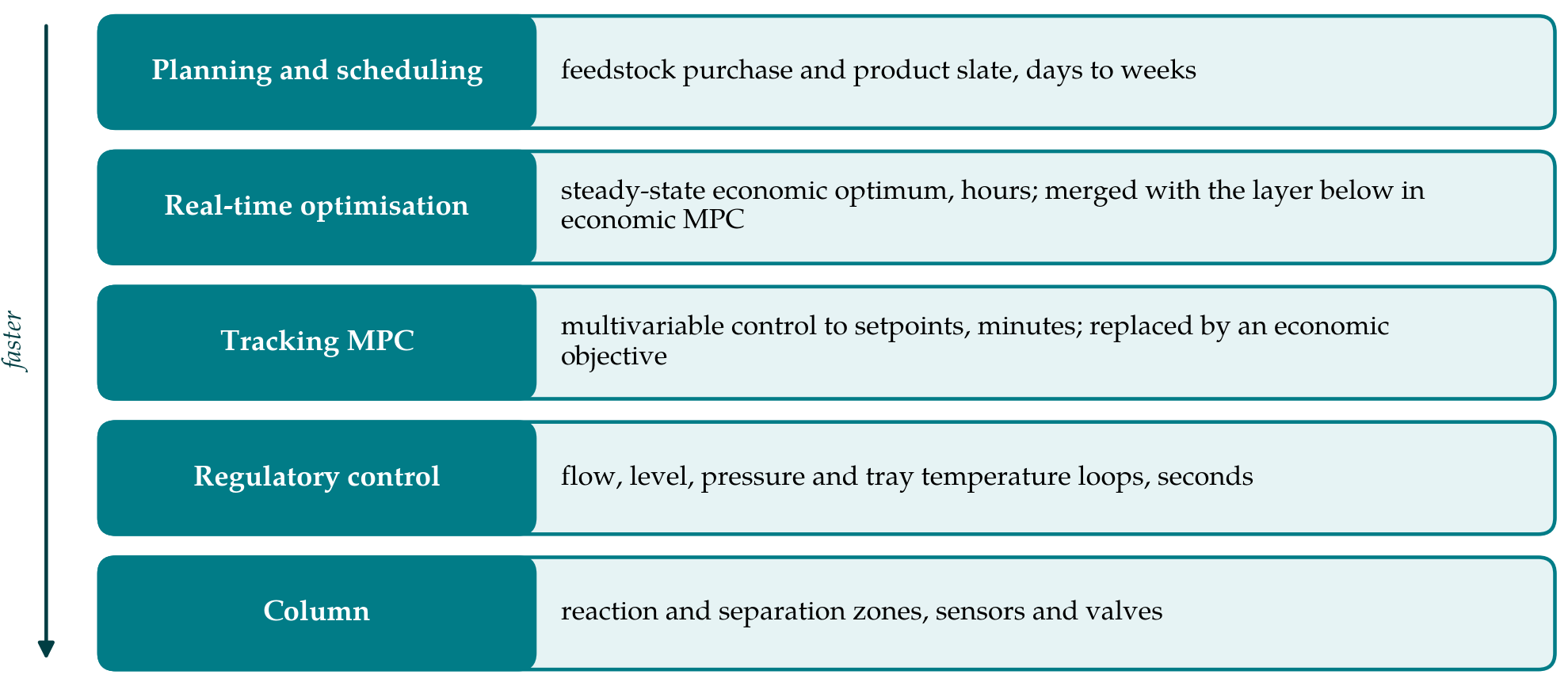
The weaknesses of the hierarchy are well documented. The optimiser can run only when the plant is judged to be at steady state, so a unit that is disturbed frequently is optimised rarely. The optimiser and the controller use different models, and the setpoint computed by one may be unreachable or poor according to the other. Economic information about the transient itself is discarded, because the controller is asked only to reach the target quickly (Engell, 2007). One response keeps the hierarchy and chooses controlled variables whose constant setpoints give acceptable loss when disturbances occur, the self-optimising control idea of Skogestad (2000). The other response, EMPC, removes the separation between optimisation and control.
4.1. Stability and performance theory
Stability theory for tracking controllers assumes a stage cost that is zero at the setpoint and positive elsewhere, and uses the optimal cost as a Lyapunov function (Mayne et al., 2000). An economic stage cost has no such property: the cheapest instantaneous operating point need not be a steady state at all. The key results of the past fifteen years show when an economic controller nevertheless behaves well. Diehl et al. (2011) constructed a Lyapunov function for the case in which strong duality holds for the steady-state problem. Angeli et al. (2012) generalised this to dissipativity and proved that, with a terminal constraint, the average closed-loop economic performance is at least as good as that of the best steady state. If the process is not dissipative, the same result says that steady operation is not optimal and the controller may legitimately cycle.
Other formulations avoid the terminal equality constraint, which is restrictive for large models. Heidarinejad et al. (2012) used an explicit Lyapunov-based controller to define a region within which the economic optimiser is free to act, with a second mode that forces convergence when required. Grüne (2013) showed that, under a turnpike property, near-optimal performance is obtained without terminal conditions if the horizon is long enough. The tutorial review by Ellis et al. (2014) and the monograph by Faulwasser et al. (2018) set these results in order. For a reactive column, with its possible multiplicities, the dissipativity question is not academic: whether the best steady state is also the best way to run the column is something the theory requires the designer to check.
5. Treating Feedstock Variability
Feed variation reaches a reactive column in several forms. The concentration of the reactive component in a mixed stream changes, as with isobutene in a C4 cut. Inert components that must leave in one product change the internal traffic of the column. Trace species such as water compete in side reactions or inhibit the catalyst. Feed rate changes with upstream production. Some of these can be measured on line, at a price and with analyser delay. Others must be inferred from their effect on the column.
The literature offers four ways of handling them within a predictive controller. A measured disturbance can be included in the model as a feedforward input. An unmeasured one can be estimated together with the states, by an extended Kalman filter or by moving horizon estimation, which handles constraints and nonlinear models in the same optimisation framework as the controller (Rao et al., 2003). The controller can be made robust to a set of possible feeds, for instance by the multi-stage formulation of Lucia et al. (2013), in which a scenario tree represents the uncertainty and future control moves are allowed to depend on which branch is realised. Finally, the back-off from quality constraints can simply be enlarged. Table 1 compares the main operating strategies by the way economics enter and by their response to a feed change.
| Strategy | How economics enter | Response to a feed change | Main limitation |
|---|---|---|---|
| Decentralised PI loops (Luyben and Yu, 2008) | Fixed setpoints chosen at design | Rejects the upset, keeps the old targets | Optimum moves with the feed |
| Self-optimising control (Skogestad, 2000) | Choice of controlled variables | Near-optimal with constant setpoints | Loss grows for large disturbances |
| Steady-state RTO over tracking MPC (Darby et al., 2011) | Steady-state profit model | New setpoints after the plant settles | Waits for steady state; two models |
| Economic MPC with terminal condition (Angeli et al., 2012) | Stage cost is operating profit | Re-optimises the transient at once | Needs an accurate dynamic model |
| Lyapunov-based economic MPC (Heidarinejad et al., 2012) | Profit within a stability region | Economic action inside safe bounds | Region can be conservative |
| Multi-stage economic MPC (Lucia et al., 2013) | Profit over a scenario tree | Hedges against the feeds considered | Problem size grows with scenarios |
None of these approaches is specific to reactive distillation, and each has a cost there. Feedforward depends on a feed analyser that is as available as the controller itself. Estimation depends on observability: several feed components and a drifting catalyst activity cannot all be reconstructed from a handful of tray temperatures, and a wrongly attributed disturbance leads the optimiser to a wrong economic conclusion. Robust formulations multiply the size of a problem that is already large. The published work has not yet settled which combination is adequate for which class of column.
6. Reported Applications to Reactive Columns
Predictive control of reactive distillation has been studied for more than two decades, mostly with tracking objectives. Khaledi and Young (2005) modelled an ETBE column and examined model predictive control of product composition and reactant conversion, a pairing that reflects the dual purpose of the unit. Work of this kind established that multivariable predictive controllers can handle the interaction between the separation and reaction objectives better than independent loops, at least in simulation.
Explicitly economic formulations are rarer. Idris and Engell (2012) investigated nonlinear predictive control strategies with economic objectives for a continuous catalytic distillation process and compared them with tracking alternatives, which makes their study one of the few to address the subject of this review directly. Beyond it, the evidence consists largely of simulation studies on benchmark etherification and esterification columns, with feed composition steps as the test disturbance. These studies agree qualitatively: an economic controller exploits the transient and moves toward the new optimum without waiting, and its advantage depends on how accurately the feed disturbance is known. The review found no detailed public account of a long-running industrial implementation, and the absence should be read as a statement about the published record and not about practice in general.
7. Computation and Implementation
A stage-by-stage column model with reaction is a system of differential and algebraic equations with some hundreds of states. Solving a nonlinear programme over it within one sampling interval was once the main obstacle. Direct methods with structure-exploiting solvers have changed that. The real-time iteration scheme of Diehl et al. (2002), illustrated by its authors with a distillation column model, performs one Newton-type step per sample, and the advanced-step controller of Zavala and Biegler (2009) solves the problem in the background for a predicted state and corrects it by a sensitivity update when the measurement arrives. Both come with stability arguments that account for the approximation.
Computation is no longer the hardest part. Implementation questions are less well covered. Product specifications are often enforced on a tank or a shipment and not instant by instant, which gives an economic controller room to trade short excursions against profit, but only if the constraint is written to reflect the commercial reality. Operators accustomed to setpoints may find a controller that has none hard to supervise, because there is no simple statement of what it is trying to do. And every layer of the conventional hierarchy offers a fallback when the layer above is switched off; a merged economic layer needs a defined degraded mode. The industrial experience summarised by Qin and Badgwell (2003) suggests that such matters decide whether a controller stays in service.
8. Gaps and Future Work
Four gaps stand out. The first is evidence from plants. Simulation studies use the same model for the controller and the process, or perturb a few parameters, and so understate the effect of structural mismatch. Pilot-scale demonstrations with a deliberately varied feed would be more persuasive than further simulations. The second is estimation. Work is needed on which feed properties are observable from realistic instrumentation on a reactive column, and on how estimation error propagates into economic loss. The third is the dissipativity of real columns: for systems with known multiplicity it has seldom been established whether steady operation is optimal, and therefore whether a cycling economic controller is a fault or a feature.
The fourth gap is comparative. Self-optimising control structures, a fast steady-state optimiser with a well-tuned tracking controller, and full economic control have rarely been compared on the same column with the same disturbance scenarios and the same model error. Without such comparisons it is hard to say how much of the benefit attributed to economic control could be obtained by simpler means, and a designer has little basis for choosing among them.
9. Conclusion
Reactive distillation columns are sensitive to feed composition for structural reasons, and the conventional hierarchy responds to that disturbance slowly. Economic model predictive control addresses the delay in principle, and its theory is now mature enough to say when stable and economically sound behaviour can be expected. The application literature for reactive columns is thin, is based mainly on simulation, and leaves open the questions of disturbance estimation, model maintenance and operator supervision that will determine practical value. The case for the approach is therefore promising but not yet demonstrated, and the most useful next contributions would be experimental.
Conflict of interest
To be declared by the author(s) before publication.
Funding
To be declared by the author(s) before publication.