1. Introduction
For a smooth projective variety X whose canonical bundle is ample or anti-ample, the bounded derived category Db(X) of coherent sheaves determines X up to isomorphism. This reconstruction theorem of Bondal and Orlov (2001) means that on a Fano variety the derived category is a complete invariant, and the practical question becomes how to read geometry from it. The most effective tool has been the semiorthogonal decomposition, introduced in the present form by Bondal and Orlov (1995), which cuts the category into admissible subcategories with morphisms running in one direction only.
Fano threefolds are the natural testing ground. They are completely classified, they are few enough to be treated one family at a time, and they include both rational and irrational varieties, so that any invariant extracted from the derived category can be compared with the classical obstruction of Clemens and Griffiths (1972). Over three decades a fairly complete picture has emerged for Picard rank one, much of it through the work of Kuznetsov.
This article is a narrative review of that published literature. It assumes the language of derived categories at the level of the textbook of Huybrechts (2006) and concentrates on statements, with indications of method where the method explains the shape of the answer. All varieties are smooth, projective and defined over the complex numbers.
2. Background
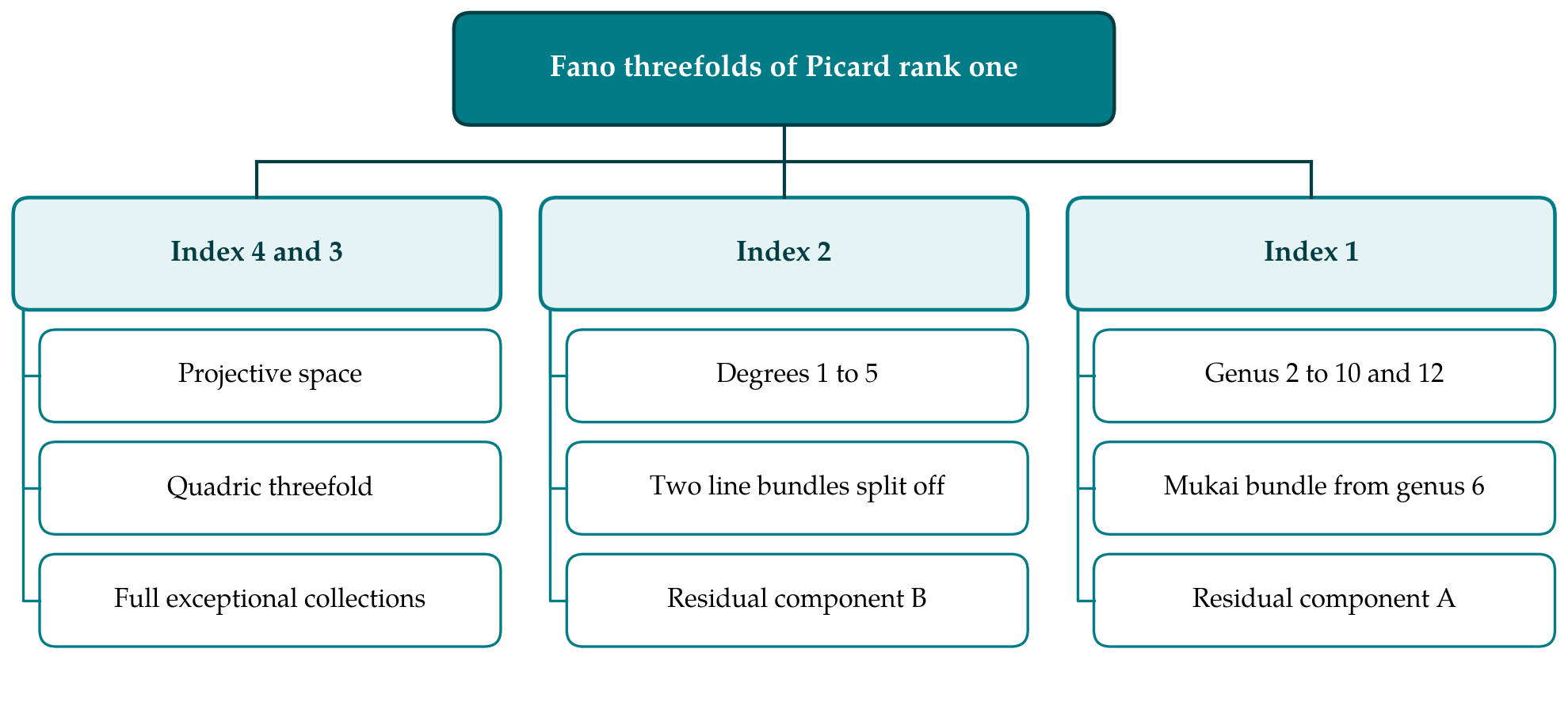
Two bodies of material are needed: the categorical notions in which the results are phrased and the classification that organises them, which is displayed in Figure 1.
2.1. Exceptional objects and semiorthogonal decompositions
An object E of Db(X) is exceptional if its endomorphism algebra is the ground field and it has no self-extensions of non-zero degree. An exceptional collection is a sequence of such objects with no morphisms of any degree from later members to earlier ones, and it is full if it generates the category. The prototype is the collection O, O(1), O(2), O(3) on P3 found by Beilinson (1978), and the formalism of mutations and helices built on it is due to Bondal (1990). More generally a semiorthogonal decomposition writes Db(X) as generated by admissible subcategories A1, ..., An with no morphisms from Aj to Ai when j is greater than i.
On a Fano variety of index r, Kodaira vanishing makes the line bundles O, O(1), ..., O(r − 1) an exceptional collection, and any exceptional collection is admissible. Its orthogonal complement is therefore a well-defined component, now usually called the Kuznetsov component. It inherits a Serre functor from X, and the form of that functor is the first invariant to compute. Additive invariants such as the Grothendieck group and Hochschild homology split along a semiorthogonal decomposition, which gives quick necessary conditions: a threefold with a full exceptional collection must have vanishing Hodge number h1,2, and the length of the collection must equal the rank of its even cohomology.
2.2. The classification of Fano threefolds
Smooth Fano threefolds fall into 105 deformation families. Those of Picard rank one were classified by Iskovskikh, building on Fano, and form 17 families (Iskovskikh and Prokhorov, 1999). The 88 families of higher Picard rank are due to Mori and Mukai (1981). In rank one the index is 4 for projective space, 3 for the quadric, 2 for the five families Yd of degree d from 1 to 5, and 1 for the ten families X2g−2 of genus g from 2 to 10 and 12. Mukai's description of the threefolds of index one and genus at least 6 as linear sections of homogeneous varieties, or of zero loci of homogeneous bundles on Grassmannians, supplies the vector bundles from which all the decompositions below are built. Figure 1 also records the part of the derived category that splits off in each branch.
3. Threefolds With a Full Exceptional Collection
Exactly four of the seventeen families have h1,2 = 0, and each of them has a full exceptional collection of length four. For projective space this is Beilinson's theorem. For the quadric threefold Kapranov (1988) produced the collection formed by the spinor bundle and three consecutive line bundles, as part of a general treatment of quadrics and Grassmannians. For the quintic del Pezzo threefold Y5, a linear section of the Grassmannian Gr(2, 5), Orlov (1991) showed that the restrictions of the tautological bundles of ranks two and three complete the pair O, O(1) to a full collection. For the threefolds X22 of genus 12 the collection was constructed by Kuznetsov (1996) from the bundles furnished by Mukai's embedding into Gr(3, 7).
In all four cases the collection consists of vector bundles, and in all four the variety is rational. The four categories are not equivalent to one another, although they have the same additive invariants: the Bondal-Orlov theorem forbids it, and the difference is visible in the quivers with relations that describe them. This is a first indication that the interest of the subject lies in the finer structure of the components and not in their numerical shadows.
4. Components That Are Derived Categories of Curves
Table 1 lists the decompositions for all families discussed in this review; in it E denotes an exceptional bundle supplied by Mukai's construction. After a full exceptional collection, the next simplest outcome is a component equivalent to Db(C) for a smooth curve C. The oldest example is the complete intersection of two quadrics in P5, the del Pezzo threefold Y4. Bondal and Orlov (1995) proved that the orthogonal complement of O and O(1) is the derived category of the curve of genus 2 that is the double cover of the pencil of quadrics branched at its six singular members. The curve had long been known classically, since its Jacobian is the intermediate Jacobian of Y4 and its moduli space of rank two bundles of fixed odd determinant is Y4 itself.
| Threefold | Shape of the decomposition | Non-trivial component | Source |
|---|---|---|---|
| 3 P | ⟨O, O(1), O(2), O(3)⟩ | None | Beilinson, 1978 |
| Quadric | Spinor bundle and three line bundles | None | Kapranov, 1988 |
| Y and X 5 22 | Four exceptional vector bundles | None | Orlov, 1991; Kuznetsov, 1996 |
| Y 4 | b ⟨D (C), O, O(1)⟩ | Curve of genus 2 | Bondal and Orlov, 1995 |
| X , X , X 12 16 18 | b ⟨D (C), E, O⟩ | Curve of genus 7, 3, 2 | Kuznetsov, 2006 |
| Y and X 3 14 | ⟨B, O, O(1)⟩ and ⟨A, E, O⟩ | Calabi-Yau of dimension 5/3 | Kuznetsov, 2004 |
| Y and X 2 10 | ⟨B, O, O(1)⟩ and ⟨A, E, O⟩ | Enriques type | Kuznetsov and Perry, 2018 |
On the index one side the same phenomenon occurs in genus 7, 9 and 10. The threefolds X12, X16 and X18 are linear sections of the ten-dimensional spinor variety, of the Lagrangian Grassmannian LGr(3, 6) and of the adjoint variety of the exceptional group G2 respectively. Kuznetsov (2006) showed that in each case the derived category is generated by the structure sheaf, one further exceptional bundle and a copy of Db(C), where C is the orthogonal linear section of the projectively dual variety and has genus 7, 3 and 2. These genera are the values of h1,2, as the additivity of Hochschild homology requires.
All of these results are instances of homological projective duality (Kuznetsov, 2007). The theory attaches to a variety with a suitable decomposition of its derived category a dual variety, possibly non-commutative, and relates the derived categories of mutually orthogonal linear sections: as the dimension of one section grows, exceptional objects are added to its category and removed from that of the other, while a common component is preserved. For the homogeneous varieties in Mukai's list the dual is again a classical variety in the relevant range, which is why curves appear.
5. Components of a New Kind
For the remaining families the component is not the derived category of any variety. The cubic threefold Y3 is the basic case. Its component B, the orthogonal complement of O and O(1), has a Serre functor whose cube is the shift by 5, so that B behaves like a Calabi-Yau category of dimension 5/3, and no derived category of a curve has this property. Kuznetsov (2004) proved that the same category occurs on the index one side: if X14 is a threefold of genus 8, a linear section of Gr(2, 6), and Y3 is the cubic threefold attached to it by the Pfaffian construction, then the component A of X14 is equivalent to B. The classical birational map between the two threefolds is thus reflected in a common piece of their derived categories.
The quartic double solid Y2 and the Gushel-Mukai threefolds X10 form a second pair of this kind. In both cases the Serre functor of the component is the shift by 2 composed with a non-trivial involution, which is the behaviour of the derived category of an Enriques surface, and Kuznetsov and Perry (2018) analysed the Gushel-Mukai case in all dimensions. For the families of lowest degree and genus, namely Y1 and the threefolds of genus 2 to 5, components can still be defined by removing the available line bundles, but they are larger and much less is known about them.
5.1. Kuznetsov's conjecture on index two and index one
The coincidences above follow a numerical pattern. A del Pezzo threefold Yd and a prime Fano threefold X4d+2 of even genus have components with the same numerical Grothendieck group. Kuznetsov (2009) assembled the known cases, d = 3, 4 and 5, into the statement that the two families of components coincide under a correspondence between the moduli spaces, and conjectured the same for d = 2. For d = 5 both components are generated by two exceptional objects and are equivalent to the derived category of a quiver; for d = 4 both are derived categories of curves of genus 2; for d = 3 the statement is the theorem on cubics and Pfaffians.
The case d = 2 has turned out to be different. The moduli of quartic double solids and of Gushel-Mukai threefolds have different dimensions, so the conjecture could only assert a correspondence, and Bayer and Perry (2023) showed that in its original form it fails: the components of a quartic double solid and of a Gushel-Mukai threefold are in general not equivalent, although the two families of categories are related by deformation.
6. Stability Conditions and Categorical Torelli Theorems
If the component is a new object, one may ask how much of the threefold it remembers. Bernardara et al. (2012) gave the first answer. They constructed a Bridgeland stability condition on the component B of a cubic threefold, identified the Fano surface of lines with a moduli space of stable objects in B, and deduced that two cubic threefolds with equivalent components are isomorphic.
A uniform construction of stability conditions on Kuznetsov components was later given by Bayer et al. (2023). Their method covers the Fano threefolds of Picard rank one and index two and those of index one and sufficiently large genus, as well as cubic fourfolds. With stability conditions available, moduli spaces of stable objects in the components become ordinary projective varieties, and classical parameter spaces of lines, conics and instanton bundles on the threefold reappear among them.
7. Rationality and Its Categorical Shadow
The blow-up formula of Orlov (1993) shows that blowing up a threefold along a point or a smooth curve adds to its derived category exceptional objects or a copy of the derived category of the curve. A rational threefold is connected to projective space by such operations and their inverses, which suggests that components of rational threefolds should be assembled from exceptional objects and curves, and that a component such as that of the cubic threefold obstructs rationality. This heuristic, set out in detail by Kuznetsov (2016), matches the classical results in every case of Table 1: the families in its first five rows are rational, while the cubic threefold, the quartic double solid and the general threefolds of genus 6 and 8 are not.
Turning the heuristic into a theorem meets a structural obstacle. Semiorthogonal decompositions do not satisfy a Jordan-Hölder property: Böhning et al. (2014) exhibited a variety with two maximal decompositions whose pieces do not match. A canonical "curve-free part" of the derived category therefore cannot be defined naively. Positive results exist under restrictions. Bernardara and Bolognesi (2013) proved that a standard conic bundle over a minimal rational surface is rational if and only if its derived category decomposes into exceptional objects and derived categories of curves. For Fano threefolds the categorical criterion remains a guide and not yet an independent proof of irrationality.
8. Open Problems
Three directions stand out. The first is the lower end of the classification. For Y1 and for threefolds of genus 2 to 5 there is no exceptional bundle beyond the line bundles, the components are large, and their structure has not been described at the level reached for higher genus.
The second is higher Picard rank. Many of the Mori-Mukai families are blow-ups or conic and del Pezzo fibrations, so that decompositions can be produced from the blow-up formula and from fibrewise versions of the results above, but no systematic account covers all 88 families. The third concerns the components themselves: a description of all their stability conditions, of their groups of autoequivalences, and of the extent to which equivalences between components of different threefolds are always induced by geometry.
9. Conclusion
On a Fano threefold of Picard rank one the derived category splits into a short exceptional collection and one residual component, and the literature surveyed here determines that component in most families: it is trivial for four of them, a curve for four more, and a new category of fractional Calabi-Yau or Enriques type for the cubic threefold, the quartic double solid and their partners of index one. The relation with rationality, though not yet a theorem, is consistent with everything known. The threefolds of small degree and those of higher Picard rank are where the description is still to be completed.
Conflict of interest
To be declared by the author(s) before publication.
Funding
To be declared by the author(s) before publication.